
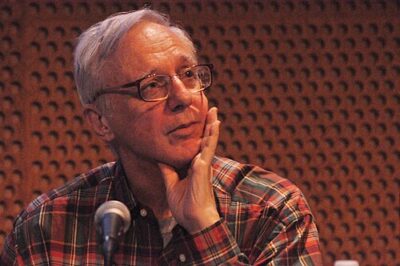
Robert Christgau
Robert Christgau is an American music journalist. Born April 18, 1942, in Greenwich Village. Educated at Dartmouth College and Flushing High School. Awards include Guggenheim Fellowship.
Facts
17 facts · 1 confirmed by two sources · 5 cited · 11 from one source
Where this comes from
Papalocal keeps its own record. It started from these sources; what each one said is kept here as it was copied, so a change on their side never changes this page by itself. Tap one to read its version.
What Wikidata says · copied November 15, 2026 · revision 2529435512
- Described as
- American music journalist (born 1942)
- Other names
- Robert Thomas Christgau
- Born
- April 18, 1942 · 2 references
- Born in
- Greenwich Village · 1 reference
- Citizen of
- United States
- Occupation
- journalist · 1 reference; reporter; essayist · 1 reference; writer; music critic; music journalist · 1 reference
- Worked for
- New York University; The Village Voice (2 times) (1969–2006); Newsday (1972–1974)
- Education
- Dartmouth College; Flushing High School · 1 reference
- Awards
- Guggenheim Fellowship · 1 reference
- Religion
- atheism
- Website
- http://www.robertchristgau.com/index.php
- Wikipedias with a page
- 39
Wikidata item Q314382 (wikidata.org/wiki/Q314382), public domain (CC0). Copied November 15, 2026.
What Wikipedia says · copied November 15, 2026 · revision 1385415073
Robert Thomas Christgau ( KRIST-gow; born April 18, 1942) is an American music journalist and essayist. Among the most influential music critics, he began his career in the late 1960s as one of the earliest professional rock critics and later became an early proponent of musical movements such as hip-hop, riot grrrl, and the import of African popular music in the West. He was the chief music critic and senior editor for The Village Voice for 37 years, during which time he created and oversaw the annual Pazz & Jop critics poll. He has also covered popular music for Esquire, Creem, Newsday, Playboy, Rolling Stone, Billboard, NPR, Blender, and MSN Music; he was a visiting arts teacher at New York University. CNN senior writer Jamie Allen has called Christgau "the E. F. Hutton of the music world—when he talks, people listen."
Christgau is best known for his terse, letter-graded capsule album reviews, composed in a concentrated, fragmented prose style featuring layered clauses, caustic wit, one-liner jokes, political digressions, and allusions ranging from common knowledge to the esoteric. His writing is often informed by leftist politics (particularly feminism and secular humanism). He has generally favored song-oriented musical forms and qualities of wit and formal rigor, as well as musicianship from uncommon sources.
Originally published in his "Consumer Guide" columns during his tenure at The Village Voice from 1969 to 2006, the reviews were collected in book form across three decade-ending volumes: Christgau's Record Guide: Rock Albums of the Seventies (1981), Christgau's Record Guide: The '80s (1990), and Christgau's Consumer Guide: Albums of the '90s (2000). Multiple collections of his essays have been published in book form, and a website published in his name since 2001 has freely hosted most of his work.
In 2006, the Voice fired Christgau after the paper's acquisition by New Times Media. He continued to write reviews in the "Consumer Guide" format for MSN Music, Cuepoint, and Noisey (Vice's music section) where they were published in his "Expert Witness" column until July 2019. In September of the same year, he launched a paid-subscription newsletter called And It Don't Stop, published on the email-newsletter platform Substack and featuring a monthly "Consumer Guide" column, among other writings.
- Born, in its opening lines
- April 18, 1942
From the Wikipedia article “Robert Christgau” (en.wikipedia.org/wiki/Robert_Christgau), by its contributors, under CC BY-SA 4.0 (creativecommons.org/licenses/by-sa/4.0/). Copied November 15, 2026; not changed.
Confirmed Two sources agree. Cited One source, and it names where it got it. One source One source, without a reference of its own. Sources disagree The sources disagree. We show the best-supported value and keep theirs below.
