
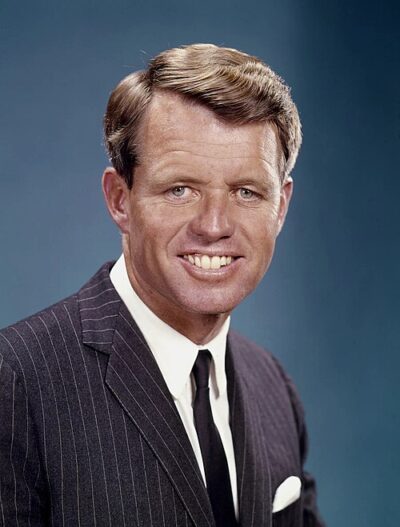
Robert F. Kennedy
Robert F. Kennedy was an American politician and lawyer. Born November 20, 1925, in Brookline. Died June 6, 1968, in Los Angeles. Positions held include United States Attorney General (1961–1964), United States senator (1965–1968) and justice minister. Educated at Harvard College and University of Virginia School of Law. Awards include Ernst Reuter Medal, Congressional Gold Medal and Presidential Medal of Freedom.

Facts
53 facts · 2 confirmed by two sources · 28 cited · 23 from one source
Where this comes from
Papalocal keeps its own record. It started from these sources; what each one said is kept here as it was copied, so a change on their side never changes this page by itself. Tap one to read its version.
What Wikidata says · copied November 13, 2026 · revision 2565186111
- Described as
- American politician and lawyer (1925–1968)
- Other names
- RFK, Robert Kennedy, Robert Francis Kennedy, Bobby Kennedy
- Born
- November 20, 1925 · 14 references
- Died
- June 6, 1968 · 12 references
- Born in
- Brookline · 1 reference
- Died in
- Los Angeles · 2 references
- Buried in
- Arlington National Cemetery (1968) · 2 references
- Cause of death
- gunshot wound
- Name at birth
- Robert Francis Kennedy
- Citizen of
- United States
- Occupation
- politician · 2 references; military officer; lawyer; writer
- Positions held
- United States Attorney General (1961–1964); United States senator (1965–1968) · 1 reference; justice minister · 1 reference
- Political party
- Democratic Party
- Education
- Harvard College; University of Virginia School of Law; Bates College; Harvard University (–1948); University of Virginia (–1951); V-12 Navy College Training Program
- Teams
- Harvard Crimson football
- Sport
- American football
- Awards
- Ernst Reuter Medal (1962) · 1 reference; Congressional Gold Medal (1978); Presidential Medal of Freedom (2025) · 1 reference
- Spouse
- Ethel Kennedy (1950–1968) · 2 references
- Children
- Kathleen Kennedy Townsend; Joseph P. Kennedy II · 1 reference; Robert F. Kennedy Jr. · 2 references; David A. Kennedy · 2 references; Courtney Kennedy Hill · 1 reference; Michael LeMoyne Kennedy · 1 reference; Kerry Kennedy · 1 reference; Christopher G. Kennedy · 1 reference; Max Kennedy · 1 reference; Douglas Harriman Kennedy · 1 reference; Rory Kennedy · 1 reference
- Father
- Joseph P. Kennedy Sr. · 1 reference
- Mother
- Rose Kennedy · 1 reference
- Siblings
- Joseph P. Kennedy Jr. · 1 reference; John F. Kennedy · 1 reference; Rosemary Kennedy · 1 reference; Kathleen Cavendish · 1 reference; Eunice Kennedy Shriver · 1 reference; Patricia Kennedy Lawford · 1 reference; Jean Kennedy Smith · 1 reference; Ted Kennedy · 1 reference
- Religion
- Catholicism
- Military branch
- United States Navy (1944–1946)
- Military rank
- Seaman apprentice
- Nickname
- Bobby
- Wikipedias with a page
- 100
Wikidata item Q25310 (wikidata.org/wiki/Q25310), public domain (CC0). Copied November 13, 2026.
What Wikipedia says · copied November 13, 2026 · revision 1385044684
Robert Francis Kennedy (November 20, 1925 – June 6, 1968), also known by his initials RFK, was an American politician and lawyer. A member of the Democratic Party, Kennedy served as the 64th United States attorney general from 1961 to 1964, and as a U.S. senator from New York from 1965 until his assassination in 1968. Like his brothers John F. Kennedy and Ted Kennedy, he is considered an icon of American liberalism in the 20th century.
Born into the prominent Kennedy family in Brookline, Massachusetts, Kennedy attended Harvard University, and later received his law degree from the University of Virginia. He began his career as a correspondent for The Boston Post and as a lawyer at the Justice Department, but later resigned to manage his brother John's successful campaign for the U.S. Senate in 1952. The following year, Kennedy worked as an assistant counsel to the Senate committee chaired by Senator Joseph McCarthy. He gained national attention as the chief counsel of the Senate Labor Rackets Committee from 1957 to 1959, where he publicly challenged Teamsters president Jimmy Hoffa over the union's corrupt practices. Kennedy resigned from the committee to conduct his brother's successful campaign in the 1960 presidential election. He was appointed United States attorney general at the age of 35, one of the youngest cabinet members in American history. Kennedy served as John's closest advisor until the latter's assassination in 1963.
Kennedy's tenure is known for his advocacy for the civil rights movement, the fight against organized crime, and his involvement in U.S. foreign policy related to Cuba. He authored his account of the Cuban Missile Crisis in a book titled Thirteen Days. As attorney general, Kennedy authorized the Federal Bureau of Investigation (FBI) to wiretap Martin Luther King Jr. and the Southern Christian Leadership Conference on a limited basis. After his brother John was assassinated, he remained in office during the presidency of Lyndon B. Johnson for several months. Kennedy left to run for the U.S. Senate from New York in 1964 and defeated Republican incumbent Kenneth Keating, overcoming criticism that he was a "carpetbagger" from Massachusetts. In office, he opposed U.S. involvement in the Vietnam War and raised awareness of poverty by sponsoring legislation designed to lure private business to blighted communities (i.e., Bedford Stuyvesant Restoration project). Kennedy was an advocate for issues related to human rights and social justice by traveling abroad to eastern Europe, Latin America, and South Africa, and formed working relationships with Martin Luther King Jr., Cesar Chavez, and Walter Reuther.
During the 1968 presidential election, Kennedy became a leading candidate for the Democratic nomination for the presidency by appealing to poor, African American, Hispanic, Catholic, and young voters. His main challenger in the race was Senator Eugene McCarthy. Shortly after winning the California primary around midnight on June 5, 1968, Kennedy was shot by Sirhan Sirhan, a 24-year-old Palestinian, in retaliation for his support of Israel following the 1967 Six-Day War. Kennedy died 25 hours later. The following year, Sirhan was convicted and sentenced to death by gas chamber for Kennedy's assassination, but this was later commuted to life in prison with the possibility of parole in 1972. As with that of his brother, Kennedy's assassination continues to be the subject of widespread analysis and numerous conspiracy theories.
- Born, in its opening lines
- November 20, 1925
- Died, in its opening lines
- June 6, 1968
From the Wikipedia article “Robert F. Kennedy” (en.wikipedia.org/wiki/Robert_F._Kennedy), by its contributors, under CC BY-SA 4.0 (creativecommons.org/licenses/by-sa/4.0/). Copied November 13, 2026; not changed.
Confirmed Two sources agree. Cited One source, and it names where it got it. One source One source, without a reference of its own. Sources disagree The sources disagree. We show the best-supported value and keep theirs below.
