
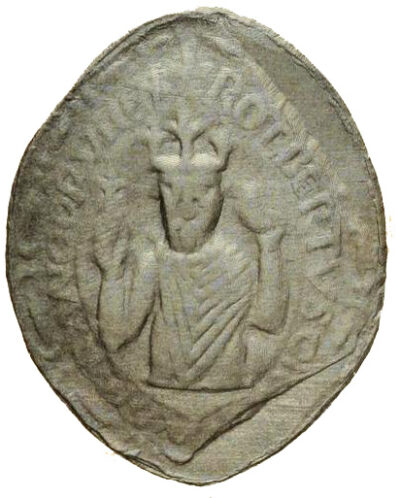
Robert II of France
Robert II of France was a king of the Franks from 996 to 1031. Born March 27, 972, in Orléans. Died July 20, 1031, in Melun. Positions held include king of Franks (996–1031).
Facts
21 facts · 2 confirmed by two sources · 9 cited · 10 from one source
Where this comes from
Papalocal keeps its own record. It started from these sources; what each one said is kept here as it was copied, so a change on their side never changes this page by itself. Tap one to read its version.
What Wikidata says · copied November 16, 2026 · revision 2567362026
- Described as
- king of the Franks from 996 to 1031
- Other names
- Robert II, Robert II le Pieux, King of France
- Born
- March 27, 972
- Died
- July 20, 1031
- Born in
- Orléans
- Died in
- Melun · 1 reference
- Buried in
- Basilica of Saint-Denis
- Citizen of
- Kingdom of France · 1 reference
- Occupation
- politician
- Positions held
- king of Franks (996–1031)
- Spouse
- Rozala of Italy · 1 reference; Bertha of Burgundy (996–) · 1 reference; Constance of Arles (1003–) · 2 references
- Children
- Hedwig of France, Countess of Nevers; Hugh Magnus · 1 reference; Henry I of France · 1 reference; Adela of France · 1 reference; Robert I of Burgundy; Eudes of France
- Father
- Hugh Capet of France · 1 reference
- Mother
- Adelaide of Aquitaine · 1 reference
- Siblings
- Hedwig of France, Countess of Mons; Gisèle de France
- Wikipedias with a page
- 63
Wikidata item Q178918 (wikidata.org/wiki/Q178918), public domain (CC0). Copied November 16, 2026.
What Wikipedia says · copied November 16, 2026 · revision 1385556264
Robert II (c. 972 – 20 July 1031), called the Pious (French: le Pieux) or the Wise (French: le Sage), was king of the Franks from 996 to 1031, the second from the Capetian dynasty. Crowned junior king in 987, he assisted his father on military matters (notably during the two sieges of Laon, in 988 and 991). His solid education, provided by Gerbert of Aurillac (the future Pope Sylvester II) in Reims, allowed him to deal with religious questions of which he quickly became the guarantor (he headed the Council of Saint-Basle de Verzy in 991 and that of Chelles in 994). Continuing the political work of his father after becoming sole ruler in 996, he managed to maintain the alliance with the Duchy of Normandy and the County of Anjou and thus was able to contain the ambitions of Count Odo II of Blois.
Robert II distinguished himself with an extraordinarily long reign for the time. His 35-year-long reign was marked by his attempts to expand the royal domain by any means, especially by his struggle to gain the Duchy of Burgundy (which ended in 1005 with his victory) after the death in 1002 without male descendants of his paternal uncle Duke Henry I, and after a war against Otto-William of Ivrea, Henry I's stepson adopted by him as his heir. His policies earned him many enemies, including three of his sons.
The marital setbacks of Robert II (he married three times, having two of these annulled and attempting to have the third annulled, prevented only by the pope's refusal to agree to a third annulment), strangely contrasted with the pious aura, bordering on holiness, which his biographer Helgaud of Fleury was willing to lend him in his work "Life of King Robert the Pious" (Epitoma vitæ regis Roberti pii). His life was then presented as a model to follow, made of innumerable pious donations to various religious establishments, of charity towards the poor and, above all, of gestures considered sacred, such as the healing of certain lepers. Robert II was the first sovereign considered to be a "miracle worker". The end of his reign revealed the relative weakness of the sovereign, who had to face the revolt of his third wife Constance and then of his own sons (Henry and Robert) between 1025 and 1031.
- Born, in its opening lines
- c. 972
- Died, in its opening lines
- July 20, 1031
From the Wikipedia article “Robert II of France” (en.wikipedia.org/wiki/Robert_II_of_France), by its contributors, under CC BY-SA 4.0 (creativecommons.org/licenses/by-sa/4.0/). Copied November 16, 2026; not changed.
Confirmed Two sources agree. Cited One source, and it names where it got it. One source One source, without a reference of its own. Sources disagree The sources disagree. We show the best-supported value and keep theirs below.
