
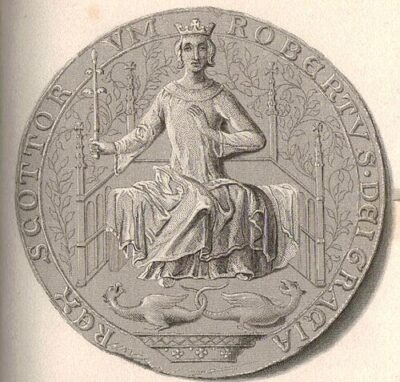
Robert II of Scotland
Robert II of Scotland was a King of Scots from 1371 to his death as the first monarch of the House of Stewart. Born March 2, 1316, in Paisley Abbey. Died April 19, 1390, in Dundonald Castle. Positions held include Monarch of Scotland (1371–1390).
Facts
25 facts · 2 confirmed by two sources · 10 cited · 13 from one source
Where this comes from
Papalocal keeps its own record. It started from these sources; what each one said is kept here as it was copied, so a change on their side never changes this page by itself. Tap one to read its version.
What Wikidata says · copied November 16, 2026 · revision 2567831160
- Described as
- King of Scots from 1371 to his death as the first monarch of the House of Stewart
- Other names
- Robert II, king of Scots, Robert II
- Born
- March 2, 1316 · 1 reference
- Died
- April 19, 1390 · 1 reference
- Born in
- Paisley Abbey
- Died in
- Dundonald Castle
- Buried in
- Scone Abbey
- Citizen of
- Kingdom of Scotland
- Occupation
- politician
- Positions held
- Monarch of Scotland (1371–1390)
- Spouse
- Elizabeth Mure (1347–) · 1 reference; Euphemia de Ross (1355–) · 1 reference
- Children
- Robert III of Scotland · 1 reference; Robert Stewart, Duke of Albany; Alexander Stewart, Earl of Buchan · 1 reference; David Stewart, Earl of Strathearn · 1 reference; Elizabeth Stewart, Countess of Crawford; Walter Stewart, Lord of Fife · 1 reference; Thomas Stewart · 1 reference; Sir John Stewart, Lord of Burley · 1 reference; Sir John Stewart of Cardney · 1 reference; Alexander Stewart · 1 reference; Alexander Stewart of Inverlunan · 1 reference; James Stewart of Kinfauns · 1 reference
- Father
- Walter Stewart, 6th High Steward of Scotland
- Mother
- Marjorie Bruce
- Religion
- Christianity
- Wikipedias with a page
- 53
Wikidata item Q312592 (wikidata.org/wiki/Q312592), public domain (CC0). Copied November 16, 2026.
What Wikipedia says · copied November 16, 2026 · revision 1381815795
Robert II (2 March 1316 – 19 April 1390) was King of Scots from 1371 to his death in 1390. The son of Walter Stewart, 6th High Steward of Scotland, and Marjorie, daughter of King Robert the Bruce, he was named Robert Stewart. Upon the death of his uncle David II, Robert succeeded to the throne as the first monarch of the House of Stuart.
Edward Bruce had been the heir presumptive for his older brother, King Robert the Bruce, but Edward had no children when he was killed in the Battle of Faughart on 14 October 1318. Marjorie Bruce died, likely in 1317, following a riding accident. After her death, Parliament named her infant son, Robert Stewart, as heir presumptive. However, this lapsed on 5 March 1324 with the birth of a son, David, to King Robert and his second wife, Elizabeth de Burgh. Robert Stewart became High Steward of Scotland on his father's death on 9 April 1327, and in the same year, Parliament confirmed the young Steward as heir should David die childless. In 1329, King Robert I died, and his five-year-old son succeeded to the throne as David II under the guardianship of Thomas Randolph, 1st Earl of Moray.
Edward Balliol, son of King John Balliol—assisted by the English and those Scottish nobles whom Robert I had disinherited—invaded Scotland, inflicting heavy defeats on the Bruce party on 11 August 1332 at Dupplin Moor. In the early morning hours of 16 December 1332, then sixteen-year-old Robert and Sir Archibald Douglas defeated Balliol at the Battle of Annan and drove him from Scotland. Balliol returned the following year with King Edward III and an English army. They defeated Archibald Douglas at the Battle of Halidon Hill on 19 July 1333. Robert, who had fought at Halidon, joined his uncle David in refuge in Dumbarton Castle. David escaped to France in 1334, and Parliament, still functioning, appointed Robert and John Randolph, 3rd Earl of Moray as joint guardians of the kingdom. The English captured Randolph in July 1335, while, in the same year, Robert submitted to Balliol, bringing about the removal of his guardianship. His former position was reinstated in 1338 and remained in effect until David returned from France in June 1341. Hostilities continued, and Robert was with David at the Neville's Cross on 17 October 1346, and either escaped or fled the field. David, however, was captured and remained a prisoner until he was ransomed in October 1357.
Robert married Elizabeth Mure around 1348, thus legitimising their four sons and five daughters. His subsequent marriage to Euphemia de Ross in 1355 produced two sons and two surviving daughters. Though Robert rebelled against King David in 1363, he submitted after a threat was made to his right of succession. Upon David’s death in 1371, Robert succeeded him at the age of fifty-five. The border magnates continued to attack English-held zones in southern Scotland, and by 1384, the Scots had re-taken most of the occupied lands. Robert ensured that Scotland was included in the Anglo-French truce of 1384, a factor in the coup in November when he lost control of the country, firstly to his eldest son John, and then from 1388 to John's younger brother, Robert. King Robert II died in Dundonald Castle in 1390 and was buried at Scone Abbey.
- Born, in its opening lines
- March 2, 1316
- Died, in its opening lines
- April 19, 1390
From the Wikipedia article “Robert II of Scotland” (en.wikipedia.org/wiki/Robert_II_of_Scotland), by its contributors, under CC BY-SA 4.0 (creativecommons.org/licenses/by-sa/4.0/). Copied November 16, 2026; not changed.
Confirmed Two sources agree. Cited One source, and it names where it got it. One source One source, without a reference of its own. Sources disagree The sources disagree. We show the best-supported value and keep theirs below.
