
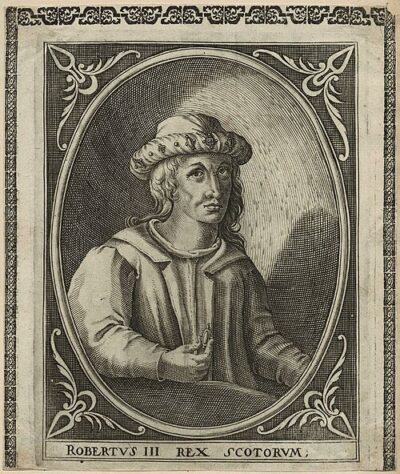
Robert III of Scotland
Robert III of Scotland was a King of Scotland. Born 1330s, in Scone Palace. Died April 4, 1406, in Rothesay Castle. Positions held include Monarch of Scotland (1390–1406).
Facts
30 facts · 1 confirmed by two sources · 8 cited · 20 from one source · 1 where the sources disagree
What’s different
- Born: we show 1330s (Sources disagree). Wikipedia says c. 1337
Where this comes from
Papalocal keeps its own record. It started from these sources; what each one said is kept here as it was copied, so a change on their side never changes this page by itself. Tap one to read its version.
What Wikidata says · copied November 16, 2026 · revision 2569841610
- Described as
- King of Scotland
- Born
- 1330s · 1 reference
- Died
- April 4, 1406 · 1 reference
- Born in
- Scone Palace
- Died in
- Rothesay Castle
- Buried in
- Paisley Abbey
- Cause of death
- myocardial infarction
- Name at birth
- John Stewart · 1 reference
- Citizen of
- Kingdom of Scotland
- Occupation
- politician
- Positions held
- Monarch of Scotland (1390–1406)
- Spouse
- Anabella Drummond
- Children
- David Stewart, Duke of Rothesay; James I of Scotland · 1 reference; Margaret Douglas; James Stewart of Kilbride · 1 reference; Sir John Stewart · 1 reference; Lady Elizabeth Stewart · 1 reference; Egidia Stewart · 1 reference; Lady Mary Stewart · 1 reference; Robert Stewart · 1 reference
- Father
- Robert II of Scotland · 1 reference
- Mother
- Elizabeth Mure
- Siblings
- Alexander Stewart, Earl of Buchan; Walter Stewart, Earl of Atholl; David Stewart, Earl of Strathearn; Robert Stewart, Duke of Albany; Walter Stewart, Lord of Fife; Elizabeth Stewart, Countess of Crawford; Thomas Stewart
- Religion
- Christianity
- Wikipedias with a page
- 51
Wikidata item Q294671 (wikidata.org/wiki/Q294671), public domain (CC0). Copied November 16, 2026.
What Wikipedia says · copied November 16, 2026 · revision 1380765227
Robert III (c. 1337 – 4 April 1406), born John Stewart, was King of Scots from 1390 to his death in 1406. He was also High Steward of Scotland from 1371 to 1390 and held the titles of Earl of Atholl (1367–1390) and Earl of Carrick (1368–1390) before ascending the throne at the age of about 53 years. He was the eldest son of King Robert II and Elizabeth Mure and was legitimised by his parents' second marriage through papal dispensation in 1349.
John joined his father and other magnates in a rebellion against his great-uncle David II early in 1363 but submitted to him soon afterwards. He was married to Annabella Drummond by 1367. In 1368, David created him Earl of Carrick. His father became king in 1371 after the unexpected death of the childless King David II. In the following years, Carrick was influential in the kingdom's governance but became impatient with his father's longevity. In 1384, Carrick was appointed the king's lieutenant after swaying the general council to remove Robert II from direct rule. Carrick's administration saw a renewal of the conflict with England. In 1388, the Scots defeated the English at the Battle of Otterburn, where the Scots' commander, James, Earl of Douglas, was killed. By this time, Carrick had been badly injured from a horse kick; however, it was the loss of his powerful ally, Douglas, that saw a turnaround in magnate support in favour of his younger brother Robert, Earl of Fife, to whom the council transferred the lieutenancy in December 1388.
In 1390, Robert II died, and Carrick ascended the throne as Robert III, but without authority to rule directly. Fife continued as Lieutenant until February 1393, when power was returned to the king jointly with his son David. At a council in 1399, owing to the king's "sickness of his person", David, now Duke of Rothesay, became Lieutenant under the supervision of a special parliamentary group dominated by Fife, now styled Duke of Albany. After this, Robert III withdrew to his lands in the west and, for a time, played little or no part in affairs of state. He was powerless to interfere when a dispute between Albany and Rothesay arose in 1401, leading to Rothesay's imprisonment and death in March 1402. The general council absolved Albany from blame and reappointed him as Lieutenant. The only impediment now remaining to an Albany Stewart monarchy was the king's only surviving son, James, Earl of Carrick. After a clash with Albany's Douglas allies in 1406, the 11-year-old James tried to escape to France. The vessel was intercepted, and James became the prisoner of Henry IV of England. Robert III died shortly after learning of his heir's imprisonment.
- Born, in its opening lines
- c. 1337
- Died, in its opening lines
- April 4, 1406
From the Wikipedia article “Robert III of Scotland” (en.wikipedia.org/wiki/Robert_III_of_Scotland), by its contributors, under CC BY-SA 4.0 (creativecommons.org/licenses/by-sa/4.0/). Copied November 16, 2026; not changed.
Confirmed Two sources agree. Cited One source, and it names where it got it. One source One source, without a reference of its own. Sources disagree The sources disagree. We show the best-supported value and keep theirs below.
