
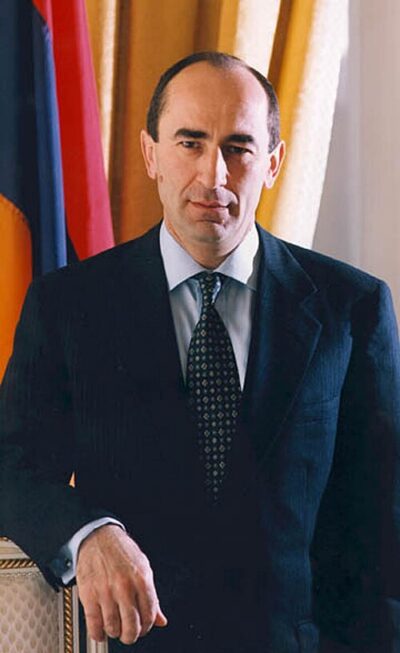
Robert Kocharyan
Robert Kocharyan is a former leader of the Nagorno-Karabakh Republic and Armenia. Born August 31, 1954, in Khankendi. Positions held include President of Armenia (1998–2008), President of Artsakh (1994–1997) and Prime Minister of Armenia (1997–1998). Educated at National Polytechnic University of Armenia. Awards include Order of the White Eagle, Hero of Artsakh and Grand Cordon of the National Order of the Cedar.
Facts
27 facts · 1 confirmed by two sources · 3 cited · 23 from one source
Where this comes from
Papalocal keeps its own record. It started from these sources; what each one said is kept here as it was copied, so a change on their side never changes this page by itself. Tap one to read its version.
What Wikidata says · copied November 16, 2026 · revision 2569586220
- Described as
- former leader of the Nagorno-Karabakh Republic and Armenia
- Other names
- Robert Sedraki Kocharyan
- Born
- August 31, 1954 · 5 references
- Born in
- Khankendi · 2 references
- Citizen of
- Soviet Union; Armenia; Republic of Artsakh
- Occupation
- politician · 1 reference; engineer; electrical engineer · 1 reference
- Positions held
- President of Armenia (1998–2008); President of Artsakh (1994–1997) · 1 reference; Prime Minister of Armenia (1997–1998); Prime Minister of Artsakh (1992–1994)
- Education
- National Polytechnic University of Armenia
- Awards
- Order of the White Eagle; Hero of Artsakh; Grand Cordon of the National Order of the Cedar; Grand Cross of the Legion of Honour; Grand Cross of the Order of the Redeemer; Grand Cross of the Order of Vytautas the Great; Order of Honour · 1 reference; Order of Bethlehem · 1 reference; Honorary doctor of Lebanese University (1999); Silver Olympic Order (2003)
- Spouse
- Bella Kocharyan
- Children
- Levon Kocharyan
- Religion
- Armenian Apostolic Church
- Website
- https://robertkocharyan.am
- Wikipedias with a page
- 73
Wikidata item Q613051 (wikidata.org/wiki/Q613051), public domain (CC0). Copied November 16, 2026.
What Wikipedia says · copied November 16, 2026 · revision 1385475053
Robert Sedraki Kocharyan (Armenian: Ռոբերտ Սեդրակի Քոչարյան pronounced [rɔˈbɛɾt sɛtʰɾɑˈki kʰɔtʃʰɑɾˈjɑn]; born 31 August 1954) is an Armenian politician. He served as the President of the Nagorno-Karabakh Republic from 1994 to 1997 and Prime Minister of Nagorno-Karabakh from 1992 to 1994. He served as the second President of Armenia between 1998 and 2008 and as Prime Minister of Armenia from 1997 to 1998.
Kocharyan was elected president of Armenia twice, in 1998 and 2003; both presidential elections were held in two rounds. During most of his presidency, between 2001 and 2007, Armenia's economy grew on average by 12% annually, largely due to a construction boom. While Kocharyan's supporters credit him with securing Armenia's economic growth during his presidency, his critics accuse him of promoting corruption and the creation of an oligarchic system of government in Armenia.
On 26 July 2018 Kocharyan was charged in connection with the crackdown on the 2008 Armenian presidential election protests in the final weeks of his presidency, which resulted in the deaths of ten people. Kocharyan's trial began on 13 May 2019. The trial ended in March 2021 after the Constitutional Court of Armenia declared unconstitutional the article of the criminal code under which Kocharyan was being tried.
Kocharyan returned to active participation in Armenian politics following the Second Nagorno-Karabakh War in 2020. He participated in the 2021 Armenian parliamentary election as the head of the Armenia Alliance with the Armenian Revolutionary Federation and the Reborn Armenia party, which came in second place after Nikol Pashinyan's Civil Contract party and entered parliament as the opposition.
- Born, in its opening lines
- August 31, 1954
From the Wikipedia article “Robert Kocharyan” (en.wikipedia.org/wiki/Robert_Kocharyan), by its contributors, under CC BY-SA 4.0 (creativecommons.org/licenses/by-sa/4.0/). Copied November 16, 2026; not changed.
Confirmed Two sources agree. Cited One source, and it names where it got it. One source One source, without a reference of its own. Sources disagree The sources disagree. We show the best-supported value and keep theirs below.
