
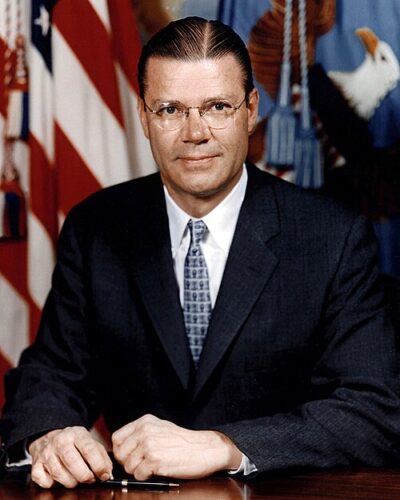
Robert McNamara
Robert McNamara was an American businessman and Secretary of Defense. Born June 9, 1916, in San Francisco. Died July 6, 2009, in Washington, D.C.. Positions held include United States Secretary of Defense (1961–1968) and President of the World Bank Group (1968–1981). Educated at University of California, Berkeley and Harvard Business School. Awards include Legionnaire of Legion of Merit, Presidential Medal of Freedom and Medal of honor Dag Hammarskjold.
Facts
38 facts · 2 confirmed by two sources · 10 cited · 26 from one source
Where this comes from
Papalocal keeps its own record. It started from these sources; what each one said is kept here as it was copied, so a change on their side never changes this page by itself. Tap one to read its version.
What Wikidata says · copied November 13, 2026 · revision 2562814161
- Described as
- American businessman and Secretary of Defense (1916-2009)
- Other names
- McNamara, Robert Strange McNamara, Robert S. McNamara
- Born
- June 9, 1916 · 7 references
- Died
- July 6, 2009 · 8 references
- Born in
- San Francisco · 3 references
- Died in
- Washington, D.C. · 3 references
- Buried in
- Arlington National Cemetery
- Citizen of
- United States
- Occupation
- banker · 1 reference; politician · 2 references; writer; economist · 1 reference; military personnel; opinion journalist · 1 reference
- Positions held
- United States Secretary of Defense (1961–1968); President of the World Bank Group (1968–1981)
- Political party
- Democratic Party (1978–); Republican Party (–1978)
- Worked for
- Harvard University; Ford Motor Company
- Education
- University of California, Berkeley (–1937); Harvard Business School (–1939); Piedmont High School (–1933) · 1 reference
- Member of
- Trilateral Commission; American Academy of Arts and Sciences; Phi Beta Kappa Society; American Philosophical Society · 1 reference
- Awards
- Legionnaire of Legion of Merit; Presidential Medal of Freedom (1968) · 1 reference; Medal of honor Dag Hammarskjold (1983); Four Freedoms Award – Freedom from Want (1983) · 1 reference; Defense Distinguished Service Medal · 1 reference; Legion of Merit · 1 reference; Eagle Scout · 1 reference; The Hillman Prize for Book Journalism (1987) · 1 reference
- Spouse
- Margaret McNamara (1940–1981)
- Children
- Robert Craig McNamara
- Religion
- Presbyterian Church (USA); Presbyterianism · 1 reference
- Military rank
- Lieutenant Colonel
- Wikipedias with a page
- 60
Wikidata item Q191999 (wikidata.org/wiki/Q191999), public domain (CC0). Copied November 13, 2026.
What Wikipedia says · copied November 13, 2026 · revision 1385391853
Robert Strange McNamara (; June 9, 1916 – July 6, 2009), also known by his initials RSM, was an American businessman and government official who served as the eighth United States secretary of defense from 1961 to 1968 under presidents John F. Kennedy and Lyndon B. Johnson at the height of the Cold War. He remains the longest-serving secretary of defense, having remained in office over seven years. He played a major role in promoting the U.S. involvement in the Vietnam War. McNamara was responsible for the institution of systems analysis in public policy, which developed into the discipline known today as policy analysis.
McNamara graduated from the University of California, Berkeley, and Harvard Business School. He served in the United States Army Air Forces during World War II. After World War II, Henry Ford II hired McNamara and a group of other Army Air Force veterans to work for the Ford Motor Company, reforming Ford with modern planning, organization, and management control systems. After briefly serving as Ford's president, McNamara accepted an appointment as secretary of defense in the Kennedy administration.
McNamara became a close adviser to Kennedy and advocated the use of a blockade during the Cuban Missile Crisis. Kennedy and McNamara instituted a Cold War defense strategy of flexible response, which anticipated the need for military responses short of massive retaliation. During the Kennedy administration, McNamara presided over the beginning of the build-up of U.S. soldiers in South Vietnam. After the 1964 Gulf of Tonkin incident, the number of U.S. soldiers in Vietnam escalated dramatically. McNamara and other U.S. policymakers feared that the fall of South Vietnam to a Communist regime would lead to the fall of other governments in the region.
McNamara grew increasingly skeptical of the efficacy of committing U.S. troops to South Vietnam. In 1968, he resigned as secretary of defense to become president of the World Bank. He served as its president until 1981, shifting the focus of the World Bank from infrastructure and industrialization towards poverty reduction. After retiring, he served as a trustee of several organizations, including the California Institute of Technology and the Brookings Institution. In later writings and interviews, including his memoir, McNamara expressed regret for some of the decisions he made during the Vietnam War.
- Born, in its opening lines
- June 9, 1916
- Died, in its opening lines
- July 6, 2009
From the Wikipedia article “Robert McNamara” (en.wikipedia.org/wiki/Robert_McNamara), by its contributors, under CC BY-SA 4.0 (creativecommons.org/licenses/by-sa/4.0/). Copied November 13, 2026; not changed.
Confirmed Two sources agree. Cited One source, and it names where it got it. One source One source, without a reference of its own. Sources disagree The sources disagree. We show the best-supported value and keep theirs below.
