
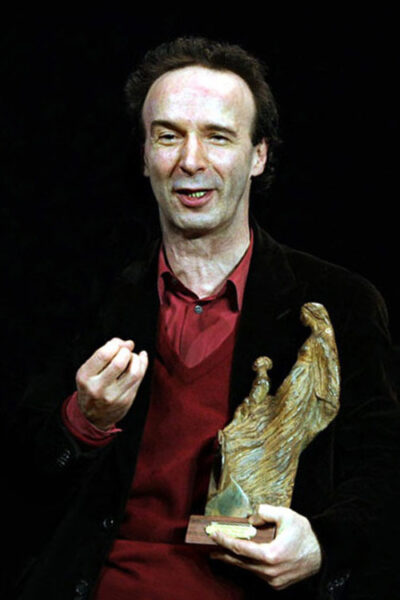
Roberto Benigni
Roberto Benigni is an Italian actor, comedian, screenwriter and film director. Born October 27, 1952, in Castiglion Fiorentino. Known for Nothing Left to Do But Cry, The Monster and Life Is Beautiful. Awards include BAFTA Award for Best Actor in a Leading Role, Nastro d'Argento for Best Actor (3 times) and Screen Actors Guild Award for Outstanding Performance by a Male Actor in a Leading Role.
Facts
35 facts · 1 confirmed by two sources · 10 cited · 24 from one source
Where this comes from
Papalocal keeps its own record. It started from these sources; what each one said is kept here as it was copied, so a change on their side never changes this page by itself. Tap one to read its version.
What Wikidata says · copied November 16, 2026 · revision 2567371039
- Described as
- Italian actor, comedian, screenwriter and film director (born 1952)
- Other names
- Roberto Remigio Benigni, Roberto R. Benigni, R. R. Benigni, R. Benigni, Benigni, Benigni, Roberto Remigio
- Born
- October 27, 1952 · 10 references
- Born in
- Castiglion Fiorentino · 1 reference
- Name at birth
- Roberto Remigio Benigni
- Citizen of
- Italy
- Occupation
- film director · 1 reference; screenwriter · 1 reference; comedian; street artist; composer; film actor; singer-songwriter · 1 reference; stage actor
- Instrument
- voice · 1 reference
- Record label
- Philips Records; Deutsche Grammophon; Mercury Records
- Known for
- Nothing Left to Do But Cry; The Monster; Life Is Beautiful
- Awards
- BAFTA Award for Best Actor in a Leading Role (1999); Nastro d'Argento for Best Actor (3 times) (1987, 1992, 1998); Screen Actors Guild Award for Outstanding Performance by a Male Actor in a Leading Role; Knight Grand Cross of the Order of Merit of the Italian Republic (2005) · 1 reference; Academy Award for Best Actor (1999); David di Donatello for Best Actor (2 times) (1989, 1998); honorary doctor of the Katholieke Universiteit Leuven (2007); Gold Medal of the Italian Order of Merit for Culture and Art · 1 reference; European Film Award for Best Film (1998) · 1 reference; European Film Award for Best Actor (1998) · 1 reference; European Film Academy Achievement in World Cinema Award (2000) · 1 reference; Golden Lion for Lifetime Achievement (2021); David di Donatello Award for Lifetime Achievement; David di Donatello for Best Director; David di Donatello for Best Original Script
- Spouse
- Nicoletta Braschi (1991–) · 1 reference
- Wikipedias with a page
- 88
Wikidata item Q23301 (wikidata.org/wiki/Q23301), public domain (CC0). Copied November 16, 2026.
What Wikipedia says · copied November 16, 2026 · revision 1383093746
Roberto Remigio Benigni ( bə-NEE-nyee, Italian: [roˈbɛrto beˈniɲɲi]; born 27 October 1952) is an Italian actor, comedian, screenwriter, and film director. He gained international recognition for writing, directing, and starring in the Holocaust comedy drama film Life Is Beautiful (1997), for which he received the Academy Awards for Best Actor and Best International Feature Film. Benigni is the first, and only, recipient of an Academy Award for Best Actor for a non-English language performance.
Benigni made his acting debut in 1977's Berlinguer, I Love You, which he also wrote, and which was directed by Giuseppe Bertolucci. Benigni's directorial debut was the 1983 anthology film Tu mi turbi, which was also the acting debut of his wife, Nicoletta Braschi. He continued directing and also starring in the comedic films Nothing Left to Do But Cry (1984), The Little Devil (1988), Johnny Stecchino (1991), The Monster (1994), the award-winning film Life Is Beautiful (1997), Pinocchio (2002, as the title character), and The Tiger and the Snow (2005).
Benigni acted in the Jim Jarmusch films Down by Law (1986), Night on Earth (1991), and Coffee and Cigarettes (2003). He also acted in Federico Fellini's The Voice of the Moon (1990), Blake Edwards' Son of the Pink Panther (1993), Woody Allen's To Rome with Love (2012), and Matteo Garrone's Pinocchio (2019, as Geppetto).
- Born, in its opening lines
- October 27, 1952
From the Wikipedia article “Roberto Benigni” (en.wikipedia.org/wiki/Roberto_Benigni), by its contributors, under CC BY-SA 4.0 (creativecommons.org/licenses/by-sa/4.0/). Copied November 16, 2026; not changed.
Confirmed Two sources agree. Cited One source, and it names where it got it. One source One source, without a reference of its own. Sources disagree The sources disagree. We show the best-supported value and keep theirs below.
