
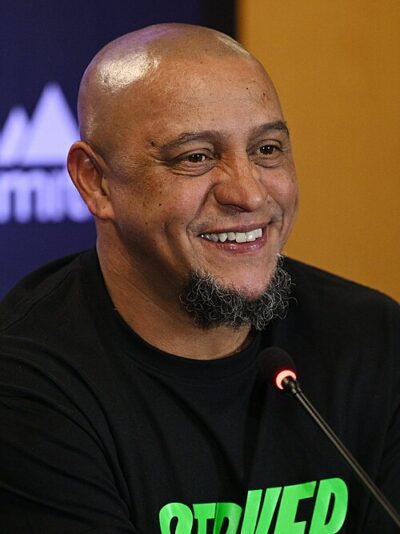
Roberto Carlos
Roberto Carlos is a Brazilian footballer. Born April 10, 1973, in Garça. Teams include FC Anzhi Makhachkala (1–2012), Inter Milan (1995–1996) and S.C. Corinthians Paulista (2010–2011).
Facts
22 facts · 1 confirmed by two sources · 2 cited · 19 from one source
Where this comes from
Papalocal keeps its own record. It started from these sources; what each one said is kept here as it was copied, so a change on their side never changes this page by itself. Tap one to read its version.
What Wikidata says · copied November 16, 2026 · revision 2569192031
- Described as
- Brazilian footballer
- Other names
- Roberto Carlos da Silva Rocha
- Born
- April 10, 1973 · 3 references
- Born in
- Garça
- Name at birth
- Roberto Carlos da Silva Rocha
- Citizen of
- Brazil
- Occupation
- association football player · 2 references; association football coach · 1 reference; futsal player
- Teams
- FC Anzhi Makhachkala (1–2012); Inter Milan (1995–1996); S.C. Corinthians Paulista (2010–2011); Sociedade Esportiva Palmeiras (1993–1995); União São João E.C. (1991–1993); Fenerbahçe Istanbul (2007–2009); Real Madrid Club de Fútbol (1996–2007); Clube Atlético Mineiro (1992); Odisha FC (2015–2016); Brazil men's national football team (1992–2006); Brazil national under-20 football team (1991)
- Sport
- association football
- Religion
- Islam
- Height
- 1.68 m (5 ft 6 in)
- Website
- https://www.robertocarlosofficial.com/
- Wikipedias with a page
- 83
Wikidata item Q429039 (wikidata.org/wiki/Q429039), public domain (CC0). Copied November 16, 2026.
What Wikipedia says · copied November 16, 2026 · revision 1385461250
Roberto Carlos da Silva Rocha (born 10 April 1973), often recognized as Roberto Carlos (Brazilian Portuguese: [ʁoˈbɛʁtu ˈkaʁlus]) and sometimes RC3, is a Brazilian former professional footballer. He has been described as the "most offensive-minded left-back in the history of the game", and one of the greatest full-backs in history. In 1997, he was runner-up in the FIFA World Player of the Year and in 2002, was runner-up for the Ballon d'Or. He is primarily known for his long career at Real Madrid and constant presence on the Brazilian national team.
He started his career in Brazil as a forward but spent most of his career as a left-back. At club level, Roberto Carlos joined Real Madrid from Inter Milan in 1996 to spend 11 highly successful seasons, playing 584 matches in all competitions and scoring 71 goals. At Real, he won four La Liga titles and the UEFA Champions League three times. In April 2013, Marca named him in their "Best Foreign Eleven in Real Madrid's History". He is one of the few players to have made over 1,100 professional career appearances at clubs and international levels.
Roberto Carlos made his debut for the Brazil national team in 1992. He played in three World Cups, helping the team reach the final in 1998 in France, and win the 2002 tournament in South Korea and Japan. He was named in the FIFA World Cup All-Star Team in 1998 and 2002. With Brazil, he is especially known for a bending 40-yard free kick against France in the inaugural match of Tournoi de France 1997. With 125 caps, he has made the fourth-most appearances for his national team. He was chosen for the FIFA World Cup Dream Team in a 2002 FIFA poll.
He took up management and was named as the manager of Sivasspor in the Turkish Süper Lig in June 2013. He resigned as head coach in December 2014. From January to June 2015, he was manager of Akhisarspor. Although he announced his retirement from playing at the age of 39 in 2012, he briefly came out of retirement in 2015 when he was appointed player/manager of Indian Super League club Delhi Dynamos.
- Born, in its opening lines
- April 10, 1973
From the Wikipedia article “Roberto Carlos” (en.wikipedia.org/wiki/Roberto_Carlos), by its contributors, under CC BY-SA 4.0 (creativecommons.org/licenses/by-sa/4.0/). Copied November 16, 2026; not changed.
Confirmed Two sources agree. Cited One source, and it names where it got it. One source One source, without a reference of its own. Sources disagree The sources disagree. We show the best-supported value and keep theirs below.
