
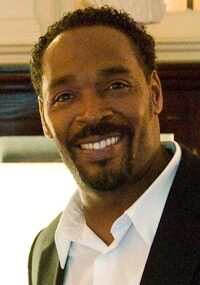
Rodney King
Rodney King was an African American police brutality victim. Born April 2, 1965, in Sacramento. Died June 17, 2012, in Rialto. Educated at John Muir High School.
Facts
12 facts · 2 confirmed by two sources · 2 cited · 8 from one source
Where this comes from
Papalocal keeps its own record. It started from these sources; what each one said is kept here as it was copied, so a change on their side never changes this page by itself. Tap one to read its version.
What Wikidata says · copied November 14, 2026 · revision 2531772892
- Described as
- African American police brutality victim (1965–2012)
- Other names
- Rodney Glen King
- Born
- April 2, 1965 · 3 references
- Died
- June 17, 2012 · 5 references
- Born in
- Sacramento · 1 reference
- Died in
- Rialto · 1 reference
- Buried in
- Forest Lawn Memorial Park
- Name at birth
- Rodney Glen King
- Citizen of
- United States
- Occupation
- author; activist; taxi driver · 1 reference
- Education
- John Muir High School · 1 reference
- Field
- taxi driver
- Wikipedias with a page
- 40
Wikidata item Q338389 (wikidata.org/wiki/Q338389), public domain (CC0). Copied November 14, 2026.
What Wikipedia says · copied November 14, 2026 · revision 1383654993
Rodney Glen King (April 2, 1965 – June 17, 2012) was an African-American man who on March 3, 1991 became a victim of police brutality when he was severely beaten by officers of the Los Angeles Police Department (LAPD) during his arrest after a high-speed pursuit on the California freeway and expressway system, having initially evaded arrest. George Holliday, an uninvolved resident, saw and filmed the incident from his nearby balcony and then sent the footage, which showed an unarmed King on the ground being beaten, to KTLA, a local news station who broadcast the film, which was then rebroadcast by other stations casting a worldwide spotlight on the LAPD and King.
King was taken to Pacifica Hospital after his arrest where he was found to have suffered a fractured facial bone, a broken right ankle, and multiple bruises and lacerations. Nurses later reported that the officers who accompanied King openly joked and bragged about the number of times they had hit him. Blood and urine samples taken five hours after his arrest measured King's blood alcohol content at 0.075%, below the legal limit of 0.08%. The LAPD initially charged King with "felony evading", but later dropped the charge.
Upon his release, King spoke to reporters from his wheelchair, with his injuries evident: a broken right leg in a cast, his face badly cut and swollen, bruises on his body, and a burn area on his chest where he had been jolted with a stun gun. King described the beating and also stated that he was scared for his life when the officers drew their guns on him.
Three of the four officers were charged with excessive force. Within hours of their acquittals the 1992 Los Angeles riots started, sparked by outrage among minorities over the trial's verdict as well as long-standing societal issues. King appeared on television to advocate for peace, which has often been paraphrased as "Can we all just get along?".
The federal government prosecuted a separate civil rights case, obtaining grand jury indictments of the four officers for violations of King's civil rights. In April 1993, two of the officers were found guilty in federal court and sentenced to prison while the other two were acquitted. In a separate civil lawsuit in 1994, a jury found the City of Los Angeles liable and awarded King $3.8 million.
- Born, in its opening lines
- April 2, 1965
- Died, in its opening lines
- June 17, 2012
From the Wikipedia article “Rodney King” (en.wikipedia.org/wiki/Rodney_King), by its contributors, under CC BY-SA 4.0 (creativecommons.org/licenses/by-sa/4.0/). Copied November 14, 2026; not changed.
Confirmed Two sources agree. Cited One source, and it names where it got it. One source One source, without a reference of its own. Sources disagree The sources disagree. We show the best-supported value and keep theirs below.
