
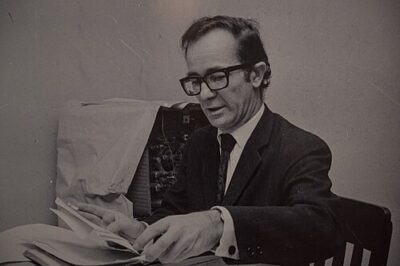
Rodolfo Walsh
Rodolfo Walsh was an Argentine journalist and writer. Born January 9, 1927, in Buenos Aires. Died March 25, 1977, in Buenos Aires. Known for Operación Masacre.
Facts
13 facts · 2 confirmed by two sources · 6 cited · 5 from one source
Where this comes from
Papalocal keeps its own record. It started from these sources; what each one said is kept here as it was copied, so a change on their side never changes this page by itself. Tap one to read its version.
What Wikidata says · copied November 18, 2026 · revision 2570936859
- Described as
- Argentine journalist and writer (1927–1977)
- Other names
- Rodolfo Jorge Walsh, Esteban, Basualdo, Norberto Freyre
- Born
- January 9, 1927 · 3 references
- Died
- March 25, 1977 · 3 references
- Born in
- Buenos Aires
- Died in
- Buenos Aires · 1 reference
- Cause of death
- gunshot wound
- Citizen of
- Argentina
- Occupation
- writer · 2 references; journalist · 1 reference; translator · 1 reference
- Member of
- Montoneros · 1 reference
- Known for
- Operación Masacre
- Children
- María Victoria Walsh · 1 reference; Patricia Walsh
- Wikipedias with a page
- 20
Wikidata item Q1111411 (wikidata.org/wiki/Q1111411), public domain (CC0). Copied November 18, 2026.
What Wikipedia says · copied November 18, 2026 · revision 1377580480
Rodolfo Jorge Walsh (January 9, 1927 – March 25, 1977) was an Argentine writer and journalist of Irish descent, considered the founder of investigative journalism in Argentina. He is most famous for his Open Letter from a Writer to the Military Junta, which he published the day before his murder, protesting that Argentina's last civil-military dictatorship's economic policies were having an even greater and disastrous effect on ordinary Argentines than its widespread human rights abuses.
Born in Lamarque, Walsh finished his primary education in a small town in Río Negro Province, from where he moved to Buenos Aires in 1941, where he completed high school. Although he started studying philosophy at university, he abandoned it and held a number of different jobs, mostly as a writer or editor. Between 1944 and 1945 he joined the Alianza Libertadora Nacionalista, a movement he later denounced as being "Nazi" in its roots. In 1953 he received the Buenos Aires Municipal Literature Award for his book Variaciones en Rojo.
Initially supporting the "Revolución Libertadora"'s coup which overthrew Juan Perón's democratic government in 1955, by 1956 Walsh already rejected the hard-line policies of the military government led by Aramburu. In 1957 he finished Operación Masacre ("Operation Massacre"), an investigative work on the illegal execution of Peron's sympathizers during an ill-fated attempt at restoring Peronism to power in June 1956. Operación Masacre is now considered by scholars as the first historical non-fiction novel, preceding Truman Capote's In Cold Blood.
In 1960 he went to Cuba, where together with Jorge Masetti Walsh founded the Prensa Latina press agency. It has been established that he decrypted a CIA telex referring to the upcoming Bay of Pigs invasion, helping Fidel Castro to prepare for the supposedly secret operation. Back in Argentina in 1961, by the late 1960s he had close ties to the CGT de los Argentinos. In 1973 Walsh joined the Montoneros guerrilla radical group, but eventually began to question the views of the organization, and so decided to fight the new dictatorship that arose in 1976 by the use of words instead of guns, then writing his famous Open Letter from a Writer to the Military Junta. Shortly after, on March 25, 1977, he was mortally wounded during a shoot-out with a "task force" group that ambushed him on the street. Walsh's body and some of his writings were kidnapped and never seen again, and he is remembered as a desaparecido, as well as a victim of state-sponsored terrorism.
At least four films have been based on his work, including Operación masacre (1973) and Murdered at Distance ("Asesinato a distancia", 1998), and three of his books were published years after his death, most notably Cuento para tahúres y otros relatos policiales. Walsh's daughter, Patricia Walsh, is a politician.
- Born, in its opening lines
- January 9, 1927
- Died, in its opening lines
- March 25, 1977
From the Wikipedia article “Rodolfo Walsh” (en.wikipedia.org/wiki/Rodolfo_Walsh), by its contributors, under CC BY-SA 4.0 (creativecommons.org/licenses/by-sa/4.0/). Copied November 18, 2026; not changed.
Confirmed Two sources agree. Cited One source, and it names where it got it. One source One source, without a reference of its own. Sources disagree The sources disagree. We show the best-supported value and keep theirs below.
