
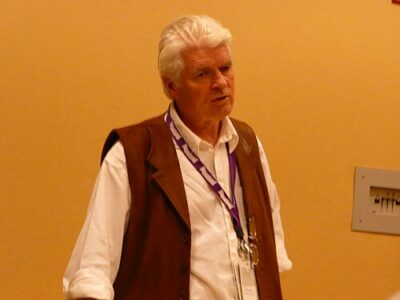
Roger Dean
Roger Dean is an English artist, designer, architect, and publisher. Born August 31, 1944, in Ashford. Educated at The Norton Knatchbull School and Kent Institute of Art & Design. Awards include World Fantasy Award—Artist.
Facts
17 facts · 1 confirmed by two sources · 4 cited · 12 from one source
Where this comes from
Papalocal keeps its own record. It started from these sources; what each one said is kept here as it was copied, so a change on their side never changes this page by itself. Tap one to read its version.
What Wikidata says · copied November 18, 2026 · revision 2566879356
- Described as
- English artist, designer, architect, and publisher
- Other names
- William Roger Dean
- Born
- August 31, 1944 · 7 references
- Born in
- Ashford · 1 reference
- Citizen of
- United Kingdom
- Occupation
- illustrator; architect; designer · 1 reference; painter; artist · 1 reference; graphic designer · 1 reference
- Education
- The Norton Knatchbull School; Kent Institute of Art & Design; Royal College of Art; University for the Creative Arts · 1 reference
- Awards
- World Fantasy Award—Artist (1977)
- Field
- architecture; graphic design
- Website
- http://www.rogerdean.com/
- Wikipedias with a page
- 22
Wikidata item Q444399 (wikidata.org/wiki/Q444399), public domain (CC0). Copied November 18, 2026.
What Wikipedia says · copied November 18, 2026 · revision 1384324963
William Roger Dean (born 31 August 1944) is an English artist, designer, and publisher, best known for his surreal, fantastical landscapes and distinctive typography that defined the visual identity of progressive rock in the 1970s. Over a career spanning six decades, more than 100 million copies of his designs have circulated globally. His landmark collaborations with bands such as Yes and Asia produced some of the most recognisable album covers, logos, and stage designs during this period.
Dean spent his childhood moving between the UK, Greece, Cyprus, and Hong Kong due to his father's military career. He returned to England in 1959, later studying industrial design at the Canterbury College of Art and furniture design at the Royal College of Art in London. As a student, he developed the Sea Urchin chair, an early precursor to the beanbag chair that was later acquired by the Victoria and Albert Museum. His postgraduate thesis focused on organic architecture and the psychology of domestic tranquility, establishing design philosophies that would shape both his later architectural concepts and his painted environments.
Dean transitioned into commercial illustration after executing design commissions for Ronnie Scott's Jazz Club, which led to his breakthrough album cover for the Afro-rock band Osibisa in 1971. Later that year, he began a historic creative partnership with Yes, designing their iconic bubble logo, stage sets, and dozens of album sleeves beginning with Fragile (1971). His recurring motifs of floating islands, exotic biomes, and biomorphic structures became a central element of the band's visual identity. Dean established a similar long-term collaboration with the supergroup Asia and provided artwork for numerous other acts, including Uriah Heep, Gentle Giant, and Budgie.
Beyond the music industry, Dean's multi-disciplinary output spans corporate branding, architecture, video games, and book publishing. He created the original logo for Richard Branson's Virgin Records in 1973 and later designed the visual identity, box art, and logo for the software publisher Psygnosis. As a publisher, he co-founded Dragons' Dream and Paper Tiger Books, releasing over a hundred illustrated art volumes, including his own bestselling debut compilation, Views (1975).
- Born, in its opening lines
- August 31, 1944
From the Wikipedia article “Roger Dean (artist)” (en.wikipedia.org/wiki/Roger_Dean_(artist)), by its contributors, under CC BY-SA 4.0 (creativecommons.org/licenses/by-sa/4.0/). Copied November 18, 2026; not changed.
Confirmed Two sources agree. Cited One source, and it names where it got it. One source One source, without a reference of its own. Sources disagree The sources disagree. We show the best-supported value and keep theirs below.
