
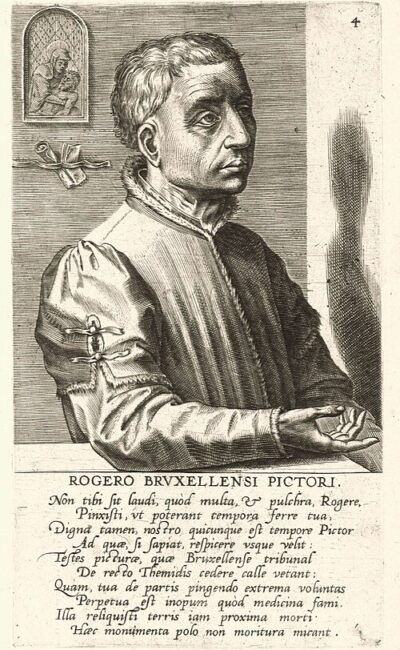
Rogier van der Weyden
Rogier van der Weyden was an early Netherlandish painter (c. 1399–1464). Born 1390s, in Tournai. Died June 18, 1464, in Brussels. Known for Braque Triptych, Saint Luke Drawing the Virgin and Miraflores Altarpiece.
Facts
24 facts · 0 confirmed by two sources · 11 cited · 12 from one source · 1 where the sources disagree
What’s different
- Died: we show June 18, 1464 (Sources disagree). Wikidata also lists June 16, 1464
Where this comes from
Papalocal keeps its own record. It started from these sources; what each one said is kept here as it was copied, so a change on their side never changes this page by itself. Tap one to read its version.
What Wikidata says · copied November 16, 2026 · revision 2569201174
- Described as
- early Netherlandish painter (c. 1399–1464)
- Other names
- Roger de la Pasture, Roger De la Pasture, Rogier Van der Weyden, Roger de La Pasture, Rogir Fan der Veĭden, Rogier De La Pasture Weyden, Roger van der Weyden, Rogier de Le Pasture, Rogier van Der Weyden, Rogier de la Pasture, Rogier Van Der Weyden, Rogier de le Pasture
- Born
- 1390s · 2 references
- Died
- June 18, 1464 · 3 references; June 16, 1464 · 2 references
- Born in
- Tournai · 5 references
- Died in
- Brussels · 5 references
- Buried in
- Cathedral of St. Michael and St. Gudula
- Name at birth
- Roger de le Pasture · 1 reference
- Citizen of
- Burgundian Netherlands
- Occupation
- painter · 4 references; illuminator · 1 reference; architectural drafter · 1 reference
- Genre
- religious painting · 2 references; portrait · 3 references; still life · 1 reference; history painting · 1 reference
- Known for
- Braque Triptych; Saint Luke Drawing the Virgin; Miraflores Altarpiece; The Descent from the Cross; Mérode Altarpiece; Annunciation Triptych; Bladelin Triptych; Columba Triptych; Medici Madonna
- Field
- painting
- Wikipedias with a page
- 61
Wikidata item Q68631 (wikidata.org/wiki/Q68631), public domain (CC0). Copied November 16, 2026.
What Wikipedia says · copied November 16, 2026 · revision 1383516045
Rogier van der Weyden (Dutch: [roːˈɣiːr vɑn dər ˈʋɛidə(n)]; 1399 or 1400 – 18 June 1464), initially Roger de la Pasture (French: [ʁɔʒe d(ə) la pastyʁ]), was an early Netherlandish painter whose surviving works consist mainly of religious triptychs, altarpieces, and commissioned single and diptych portraits. He was highly successful in his lifetime; his paintings were exported to Italy and Spain, and he received commissions from, amongst others, Philip the Good, Burgundian nobility, and foreign aristocrats. By the latter half of the 15th century, he had eclipsed Jan van Eyck in popularity. However his fame lasted only until the 17th century, and largely due to changing taste, he was almost totally forgotten by the mid-18th century. His reputation was slowly rebuilt during the 200 years that followed; today he is known, with Robert Campin and Van Eyck, as the third (by birth date) of the three great Early Netherlandish artists (Vlaamse Primitieven or "Flemish Primitives"), and widely as the most influential Northern painter of the 15th century.
Very few details of Van der Weyden's life are known. The few facts we know come from fragmentary civic records. Yet the attribution of paintings now associated to him is widely accepted, partly on the basis of circumstantial evidence, but primarily on the stylistic evidence of a number of paintings by an innovative master.
Van der Weyden worked from life models, and details were closely observed. Yet he often idealised certain elements of his models' facial features, who were typically statuesque, especially in his triptychs. All of his forms are rendered with rich, warm colourisation and a sympathetic expression, while he is known for his expressive pathos and naturalism. His portraits tend to be half length and half profile, and he is as sympathetic here as in his religious triptychs. Van der Weyden used an unusually broad range of colours and varied tones; in his finest work the same tone is not repeated in any other area of the canvas, so even the whites are varied.
From the Wikipedia article “Rogier van der Weyden” (en.wikipedia.org/wiki/Rogier_van_der_Weyden), by its contributors, under CC BY-SA 4.0 (creativecommons.org/licenses/by-sa/4.0/). Copied November 16, 2026; not changed.
Confirmed Two sources agree. Cited One source, and it names where it got it. One source One source, without a reference of its own. Sources disagree The sources disagree. We show the best-supported value and keep theirs below.
