
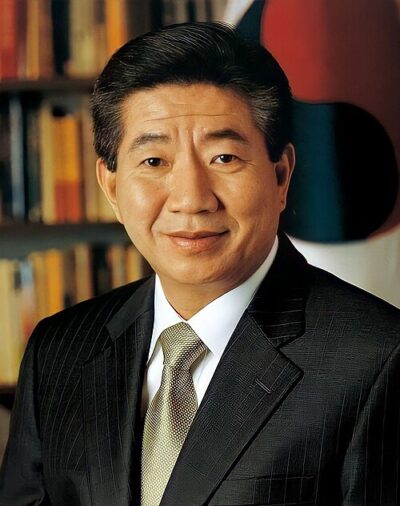
Roh Moo-hyun
Roh Moo-hyun was the 16th President of the Republic of Korea. Born September 1, 1946, in Bongha Village. Died May 23, 2009, in Pusan National University Yangsan Hospital. Positions held include President of South Korea (2003–2008), Member of the National Assembly of South Korea (2 times) (1998–2000) and Minister of Oceans and Fisheries of South Korea (2000–2001). Educated at Jinyeong Daechang Elementary School and Jinyeong Middle School. Awards include Knight Grand Cross of the Order of the Bath, Order of the White Eagle (Third Polish Republic) and Grand Order of Mugunghwa.
Facts
40 facts · 2 confirmed by two sources · 3 cited · 34 from one source · 1 where the sources disagree
What’s different
- Cause of death: we show suicide by jumping from height (Sources disagree). Wikidata also lists cranial trauma
Where this comes from
Papalocal keeps its own record. It started from these sources; what each one said is kept here as it was copied, so a change on their side never changes this page by itself. Tap one to read its version.
What Wikidata says · copied November 16, 2026 · revision 2569093502
- Described as
- 16th President of the Republic of Korea (1946–2009)
- Other names
- Roh Mu-hyeon
- Born
- September 1, 1946
- Died
- May 23, 2009 · 6 references
- Born in
- Bongha Village
- Died in
- Pusan National University Yangsan Hospital
- Buried in
- Bongha Village
- Cause of death
- suicide by jumping from height; cranial trauma
- Citizen of
- First Republic of South Korea; Second Republic of South Korea; Third Republic of South Korea; Fourth Republic of South Korea
- Occupation
- judge; politician · 1 reference; lawyer; farmer; inventor
- Positions held
- President of South Korea (2003–2008); Member of the National Assembly of South Korea (2 times) (1998–2000); Minister of Oceans and Fisheries of South Korea (2000–2001)
- Political party
- Democratic Party; Uri Party
- Education
- Jinyeong Daechang Elementary School; Jinyeong Middle School; Gaesung High School
- Awards
- Knight Grand Cross of the Order of the Bath; Order of the White Eagle (Third Polish Republic) (2004); Grand Order of Mugunghwa; Knight of the Order of the Elephant (2007); Collar of the Spanish Order of the Civil Merit (2007) · 1 reference; National Order of Merit · 1 reference; Order of Independence · 1 reference; Order of the Bath · 1 reference; Order of Civil Merit · 1 reference; Order of the National Flag, 1st class · 1 reference
- Spouse
- Kwon Yang-sook (1972–2009)
- Children
- Roh Geon-ho · 1 reference; Roh Jeongyeon · 1 reference
- Father
- Roh Pan-seok
- Siblings
- Noh Geon-pyeong
- Religion
- Catholicism
- Military branch
- Republic of Korea Army · 1 reference
- Wikipedias with a page
- 86
Wikidata item Q14345 (wikidata.org/wiki/Q14345), public domain (CC0). Copied November 16, 2026.
What Wikipedia says · copied November 16, 2026 · revision 1385008900
Roh Moo-hyun (Korean: 노무현, pronounced [no muçʌn]; 1 September 1946 – 23 May 2009) was a South Korean politician and attorney who served as the ninth President of South Korea from 2003 to 2008.
Roh's pre-presidential political career was focused on human rights advocacy for student activists in South Korea. His electoral career later expanded to a focus on overcoming regionalism in South Korean politics, culminating in his election to the presidency. He achieved a large following among younger internet users, which aided his success in the presidential election. Roh's election was notable for the arrival in power of a new generation of Korean politicians, the so-called 386 Generation (people in their thirties, when the term was coined, who had attended university in the 1980s and who were born in the 1960s). This generation had been veterans of student protests against authoritarian rule and advocated a conciliatory approach towards North Korea, even at the expense of good relations with the United States. Roh himself was the first South Korean president to be born after the end of Japanese rule in Korea.
South Korea received the highest marks on the Reporters Without Borders Press Freedom Index under his administration. The value of the South Korean won against the US dollar was the strongest during his administration since 1997. Due to the strong currency, for the first time in history, South Korea became the world's 10th largest economy and exceeded the $20,000 milestone in nominal GDP per capita during his administration. In 2007, he met with North Korean leader Kim Jong Il in Pyongyang. However, despite high expectations at the beginning of his presidency, Roh encountered strong opposition from both the opposition conservative Grand National Party and media, and he was frequently accused of incompetence. As a result, many of Roh's policies, such as a plan to move the capital of Seoul and a plan to form a coalition with the opposition, made little progress. Because of his poor performance in economy and diplomacy, Roh was not a popular president, having the worst approval rating on average ever recorded in South Korean political history.
After leaving office, Roh returned to his hometown of Bongha Village. He ran a duck farm and lived an ordinary life, sharing it through his blog. He also ran a website called "Democracy 2.0" to promote healthy online discussions. Fourteen months later, Roh was suspected of bribery by prosecutors, and the subsequent investigations attracted public attention. Roh committed suicide on 23 May 2009 when he jumped from a mountain cliff behind his home, after saying that "there are too many people suffering because of me" on a suicide note on his computer. About 4 million people visited Roh's hometown in the week following his death. His suicide was confirmed by police. Prosecutor General Lim Chae-jin resigned due to growing public criticism following Roh's death. Public opinion on Roh has improved considerably since his death, which has taken into account his human rights background and national economic progress during his presidency. In a 2019 Gallup Korea poll, Roh was cited as the most popular president in South Korean history amongst the general public.
- Born, in its opening lines
- September 1, 1946
- Died, in its opening lines
- May 23, 2009
From the Wikipedia article “Roh Moo-hyun” (en.wikipedia.org/wiki/Roh_Moo-hyun), by its contributors, under CC BY-SA 4.0 (creativecommons.org/licenses/by-sa/4.0/). Copied November 16, 2026; not changed.
Confirmed Two sources agree. Cited One source, and it names where it got it. One source One source, without a reference of its own. Sources disagree The sources disagree. We show the best-supported value and keep theirs below.
