
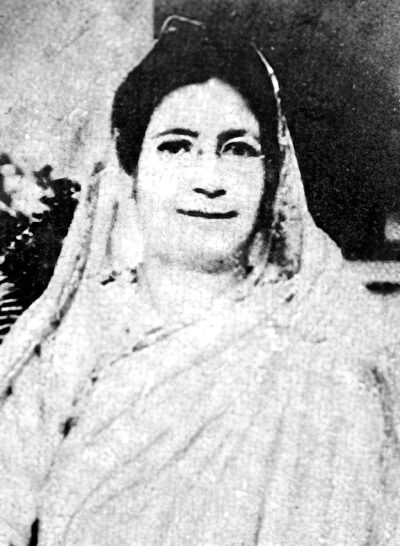
Rokeya Sakhawat Hossain
Rokeya Sakhawat Hossain was a Bengali feminist writer and social reformer. Born December 9, 1880, in Rangpur District. Died December 9, 1932, in Kolkata. Known for Abarodh Basini, Sultana's Dream and Matichur.
Facts
16 facts · 2 confirmed by two sources · 3 cited · 11 from one source
Where this comes from
Papalocal keeps its own record. It started from these sources; what each one said is kept here as it was copied, so a change on their side never changes this page by itself. Tap one to read its version.
What Wikidata says · copied November 16, 2026 · revision 2570028930
- Described as
- Bengali feminist writer and social reformer (1880-1932)
- Other names
- Begum Rokeya, R. S. Hossein, Roquia Sakhawat Hussain, Begama Rokeẏā
- Born
- December 9, 1880 · 4 references
- Died
- December 9, 1932 · 5 references
- Born in
- Rangpur District
- Died in
- Kolkata
- Cause of death
- cardiovascular disease
- Citizen of
- British Raj
- Occupation
- writer · 1 reference; science fiction writer; social reformer · 1 reference; feminist · 1 reference
- Genre
- feminist science fiction
- Known for
- Abarodh Basini; Sultana's Dream; Matichur
- Siblings
- Karimunnesa Khanam Chaudhurani
- Religion
- Islam
- Wikipedias with a page
- 46
Wikidata item Q467083 (wikidata.org/wiki/Q467083), public domain (CC0). Copied November 16, 2026.
What Wikipedia says · copied November 16, 2026 · revision 1383230230
Rokeya Sakhawat Hossain (9 December 1880 – 9 December 1932), commonly known as Begum Rokeya, was a prominent Bengali feminist thinker, writer, educator and political activist from British India. She is widely regarded as a pioneer of feminism in Bangladesh and India.
She advocated for men and women to be treated equally as rational beings, noting that the lack of education for women was responsible for their inferior economic position. Her major works include Matichur (A String of Sweet Pearls, 1904 and 1922), a two-volume collection of essays articulating her feminist ideas; Sultana's Dream (1905), a feminist science fiction novella set in Ladyland, a realm governed by women; Padmarag (Essence of the Lotus, 1924), portraying the struggles of Bengali wives; and Abarodhbasini (The Confined Women, 1931), a bold critique of the extreme purdah system that imperiled women's freedom and self-worth.
Rokeya held education to be the central precondition of women's liberation, establishing the first school aimed primarily at Muslim girls in Kolkata. She is said to have gone from house to house persuading the parents to send their girls to her school in Nisha. Until her death, she ran the school despite facing hostile criticism and social obstacles.
In 1916, she founded the Muslim Women's Association, an organization that fought for women's education and employment. In 1926, Rokeya presided over the Bengal Women's Education Conference convened in Kolkata, the first significant attempt to bring women together in support of women's education rights. She was engaged in debates and conferences regarding the advancement of women until her death on 9 December 1932, shortly after presiding over a session during the Indian Women's Conference.
Bangladesh observes Rokeya Day on 9 December every year to commemorate her works and legacy. On that day, the Bangladesh government also confers the Begum Rokeya Padak on individual women for their exceptional achievement. In 2004, Rokeya was ranked number 6 in the BBC's poll of the Greatest Bengali of all time.
- Born, in its opening lines
- December 9, 1880
- Died, in its opening lines
- December 9, 1932
From the Wikipedia article “Begum Rokeya” (en.wikipedia.org/wiki/Begum_Rokeya), by its contributors, under CC BY-SA 4.0 (creativecommons.org/licenses/by-sa/4.0/). Copied November 16, 2026; not changed.
Confirmed Two sources agree. Cited One source, and it names where it got it. One source One source, without a reference of its own. Sources disagree The sources disagree. We show the best-supported value and keep theirs below.
