
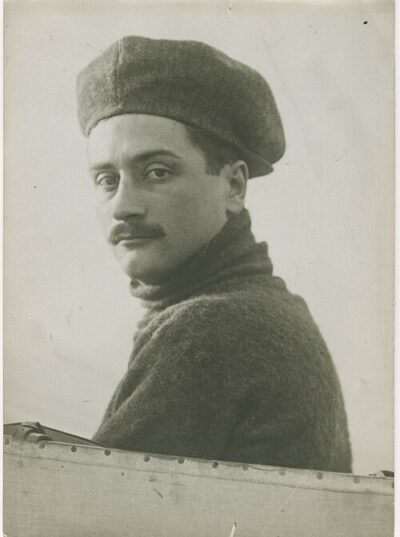
Roland Garros
Roland Garros was a Reunionese aviator. Born October 6, 1888, in Saint-Denis. Died October 5, 1918, in Vouziers. Educated at HEC Paris and Collège Stanislas de Paris. Awards include Officer of the Legion of Honour, mort pour la France and Grande médaille de l'Aéro-Club de France.
Facts
21 facts · 2 confirmed by two sources · 4 cited · 15 from one source
Where this comes from
Papalocal keeps its own record. It started from these sources; what each one said is kept here as it was copied, so a change on their side never changes this page by itself. Tap one to read its version.
What Wikidata says · copied November 16, 2026 · revision 2564096533
- Described as
- Reunionese aviator
- Other names
- Eugène Adrien Roland Georges Garros, Roland Georges Garros
- Born
- October 6, 1888 · 6 references
- Died
- October 5, 1918 · 6 references
- Born in
- Saint-Denis · 1 reference
- Died in
- Vouziers · 2 references
- Buried in
- Vouziers
- Name at birth
- Eugène Adrien Roland Chacon Georges Garros · 1 reference
- Citizen of
- France
- Occupation
- aircraft pilot; rugby union player; military personnel · 1 reference
- Education
- HEC Paris; Collège Stanislas de Paris; Lycée Janson-de-Sailly · 1 reference
- Member of
- Académie de l'île de La Réunion (1913–1918) · 1 reference; HEC Alumni
- Sport
- tennis
- Awards
- Officer of the Legion of Honour; mort pour la France; Grande médaille de l'Aéro-Club de France
- Military branch
- French Armed Forces · 1 reference
- Military rank
- lieutenant · 1 reference
- Wikipedias with a page
- 51
Wikidata item Q207709 (wikidata.org/wiki/Q207709), public domain (CC0). Copied November 16, 2026.
What Wikipedia says · copied November 16, 2026 · revision 1381088687
Eugène Adrien Roland Georges Garros (French: [ʁɔlɑ̃ ɡaʁos]; 6 October 1888 – 5 October 1918) was a French aviation pioneer and fighter pilot. A self-taught pilot, he performed many early aviation feats such as the first-ever airplane crossing of the Mediterranean Sea in 1913. He later joined the French Army and became one of the earliest fighter pilots during First World War.
Born in Saint-Denis, Réunion, Garros developed an interest in aviation from a young age. He began his career in 1909, flying a Santos-Dumont Demoiselle, and gained his licence a year later. Following successful performances in several air races and multiple altitude records, Garros achieved international fame in 1913 for making the first non-stop flight across the Mediterranean Sea, from southern France to Tunisia in a Morane-Saulnier G.
Garros enlisted as a reconnaissance pilot in the French Army on the outbreak of the First World War. He helped develop the first forward-firing machine gun mounted on a combat aircraft, with which he shot down his first German aircraft in early April 1915. In mid-April, after two more air victories, Garros' plane came down behind German lines due to engine trouble, and he spent nearly three years as a prisoner of war. He escaped captivity in early 1918 and rejoined the French Army, but was shot down and killed in the Ardennes later that year.
In 1928, the Roland Garros tennis stadium in Paris opened and was named in Garros' memory. The French Open, held in the stadium, officially takes his name.
- Born, in its opening lines
- October 6, 1888
- Died, in its opening lines
- October 5, 1918
From the Wikipedia article “Roland Garros (aviator)” (en.wikipedia.org/wiki/Roland_Garros_(aviator)), by its contributors, under CC BY-SA 4.0 (creativecommons.org/licenses/by-sa/4.0/). Copied November 16, 2026; not changed.
Confirmed Two sources agree. Cited One source, and it names where it got it. One source One source, without a reference of its own. Sources disagree The sources disagree. We show the best-supported value and keep theirs below.
