
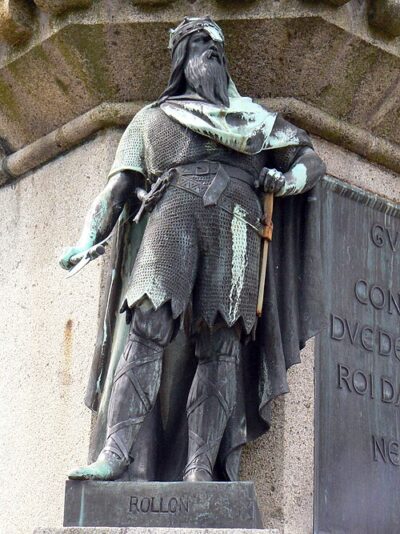
Rollo
Rollo was the 10th-century Viking and Count of Rouen. Born 860, in Norway. Died 932, in Normandy. Positions held include Duke of Normandy (911–927).
Facts
27 facts · 0 confirmed by two sources · 14 cited · 11 from one source · 2 where the sources disagree
What’s different
- Born: we show 860 (Sources disagree). Wikipedia says 870
- Died: we show 932 (Sources disagree). Wikipedia says 933
Where this comes from
Papalocal keeps its own record. It started from these sources; what each one said is kept here as it was copied, so a change on their side never changes this page by itself. Tap one to read its version.
What Wikidata says · copied November 16, 2026 · revision 2558229779
- Described as
- 10th-century Viking and Count of Rouen
- Other names
- Rolf the Ganger, Göngu Hrólfr, Rollo, Count of Rouen, Hrolf, Robert I, Ganger-Hrólf, Hrólfr, Rollo, Duke of Normandy, Ganger-Hrolf
- Born
- 860 · 1 reference
- Died
- 932 · 2 references
- Born in
- Norway · 2 references
- Died in
- Normandy
- Buried in
- Rouen Cathedral
- Occupation
- mercenary; feudatory
- Positions held
- Duke of Normandy (911–927)
- Spouse
- Poppa of Bayeux (886–) · 2 references; Gisela of France (912–) · 1 reference; wife of Rollo · 1 reference
- Children
- William Longsword · 1 reference; Gerloc · 1 reference; unknown (?) · 1 reference; Robert of Corbeil · 1 reference; Crespina de Normandie · 1 reference; Gerletta de Normandie · 1 reference; Kathlin de Normandie · 1 reference
- Father
- Rǫgnvaldr Eysteinsson · 2 references
- Mother
- Hildr Hrólfsdóttir · 2 references
- Siblings
- Hallað Rǫgnvaldsson · 1 reference; Þórir þegjandi Rǫgnvaldsson · 1 reference; Torf-Einarr · 1 reference; Ívarr Rǫgnvaldsson · 2 references; Hrollaugr Rǫgnvaldsson · 1 reference
- Religion
- Old Norse religion; Catholicism (912–)
- Wikipedias with a page
- 54
Wikidata item Q273773 (wikidata.org/wiki/Q273773), public domain (CC0). Copied November 16, 2026.
What Wikipedia says · copied November 16, 2026 · revision 1384843241
Rollo (Norman: Rou, Rolloun; Old Norse: Hrólfr; French: Rollon; c. 835/870 – 933) was a Viking who, as Count of Rouen, became the first ruler of Normandy, a region in today's northern France. He emerged as a war leader among the Norsemen who had secured a permanent foothold on Frankish soil in the valley of the lower Seine. He was a prominent figure among the Vikings who besieged Paris in 885 and led the ill-fated Siege of Chartres in 911. The latter was nonetheless the catalyst for the consequential Treaty of Saint-Clair-sur-Epte, which saw Charles the Simple, king of West Francia, grant Rollo lands between the river Epte and the sea in exchange for Rollo agreeing to end his brigandage, swear allegiance to Charles, convert to Christianity, and pledge to defend the Seine estuary from other Viking raiders.
Rollo's life was recorded by Dudo of St. Quentin. Historians such as W. Vogel, Alexander Bugge, and Henri Prentout have debated whether Dudo's account is historically accurate, and Rollo's origin and life are heavily disputed. Rollo is usually identified with Hrólfr "the Walker" in Norwegian and Icelandic historiography.
Rollo is first recorded in a charter of 918 as the leader of a group of Viking settlers, and he reigned over the region of Normandy until at least 928. He was succeeded as ruler of the new Duchy of Normandy by his son William Longsword. The offspring of Rollo and his followers, through their intermingling with the local Frankish and Gallo-Roman population, became known as the "Normans". After the Norman conquest of England and of southern Italy and Sicily over the following two centuries, their descendants came to rule England, much of Ireland, Sicily and Antioch from the 11th to 13th centuries, leaving behind an enduring legacy in the histories of Europe and the Near East.
- Born, in its opening lines
- 870
- Died, in its opening lines
- 933
From the Wikipedia article “Rollo” (en.wikipedia.org/wiki/Rollo), by its contributors, under CC BY-SA 4.0 (creativecommons.org/licenses/by-sa/4.0/). Copied November 16, 2026; not changed.
Confirmed Two sources agree. Cited One source, and it names where it got it. One source One source, without a reference of its own. Sources disagree The sources disagree. We show the best-supported value and keep theirs below.
