
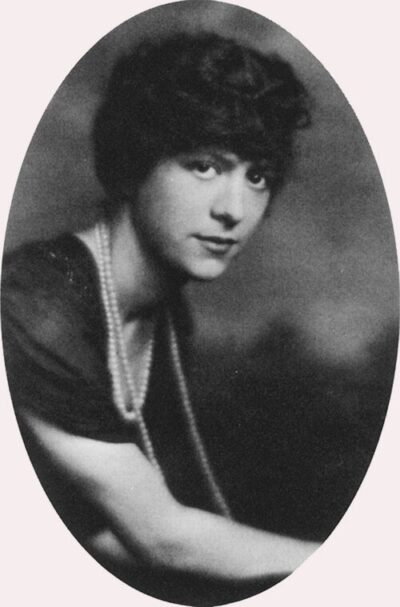
Romaine Brooks
Romaine Brooks was an American artist. Born May 1, 1874, in Rome. Died December 7, 1970, in Nice. Known for Portrait of Natalie Clifford Barney and Madame Gaston Legrand au champ de courses. Educated at Académie Colarossi and Doane Academy. Awards include Knight of the Legion of Honour.
Facts
27 facts · 2 confirmed by two sources · 12 cited · 13 from one source
Where this comes from
Papalocal keeps its own record. It started from these sources; what each one said is kept here as it was copied, so a change on their side never changes this page by itself. Tap one to read its version.
What Wikidata says · copied November 15, 2026 · revision 2561795529
- Described as
- American artist (1874-1970)
- Other names
- Romaine, Romaine Goddard-Brooks, Beatrice Romaine Goddard
- Born
- May 1, 1874 · 7 references
- Died
- December 7, 1970 · 5 references
- Born in
- Rome · 3 references
- Died in
- Nice · 2 references
- Buried in
- Russian Orthodox Cemetery in Nice
- Name at birth
- Beatrice Romaine Goddard
- Citizen of
- Italy (1946–); United States; Kingdom of Italy (–1946)
- Occupation
- painter · 3 references; sculptor; architectural drafter · 1 reference; artist · 4 references
- Education
- Académie Colarossi; Doane Academy · 1 reference
- Genre
- portrait; portrait painting · 1 reference
- Known for
- Portrait of Natalie Clifford Barney; Madame Gaston Legrand au champ de courses
- Awards
- Knight of the Legion of Honour
- Field
- painting · 1 reference; portrait painting · 1 reference; portrait · 1 reference; art of drawing · 1 reference
- Spouse
- John Ellingham Brooks · 1 reference
- Father
- Maj. Henry Seaman Goddard · 1 reference
- Mother
- Ella Waterman · 1 reference
- Wikipedias with a page
- 29
Wikidata item Q466607 (wikidata.org/wiki/Q466607), public domain (CC0). Copied November 15, 2026.
What Wikipedia says · copied November 15, 2026 · revision 1384412320
Romaine Brooks (born Beatrice Romaine Goddard; May 1, 1874 – December 7, 1970) was an American painter who worked mostly in Paris and Capri. She specialized in portraiture and used a subdued tonal palette keyed to the color gray. Brooks ignored contemporary artistic trends such as Cubism and Fauvism, drawing on her own original aesthetic inspired by the works of Charles Conder, Walter Sickert, and James McNeill Whistler. Her subjects ranged from anonymous models to titled aristocrats. She is best known for her images of women in androgynous or masculine dress, including her self-portrait of 1923, which is her most widely reproduced work.
Although her family was wealthy, Brooks had an unhappy childhood after her alcoholic father abandoned the family; her mother was emotionally abusive and her brother mentally ill. By her own account, her childhood cast a shadow over her whole life. She spent several years in Italy and France as a poor art student, then inherited a fortune upon her mother's death in 1902. Wealth gave her the freedom to choose her own subjects. She often painted people close to her, such as the Italian writer and politician Gabriele D'Annunzio, the Russian dancer Ida Rubinstein, and her partner of more than 50 years, the writer Natalie Barney.
Although she lived until 1970, it is erroneously believed that she painted very little after 1925 despite evidence to the contrary. She made a series of drawings during the 1930s, using an "unpremeditated" techniques predating automatic drawing. She spent time in New York City in the mid 1930s, completing portraits of Carl Van Vechten and Muriel Draper. Many of her works are unaccounted for, but photographic reproductions attest to her ongoing artwork. It is thought to have culminated in her 1961 portrait of Duke Uberto Strozzi.
- Born, in its opening lines
- May 1, 1874
- Died, in its opening lines
- December 7, 1970
From the Wikipedia article “Romaine Brooks” (en.wikipedia.org/wiki/Romaine_Brooks), by its contributors, under CC BY-SA 4.0 (creativecommons.org/licenses/by-sa/4.0/). Copied November 15, 2026; not changed.
Confirmed Two sources agree. Cited One source, and it names where it got it. One source One source, without a reference of its own. Sources disagree The sources disagree. We show the best-supported value and keep theirs below.
