
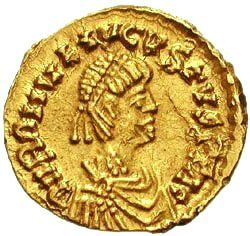
Romulus Augustus
Romulus Augustus was a last emperor of the Western Roman Empire. Born 462, in Pannonia. Died 510s. Positions held include Western Roman emperor (475–476).
Facts
8 facts · 0 confirmed by two sources · 0 cited · 6 from one source · 2 where the sources disagree
What’s different
- Born: we show 462 (Sources disagree). Wikipedia says 460
- Died: we show 510s (Sources disagree). Wikidata also lists 530s
Where this comes from
Papalocal keeps its own record. It started from these sources; what each one said is kept here as it was copied, so a change on their side never changes this page by itself. Tap one to read its version.
What Wikidata says · copied November 16, 2026 · revision 2569170524
- Described as
- last emperor of the Western Roman Empire (475–476)
- Other names
- Romulus Augustulus, Flavius Romulus
- Born
- 462
- Died
- 510s; 530s
- Born in
- Pannonia · 1 reference
- Citizen of
- Western Roman Empire
- Occupation
- emperor
- Positions held
- Western Roman emperor (475–476)
- Father
- Orestes
- Religion
- Christianity · 1 reference
- Wikipedias with a page
- 86
Wikidata item Q130601 (wikidata.org/wiki/Q130601), public domain (CC0). Copied November 16, 2026.
What Wikipedia says · copied November 16, 2026 · revision 1380310254
Romulus Augustus (c. 460–465 – c. 511–530), nicknamed Augustulus, was Roman emperor of the West from 31 October 475 until 4 September 476. Romulus was placed on the imperial throne while still a minor by his father Orestes, the magister militum, for whom he served as little more than a figurehead. After a rule of ten months, the barbarian general Odoacer defeated and killed Orestes and deposed Romulus. As Odoacer did not proclaim any successor, Romulus is typically regarded as the last Western Roman emperor, his deposition marking the end of the Western Roman Empire as a political entity. The deposition of Romulus Augustulus is also sometimes used by historians to mark the transition from antiquity to the medieval period.
Very few records survive of Romulus's reign. There are no known policies, laws or inscriptions of significance of the emperor, which leaves the impression that he was a shadowy and relatively inconsequential figure. The nickname "Augustulus" means "little Augustus" and was a derisive reference to his young age. Romulus's immediate family, including his father and possibly his mother, and maybe both his paternal and maternal grandparents, were from the Roman province of Pannonia, and many of his family members had military backgrounds.
Romulus came to power through the usurpation of his predecessor Julius Nepos (r. 474–475 in Italy) in 475. Nepos fled to Dalmatia and continued to claim the imperial title in exile, which hampered Romulus's legitimacy and ensured that he was never recognised by the Eastern Roman emperor Zeno. In 476, the allied barbarian foederati in Italy demanded Italian lands to settle on, which was refused by Orestes. Under Odoacer, the foederati defeated and killed Orestes and deposed Romulus, whereafter Odoacer became the first King of Italy and accepted Emperor Zeno as his nominal superior.
Romulus's life was spared by Odoacer, and he was allowed to retire to the castellum Lucullanum, a great fortress in Campania. Little certain information is known concerning Romulus's life in exile. He might have played a role in founding a monastery at castellum Lucullanum in the 480s or 490s, dedicated to Saint Severinus of Noricum. Romulus could have been alive as late as 507 or 511 when Theodoric the Great, Odoacer's successor, wrote a letter to a "Romulus" concerning a pension, but was likely dead before his mid-40s, as accounts of the eastern Roman invasion of Italy at that time do not mention him.
- Born, in its opening lines
- 460
- Died, in its opening lines
- 465
From the Wikipedia article “Romulus Augustulus” (en.wikipedia.org/wiki/Romulus_Augustulus), by its contributors, under CC BY-SA 4.0 (creativecommons.org/licenses/by-sa/4.0/). Copied November 16, 2026; not changed.
Confirmed Two sources agree. Cited One source, and it names where it got it. One source One source, without a reference of its own. Sources disagree The sources disagree. We show the best-supported value and keep theirs below.
