
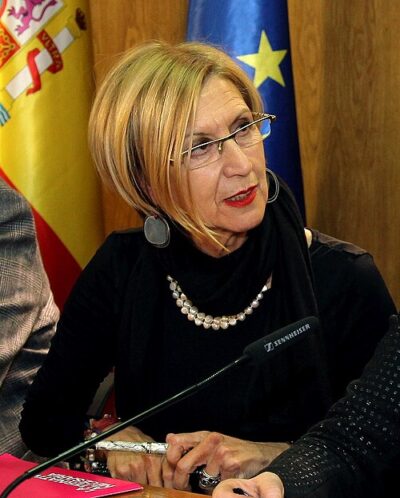
Rosa Díez
Rosa Díez is a Spanish politician. Born May 27, 1952, in Güeñes. Positions held include Member of the Congress of Deputies (2008–2016), deputy of the Basque Parliament (2 times) (1987–1999) and Member of the European Parliament (1999–2007). Awards include medal of the Order of Constitutional Merit.
Facts
22 facts · 1 confirmed by two sources · 8 cited · 13 from one source
Where this comes from
Papalocal keeps its own record. It started from these sources; what each one said is kept here as it was copied, so a change on their side never changes this page by itself. Tap one to read its version.
What Wikidata says · copied November 18, 2026 · revision 2565735749
- Described as
- Spanish politician
- Other names
- Rosa Diez
- Born
- May 27, 1952
- Born in
- Güeñes
- Citizen of
- Spain
- Occupation
- politician (1977–) · 3 references; writer (2006–); civil servant (1973–2016) · 1 reference
- Positions held
- Member of the Congress of Deputies (2008–2016) · 1 reference; deputy of the Basque Parliament (2 times) (1987–1999); Member of the European Parliament (1999–2007) · 1 reference; Porte-parole d'Union, progrès et démocratie (2007–2015)
- Political party
- Spanish Socialist Workers' Party (1977–2007); Union, Progress and Democracy (2007–2016) · 2 references
- Worked for
- Dun & Bradstreet (1970–1973)
- Member of
- Socialist Party of the Basque Country – Basque Country Left (1993–2007); Euskadiko Alderdi Sozialista (1977–1993); Unión General de Trabajadores (1976–2007) · 1 reference; ¡Basta Ya! (1999–2007)
- Awards
- medal of the Order of Constitutional Merit (2003) · 1 reference
- Spouse
- José Ignacio Fernández de Ochoa (1974–) · 1 reference
- Father
- Heraclio Díez Rozas
- Mother
- María González Pérez
- Religion
- agnosticism · 1 reference
- Wikipedias with a page
- 22
Wikidata item Q255666 (wikidata.org/wiki/Q255666), public domain (CC0). Copied November 18, 2026.
What Wikipedia says · copied November 18, 2026 · revision 1347289670
Rosa María Díez González (born 27 May 1952) is a Spanish politician from Union, Progress and Democracy, UPyD deputy in the Congress of Deputies from 2008 to 2016.
During her time in the PSOE, she defined herself exclusively as a social democrat. In her 2000 manifesto for the post of Secretary-General at the 35th Federal Congress of the Socialist Party, she argued that the PSOE should be a clearly social democratic party representing and integrating a broad sociological spectrum. That spectrum would have gone "from the centre to the political left—that is, from liberalism with a greater emphasis on social conscience to classical social democracy". She also asserted that "egalitarian doctrines can only flourish in a free society, meaning they're incompatible with authoritarianism and systems that deny the free market". This was consistent with her evolution in claiming to belong to both social democracy and political liberalism when she was UPyD's leader and spokesperson. Consequently, Rosa Díez now self-defines as a social liberal—or an unorthodox social democrat—politician who endorses free-market economics, civil liberties, and the welfare state, albeit still maintaining an essentially social democratic conviction. It's also noteworthy that she shifted from defending regional autonomism during most of her socialist period to advocating centralism. This divergence regarding the form of state, as well as her rejection of the anti-terrorist policy implemented by José Luis Rodríguez Zapatero's socialist government, was the main reason for her departure from the PSOE. Although she had previously identified as a republican during her time in both the PSOE and UPyD, she eventually declared herself a monarchist person "in self-defence". In addition, Rosa Díez is a secularist politician who stands up for secularity as "respect for all religious beliefs, except for Islam and any other religion that isn't respectful of human rights". She also professes herself to be a constitutionalist, feminist, pro-European, progressive, reformist, Spanish patriot, and upholder of liberal democracy.
While remaining firmly centre-left during her career as a socialist, Rosa Díez self-identifies with transversality as well as centre-left since she created UPyD. Therefore, she vehemently defends what she deems progressive from anywhere on the left–right political spectrum. She also asseverates that centrism is worthless, as it just represents a moderate, equidistant position between the left and right. Furthermore, she describes herself as a "radical democrat who strives for democracy's regeneration by abiding by its rules". Expressed differently, she defines herself as "a pro-institutional leader whose radical politics—moderate in form and revolutionary in essence—bothers the establishment", for she wants to "transform politics by bringing off substantial, in-depth changes from within institutions". Due to her self-proclaimed radicalism and transversality, Rosa Díez is frequently associated with radical centrism.
Unlike Citizens' "sensible and moderate centrism", characterised by a fear of being perceived as right-wing, her radical centrist views have not prevented her from supporting an electoral coalition between the People's Party, Vox, and Citizens. Indeed, she urged people to vote for the centre-right PP in the November 2019 Spanish general election. Even more notably, she lent her support to the two no-confidence motions against Pedro Sánchez that were proposed by the right-wing national-conservative party Vox during the 14th legislature.
- Born, in its opening lines
- May 27, 1952
From the Wikipedia article “Rosa Díez” (en.wikipedia.org/wiki/Rosa_Díez), by its contributors, under CC BY-SA 4.0 (creativecommons.org/licenses/by-sa/4.0/). Copied November 18, 2026; not changed.
Confirmed Two sources agree. Cited One source, and it names where it got it. One source One source, without a reference of its own. Sources disagree The sources disagree. We show the best-supported value and keep theirs below.
