
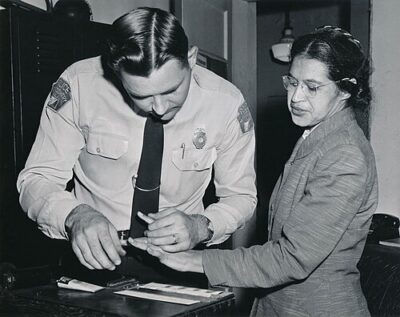
Rosa Parks
Rosa Parks was a civil rights activist. Born February 4, 1913, in Tuskegee. Died October 24, 2005, in Detroit. Educated at Alabama State University. Awards include National Women's Hall of Fame, Michigan Women's Hall of Fame and Alabama Women's Hall of Fame.
Facts
35 facts · 2 confirmed by two sources · 16 cited · 17 from one source
Where this comes from
Papalocal keeps its own record. It started from these sources; what each one said is kept here as it was copied, so a change on their side never changes this page by itself. Tap one to read its version.
What Wikidata says · copied November 13, 2026 · revision 2568702818
- Described as
- civil rights activist
- Other names
- Rosa Louise McCauley, Rosa Louise McCauley Parks, Rosa "Lee" Louise McCauley Parks, Rosa McCauley Parks, Rosa McCauley
- Born
- February 4, 1913 · 10 references
- Died
- October 24, 2005 · 10 references
- Born in
- Tuskegee · 5 references
- Died in
- Detroit · 3 references
- Buried in
- Woodlawn Cemetery · 2 references
- Name at birth
- Rosa Louise McCauley
- Citizen of
- United States · 1 reference
- Occupation
- autobiographer; human rights defender · 1 reference; civil rights advocate · 1 reference; public figure · 1 reference; political activist · 1 reference
- Education
- Alabama State University
- Member of
- Alpha Kappa Alpha; civil rights movement
- Awards
- National Women's Hall of Fame (1993) · 1 reference; Michigan Women's Hall of Fame (1983) · 1 reference; Alabama Women's Hall of Fame (2008) · 1 reference; Candace Award (1984); Congressional Gold Medal (1999); Presidential Medal of Freedom (1996) · 1 reference; Spingarn Medal (1979) · 1 reference; Golden Plate Award (1995); International Freedom Conductor Award (198); Women's Caucus for Art Lifetime Achievement Award (1981); NAACP Image Award for Outstanding Supporting Actress in a Drama Series (2000); Ellis Island Medal of Honor · 1 reference
- Field
- civil rights movement · 1 reference; civil and political rights · 1 reference; racial segregation · 1 reference; activism · 1 reference; civil rights · 1 reference
- Spouse
- Raymond Parks · 1 reference
- Religion
- United Methodist Church
- Lived in
- Detroit (–2005)
- Wikipedias with a page
- 131
Wikidata item Q41921 (wikidata.org/wiki/Q41921), public domain (CC0). Copied November 13, 2026.
What Wikipedia says · copied November 13, 2026 · revision 1382203518
Rosa Louise McCauley Parks (February 4, 1913 – October 24, 2005) was an American civil rights activist. She is best known for her 1955 refusal to move from her seat on a bus in Montgomery, Alabama, in defiance of Jim Crow racial segregation laws, which sparked the Montgomery bus boycott. She is sometimes known as the "mother of the civil rights movement".
Born in Tuskegee, Alabama, Parks grew up under Jim Crow segregation. She later moved to Montgomery and joined the city's chapter of the National Association for the Advancement of Colored People (NAACP) in 1943, serving as the organization's secretary. Despite policies designed to disenfranchise Black citizens, Parks successfully registered to vote after three separate attempts between 1943 and 1945. She investigated and organized campaigns around cases of racial and sexual violence in her capacity as NAACP secretary, including those of Recy Taylor and Jeremiah Reeves, laying the groundwork for future civil rights campaigns.
Custom in Montgomery required Black passengers to surrender their seats in the front of the bus to accommodate white riders. The rows in the back were designated for Black riders. Before Parks's refusal to move, several Black Montgomerians had refused to do so, including 15-year-old high school student Claudette Colvin, leading to arrests. When Parks was arrested in 1955, local leaders were searching for a person who would be a good legal test case against segregation. She was deemed a suitable candidate, and the Women's Political Council (WPC) organized a one-day bus boycott on the day of her trial. The boycott was widespread. Many Black Montgomerians refused to ride the buses that day. After Parks was found guilty of violating state law, the boycott was extended indefinitely, with the Montgomery Improvement Association (MIA) organizing its own community transportation network to sustain it. Parks and other boycott leaders faced harassment, ostracization, and various legal obstacles. The boycott lasted for 381 days, finally concluding after segregation on buses was deemed unconstitutional in the court case Browder v. Gayle.
After the boycott ended, Parks experienced financial hardship and health problems due, in part, to her participation. In 1957, she relocated to Detroit, Michigan. She continued to advocate for civil rights, supporting people such as John Conyers, Joanne Little, Gary Tyler, Angela Davis, Joe Madison, and Nelson Mandela. She was also a supporter of the Black power movement and an anti-apartheid activist, participating in protests and conferences as part of the Free South Africa Movement. In 1987, she co-founded the Rosa and Raymond Parks Institute for Self Development with Elaine Eason Steele. After Parks's death in 2005, she was honored with public viewings and memorial services in three cities: in Montgomery; in Washington, D.C., where she lay in state at the United States Capitol rotunda; and in Detroit, where she was ultimately interred at Woodlawn Cemetery. Parks received many awards and honors, both throughout her life and posthumously. She received the Presidential Medal of Freedom and a Congressional Gold Medal and was the first Black American to be memorialized in the National Statuary Hall.
- Born, in its opening lines
- February 4, 1913
- Died, in its opening lines
- October 24, 2005
From the Wikipedia article “Rosa Parks” (en.wikipedia.org/wiki/Rosa_Parks), by its contributors, under CC BY-SA 4.0 (creativecommons.org/licenses/by-sa/4.0/). Copied November 13, 2026; not changed.
Confirmed Two sources agree. Cited One source, and it names where it got it. One source One source, without a reference of its own. Sources disagree The sources disagree. We show the best-supported value and keep theirs below.
