
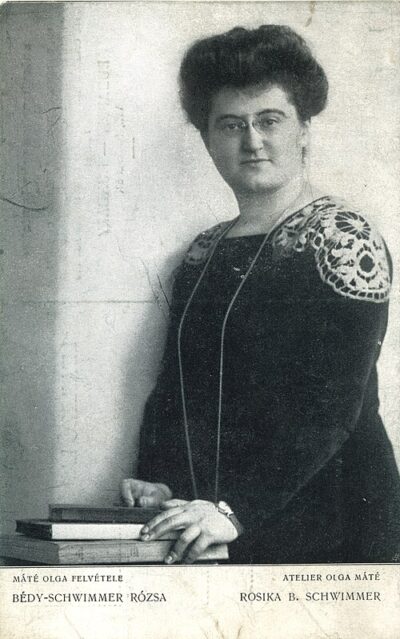
Rosika Schwimmer
Rosika Schwimmer was a Hungarian activist, editor. Born September 11, 1877, in Budapest. Died August 3, 1948, in New York City. Positions held include ambassador of Hungary to Switzerland (1918–1919).
Facts
23 facts · 2 confirmed by two sources · 11 cited · 10 from one source
Where this comes from
Papalocal keeps its own record. It started from these sources; what each one said is kept here as it was copied, so a change on their side never changes this page by itself. Tap one to read its version.
What Wikidata says · copied November 16, 2026 · revision 2558024267
- Described as
- Hungarian activist, editor (1877-1948)
- Other names
- Rózsa Bédy-Schwimmer, Rozsa Bedy-Schwimmer, Rózsa Bédy, Rózsa Schwimmer, Róza Schwimmer, Rózsika Schwimmer, Roza Schwimmer
- Born
- September 11, 1877 · 2 references
- Died
- August 3, 1948 · 2 references
- Born in
- Budapest · 1 reference
- Died in
- New York City · 1 reference
- Buried in
- Ferncliff Cemetery
- Cause of death
- pneumonia
- Citizen of
- Kingdom of Hungary (–1921)
- Occupation
- journalist · 1 reference; non-fiction writer; politician; peace activist; editor · 1 reference; lecturer · 1 reference; suffragist; pacifist · 1 reference
- Positions held
- ambassador of Hungary to Switzerland (1918–1919) · 1 reference
- Member of
- Women's International League for Peace and Freedom; International Committee of Women for Permanent Peace
- Field
- pacifism · 1 reference; feminism · 1 reference; journalism · 1 reference; lectorship · 1 reference
- Religion
- atheism
- Wikipedias with a page
- 38
Wikidata item Q853932 (wikidata.org/wiki/Q853932), public domain (CC0). Copied November 16, 2026.
What Wikipedia says · copied November 16, 2026 · revision 1368044405
Rosika Schwimmer (Hungarian: Schwimmer Rózsa; 11 September 1877 – 3 August 1948) was a Hungarian-born pacifist, feminist, world federalist and women's suffragist. A co-founder of the Campaign for World Government with Lola Maverick Lloyd, her radical vision of world peace led to the creation of several world federalist movements and organizations. Sixty years after she first envisaged it, the movement she helped to create indeed took a leading role in the creation of the International Criminal Court, the first permanent international tribunal tasked with charging individuals with war crimes, crimes against humanity and genocide.
Schwimmer was born into a Jewish family in Budapest in 1877, she graduated from public school in 1891. An accomplished linguist, she spoke or read eight languages. In her early career, she had difficulty finding a job that paid a living wage and was sensitized by that experience to women's employment issues. Gathering data to provide statistics on working women, Schwimmer came into contact with members of the international women's suffrage movement and by 1904 became involved in the struggle. She co-founded the first national women's labor umbrella organization in Hungary and the Hungarian Feminist Association. She also assisted in organizing the Seventh Conference of the International Woman Suffrage Alliance, hosted in Budapest in 1913.
The following year, Schwimmer was hired as a press secretary of the International Woman Suffrage Alliance in London. When World War I broke out, she was branded an enemy alien and left Europe for the United States, where she spoke on suffrage and pacifism. She was one of the founders of the Woman's Peace Party and the organization which would become the Women's International League for Peace and Freedom.
In 1915, after attending the International Congress of Women in The Hague, she worked with other feminists to persuade foreign ministers in Europe to support the creation of a body to peacefully mediate world affairs and was instrumental in convincing Henry Ford to charter the Peace Ship. From 1916 to 1918, Schwimmer lived in Europe working on various plans to end the war. In 1918, with the establishment of the First Hungarian Republic, she was appointed the first woman diplomat, as Hungarian Minister Plenipotentiary to Switzerland. When the Republic was toppled by a coup d'état, she fled to the United States, renouncing her Hungarian citizenship.
Applying for naturalization, Schwimmer was rejected on the basis of her pacifism. The case was overturned on appeal in 1928, and the following year the appeal was overturned by the U.S. Supreme Court in the decision United States v. Schwimmer. For the remainder of her life, she remained stateless. Unable to work because of ill-health and a smear campaign, she was supported by loyal friends.
In 1935, Schwimmer and Mary Ritter Beard established the World Center for Women's Archives to create an educational reference for women's history and document the individual and organizational achievements of influential women. She was one of the first world federalists, proposing a world government in 1937. Nominated for the Nobel Peace Prize in 1948, she died before the committee decided not to award it that year. In 1952, naturalization laws in the United States were changed to allow for conscientious objection.
- Born, in its opening lines
- September 11, 1877
- Died, in its opening lines
- August 3, 1948
From the Wikipedia article “Rosika Schwimmer” (en.wikipedia.org/wiki/Rosika_Schwimmer), by its contributors, under CC BY-SA 4.0 (creativecommons.org/licenses/by-sa/4.0/). Copied November 16, 2026; not changed.
Confirmed Two sources agree. Cited One source, and it names where it got it. One source One source, without a reference of its own. Sources disagree The sources disagree. We show the best-supported value and keep theirs below.
