
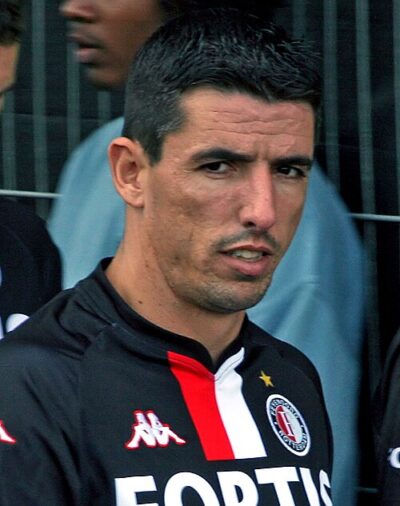
Roy Makaay
Roy Makaay is a Dutch footballer. Born February 24, 1975, in Wijchen. Teams include Feyenoord Rotterdam (2007–2010), FC Bayern Munich (2003–2007) and Deportivo de A Coruña (1999–2003). Awards include European Golden Shoe.
Facts
19 facts · 0 confirmed by two sources · 1 cited · 17 from one source · 1 where the sources disagree
What’s different
- Born: we show February 24, 1975 (Sources disagree). Wikipedia says March 9, 1975
Where this comes from
Papalocal keeps its own record. It started from these sources; what each one said is kept here as it was copied, so a change on their side never changes this page by itself. Tap one to read its version.
What Wikidata says · copied November 16, 2026 · revision 2555067949
- Described as
- Dutch footballer (born 1975)
- Other names
- Roy Rudolphus Antonius Makaay
- Born
- February 24, 1975 · 2 references
- Born in
- Wijchen
- Name at birth
- Roy Rudolphus Antonius Makaay · 1 reference
- Citizen of
- Kingdom of the Netherlands
- Occupation
- association football player; association football coach
- Teams
- Feyenoord Rotterdam (2007–2010); FC Bayern Munich (2003–2007); Deportivo de A Coruña (1999–2003); SBV Vitesse (1993–1997); C.D. Tenerife (1997–1999); Netherlands national association football team (1996–2005); Netherlands Olympic football team (2008); Netherlands national under-21 football team (1993–1996)
- Sport
- association football
- Awards
- European Golden Shoe (2003)
- Siblings
- Erik Makaay
- Height
- 1.88 m (6 ft 2 in)
- Website
- http://www.roymakaay.com/
- Wikipedias with a page
- 47
Wikidata item Q152725 (wikidata.org/wiki/Q152725), public domain (CC0). Copied November 16, 2026.
What Wikipedia says · copied November 16, 2026 · revision 1385595650
Roy Rudolphus Antonius Makaay (born 9 March 1975) is a Dutch professional football coach and former player. As a forward, he was known for his goal-scoring ability as a result of his "aerial prowess and quick drives to the net where he can put the ball away with either foot."
He began his career at Vitesse and Tenerife before moving to Deportivo de La Coruña in 1999 and helping the side to their first La Liga title in his first season there. He also won the Copa del Rey in 2002 and the following season was given the European Golden Boot for a 29-goal haul. He remains the club's all-time leading goalscorer. He then moved to Bayern Munich for a then club record €18.75 million, where he picked up the nickname Das Phantom (The Phantom), for his ability to score out of nowhere, as well as Tormaschine (goal machine), for his consistent ability to find the back of the net. After winning two consecutive Bundesliga and DFB-Pokal doubles at Bayern, he returned to the Netherlands with Feyenoord in 2007.
A full international from 1996 to 2005, Makaay scored six international goals in 43 matches, despite competition for a place in the national team. He competed with the Dutch side at two UEFA European Championships and the 2008 Olympics.
- Born, in its opening lines
- March 9, 1975
From the Wikipedia article “Roy Makaay” (en.wikipedia.org/wiki/Roy_Makaay), by its contributors, under CC BY-SA 4.0 (creativecommons.org/licenses/by-sa/4.0/). Copied November 16, 2026; not changed.
Confirmed Two sources agree. Cited One source, and it names where it got it. One source One source, without a reference of its own. Sources disagree The sources disagree. We show the best-supported value and keep theirs below.
