
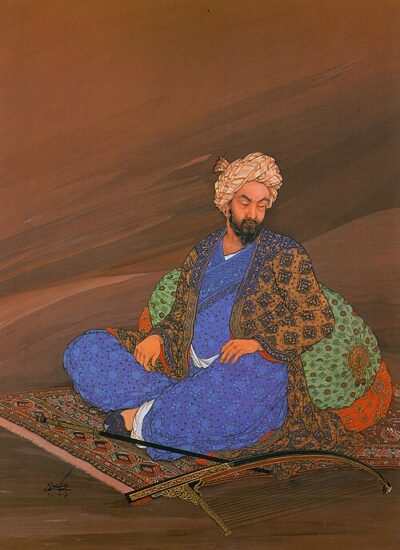
Rudaki
Rudaki was a Persian poet, the father of Persian poetry. Born 859, in Panjrūd. Died 941, in Panjrūd.
Facts
10 facts · 0 confirmed by two sources · 4 cited · 4 from one source · 2 where the sources disagree
What’s different
- Born: we show 859 (Sources disagree). Wikipedia says 858
- Died: we show 941 (Sources disagree). Wikipedia says 940
Where this comes from
Papalocal keeps its own record. It started from these sources; what each one said is kept here as it was copied, so a change on their side never changes this page by itself. Tap one to read its version.
What Wikidata says · copied November 16, 2026 · revision 2565600684
- Described as
- Persian poet, the father of Persian poetry
- Other names
- Abu Abdallah Rudaki, Rūdakī
- Born
- 859 · 1 reference
- Died
- 941 · 2 references
- Born in
- Panjrūd · 1 reference
- Died in
- Panjrūd · 1 reference
- Citizen of
- Samanid Empire · 1 reference
- Occupation
- poet; writer · 1 reference
- Genre
- ruba'i · 1 reference; Qasida · 1 reference; ghazal · 1 reference
- Wikipedias with a page
- 71
Wikidata item Q312954 (wikidata.org/wiki/Q312954), public domain (CC0). Copied November 16, 2026.
What Wikipedia says · copied November 16, 2026 · revision 1375393287
Rudaki (also spelled Rodaki; Persian: رودکی; c. 858 – 940/41) was a poet, singer, and musician who is regarded as the first major poet to write in New Persian. A court poet under the Samanids, he reportedly composed more than 180,000 verses, yet only a small portion of his work has survived, most notably parts of his versification of the Kalīla wa-Dimna, an Arabic translation of Panchatantra.
Born in the village of Panjrud near Samarqand, the most important part of Rudaki's career was spent at the court of the Samanids, in Bukhara. While biographical information connects him to the Samanid amir (ruler) Nasr II (r. 914–943), he may have already joined the court under the latter's predecessor, Ahmad Samani (r. 907–914).
Rudaki's success was largely due to the support of his primary patron, the vizier Abu'l-Fadl al-Bal'ami (died 940), who played an important role in the blooming of New Persian literature in the 10th-century. Following the downfall of Bal'ami in 937, Rudaki's career deteriorated, eventually being dismissed from the court. He thereafter lived his last years in poverty, dying blind and alone in his hometown.
In Iran, Rudaki is acknowledged as the "founder of New Persian poetry" and in Tajikistan as the "father of Tajik literature".
- Born, in its opening lines
- 858
- Died, in its opening lines
- 940
From the Wikipedia article “Rudaki” (en.wikipedia.org/wiki/Rudaki), by its contributors, under CC BY-SA 4.0 (creativecommons.org/licenses/by-sa/4.0/). Copied November 16, 2026; not changed.
Confirmed Two sources agree. Cited One source, and it names where it got it. One source One source, without a reference of its own. Sources disagree The sources disagree. We show the best-supported value and keep theirs below.
