
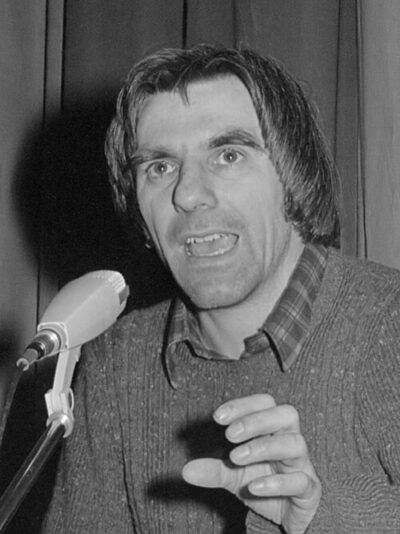
Rudi Dutschke
Rudi Dutschke was a German student activist. Born March 7, 1940, in Schönefeld. Died December 24, 1979, in Aarhus. Educated at Askanian Gymnasium and Freie Universität Berlin.
Facts
29 facts · 2 confirmed by two sources · 11 cited · 16 from one source
Where this comes from
Papalocal keeps its own record. It started from these sources; what each one said is kept here as it was copied, so a change on their side never changes this page by itself. Tap one to read its version.
What Wikidata says · copied November 16, 2026 · revision 2570010736
- Described as
- German student activist (1940–1979)
- Other names
- Alfred Willi Rudi Dutschke, Alfred Willi Rudolf Dutschke
- Born
- March 7, 1940 · 10 references
- Died
- December 24, 1979 · 9 references
- Born in
- Schönefeld · 1 reference
- Died in
- Aarhus · 2 references
- Buried in
- St. Annen-Kirchhof
- Cause of death
- drowning
- Name at birth
- Alfred Willi Rudolf Dutschke
- Citizen of
- Nazi Germany; West Germany · 1 reference; Germany · 1 reference
- Occupation
- sociologist · 1 reference; politician; writer · 2 references; journalist · 2 references; industrial management assistant · 1 reference
- Political party
- Bremen Green List (1979–)
- Worked for
- Aarhus University
- Education
- Askanian Gymnasium; Freie Universität Berlin; Clare Hall
- Member of
- Sozialistischer Deutscher Studentenbund (1964–); Außerparlamentarische Opposition
- Spouse
- Gretchen Dutschke-Klotz (1966–) · 2 references
- Children
- Hosea Dutschke · 3 references; Polly-Nicole Dutschke; Rudi-Marek Dutschke · 1 reference
- Father
- Alfred Dutschke
- Mother
- Elsbeth Dutschke
- Religion
- Lutheranism
- Wikipedias with a page
- 37
Wikidata item Q57218 (wikidata.org/wiki/Q57218), public domain (CC0). Copied November 16, 2026.
What Wikipedia says · copied November 16, 2026 · revision 1386073929
Alfred Willi Rudolf Dutschke (German: [ˈʁuːdi ˈdʊtʃkə]; 7 March 1940 – 24 December 1979) was a German sociologist and political activist who, until severely injured by an assassin in 1968, was a leading charismatic figure within both the Sozialistischer Deutscher Studentenbund (Socialist Students Union) in West Germany and that country's broader Außerparlamentarische Opposition ("extra-parliamentary opposition").
Dutschke claimed both Christian and Marxist inspiration for a socialism that rejected both the Leninist model of party dictatorship that he had experienced as a youth in Communist East Germany, and the compromises of West German social democracy. He advocated the creation of alternative or parallel social, economic and political institutions structured on the principles of direct democracy. At the same time, he joined Moscow- and Beijing-oriented communists in hailing Third World national liberation struggles as fronts in a socialist world revolution.
Controversially for many of those who had protested with him in the 1960s, Dutschke in the 1970s styled himself a patriotic socialist ("Pro Patria Sozi"), and called on the left to re-engage the "national question" and seek a bloc-free path to German reunification.
Shortly before his death in 1979 from complications arising from his injuries in 1968, Dutschke was elected as a delegate to the founding congress of the environmentalist and social-justice Greens. It was a project then understood as the creation of an "anti-party party", engaging with parliamentary politics but remaining a grass-roots movement.
- Born, in its opening lines
- March 7, 1940
- Died, in its opening lines
- December 24, 1979
From the Wikipedia article “Rudi Dutschke” (en.wikipedia.org/wiki/Rudi_Dutschke), by its contributors, under CC BY-SA 4.0 (creativecommons.org/licenses/by-sa/4.0/). Copied November 16, 2026; not changed.
Confirmed Two sources agree. Cited One source, and it names where it got it. One source One source, without a reference of its own. Sources disagree The sources disagree. We show the best-supported value and keep theirs below.
