
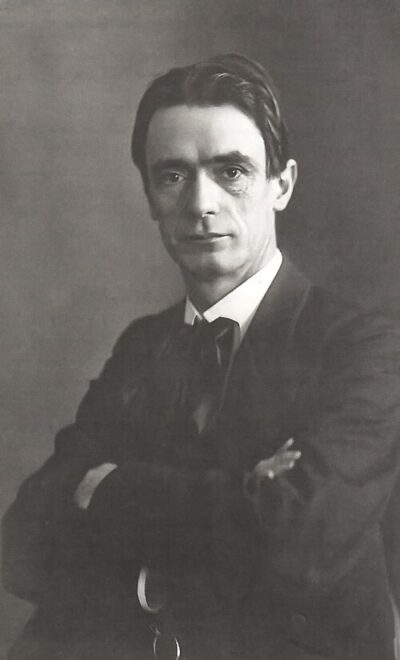
Rudolf Steiner
Rudolf Steiner was an Austrian social reformer, occultist and esotericist. Born February 27, 1861, in Donji Kraljevec. Died March 30, 1925, in Dornach. Educated at TU Wien and University of Rostock. Awards include Subba Row Medal.
Facts
33 facts · 1 confirmed by two sources · 15 cited · 16 from one source · 1 where the sources disagree
What’s different
- Born: we show February 27, 1861 (Sources disagree). Wikipedia says February 25, 1861
Where this comes from
Papalocal keeps its own record. It started from these sources; what each one said is kept here as it was copied, so a change on their side never changes this page by itself. Tap one to read its version.
What Wikidata says · copied November 16, 2026 · revision 2565963331
- Described as
- Austrian social reformer, occultist and esotericist (1861–1925)
- Other names
- Rudolf Joseph Lorenz Steiner
- Born
- February 27, 1861 · 6 references
- Died
- March 30, 1925 · 19 references
- Born in
- Donji Kraljevec · 1 reference
- Died in
- Dornach · 6 references
- Buried in
- Dornach
- Name at birth
- Rudolf Joseph Lorenz Steiner
- Citizen of
- Austrian Empire; Switzerland · 1 reference; Austria · 2 references; Croatia · 1 reference
- Occupation
- occultist · 1 reference; writer · 1 reference; poet; musicologist · 1 reference; choreographer · 1 reference; literary critic · 1 reference; autobiographer · 1 reference; philosopher · 2 references
- Worked for
- Goethe and Schiller Archives
- Education
- TU Wien; University of Rostock
- Awards
- Subba Row Medal (1909) · 1 reference
- Field
- alternative medicine; metaphysics; occultism; Theosophy; Christianity; philosophy · 1 reference
- Spouse
- Marie Steiner-von Sivers · 1 reference; Anna Steiner · 1 reference
- Religion
- anthroposophy · 1 reference; Catholicism · 1 reference
- Lived in
- Austria–Hungary · 1 reference
- Wikipedias with a page
- 86
Wikidata item Q78484 (wikidata.org/wiki/Q78484), public domain (CC0). Copied November 16, 2026.
What Wikipedia says · copied November 16, 2026 · revision 1385649614
Rudolf Joseph Lorenz Steiner (German: [ˈʃtaɪnɐ]; 27 or 25 February 1861 – 30 March 1925) was an Austrian New Age guru, philosopher, occultist, social reformer, architect, esotericist, and claimed clairvoyant and speaker with the dead. Steiner gained initial recognition at the end of the nineteenth century as a literary critic and published works including The Philosophy of Freedom. At the beginning of the twentieth century he founded an esoteric spiritual movement, anthroposophy, with roots in German idealist philosophy and theosophy. His teachings are influenced by (Christian) Gnosticism or neognosticism. Many of his ideas are pseudoscientific. He was also prone to pseudohistory.
In the first, more philosophically oriented phase of this movement, Steiner attempted to find a synthesis between science and spirituality by developing what he termed "spiritual science", in which he sought to apply the clarity of thinking characteristic of Western philosophy to spiritual questions, intending to differentiate his approach from what he considered to be vaguer approaches to mysticism. In a second phase, beginning around 1907, he began working collaboratively in a variety of artistic media, including drama, dance and architecture, culminating in the building of the Goetheanum, a cultural centre to house all the arts. In the third phase of his work, beginning after World War I, Steiner worked on various ostensibly applied projects, including Waldorf education, biodynamic agriculture, and anthroposophical medicine.
Steiner advocated what has been described as ethical individualism, to which he later brought a more explicitly spiritual approach. He based his epistemology on Johann Wolfgang von Goethe's world view in which "thinking...is no more and no less an organ of perception than the eye or ear. Just as the eye perceives colours and the ear sounds, so thinking perceives ideas." A consistent thread that runs through his work is the goal of demonstrating that there are no limits to human knowledge.
- Born, in its opening lines
- February 25, 1861
- Died, in its opening lines
- March 30, 1925
From the Wikipedia article “Rudolf Steiner” (en.wikipedia.org/wiki/Rudolf_Steiner), by its contributors, under CC BY-SA 4.0 (creativecommons.org/licenses/by-sa/4.0/). Copied November 16, 2026; not changed.
Confirmed Two sources agree. Cited One source, and it names where it got it. One source One source, without a reference of its own. Sources disagree The sources disagree. We show the best-supported value and keep theirs below.
