
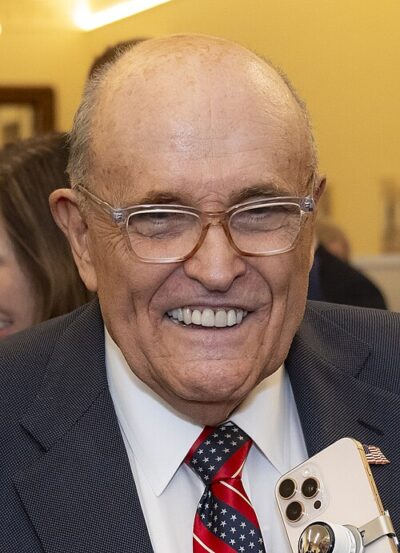
Rudy Giuliani
Rudy Giuliani is an American attorney and politician. Born May 28, 1944, in Brooklyn. Positions held include Mayor of New York City (1994–2001), United States Attorney for the Southern District of New York (1983–1989) and United States Associate Attorney General (1981–1983). Educated at Manhattan University and New York University School of Law. Awards include Knight Commander of the Order of the British Empire, Ronald Reagan Freedom Award and Golden Plate Award.
Facts
42 facts · 1 confirmed by two sources · 10 cited · 31 from one source
Where this comes from
Papalocal keeps its own record. It started from these sources; what each one said is kept here as it was copied, so a change on their side never changes this page by itself. Tap one to read its version.
What Wikidata says · copied November 13, 2026 · revision 2558231265
- Described as
- American attorney and politician (born 1944)
- Other names
- Rudolph William Louis Giuliani, Rudolph Giuliani
- Born
- May 28, 1944 · 4 references
- Born in
- Brooklyn · 1 reference
- Name at birth
- Rudolph William Louis Giuliani
- Citizen of
- United States
- Occupation
- lawyer; politician · 2 references; writer; entrepreneur; jurist · 1 reference; mayor · 1 reference; businessperson · 1 reference; prosecutor · 1 reference
- Positions held
- Mayor of New York City (1994–2001); United States Attorney for the Southern District of New York (1983–1989); United States Associate Attorney General (1981–1983)
- Political party
- Republican Party · 1 reference
- Education
- Manhattan University; New York University School of Law; Bishop Loughlin Memorial High School · 1 reference; New York University · 1 reference
- Awards
- Knight Commander of the Order of the British Empire; Ronald Reagan Freedom Award; Golden Plate Award; Knight Grand Cross of the Order of Merit of the Italian Republic; Doublespeak Award (2018); Richard A. Cook Gold Medal (1998) · 1 reference; Time Person of the Year (2001); German Media Award; Bambi Award (2001); honorary doctorate (2003–2022) · 1 reference; honorary doctor of Syracuse University; Christopher Award; Medal of Heroism (2002); Ellis Island Medal of Honor; honorary doctor of the University of Łódź (2010) · 1 reference
- Spouse
- Judith Giuliani (2003–2019); Donna Hanover (1984–2002); Regina Peruggi (1968–1982)
- Children
- Andrew Giuliani; Caroline Giuliani
- Mother
- Helen Giuliani
- Lived in
- Palm Beach · 1 reference
- Wikipedias with a page
- 68
Wikidata item Q212648 (wikidata.org/wiki/Q212648), public domain (CC0). Copied November 13, 2026.
What Wikipedia says · copied November 13, 2026 · revision 1385299532
Rudolph William Louis Giuliani (, Italian: [dʒuˈljaːni]; born May 28, 1944) is an American politician and disbarred lawyer who served as the 108th mayor of New York City from 1994 to 2001. He previously served as the U.S. Associate Attorney General from 1981 to 1983 and the U.S. Attorney for the Southern District of New York from 1983 to 1989. Giuliani led the 1980s federal prosecution of New York City mafia bosses as U.S. attorney for the Southern District of New York. After a failed campaign for mayor of New York City in the 1989 election, he succeeded in 1993, and was reelected in 1997, campaigning on a "tough on crime" platform. He led New York's controversial "civic cleanup" from 1994 to 2001, and appointed William Bratton as New York City's new police commissioner. In 2000, he ran against First Lady Hillary Clinton for a U.S. Senate seat from New York, but left the race once diagnosed with prostate cancer. For his mayoral leadership following the September 11 attacks in 2001, he was called "America's mayor" and was named Time Person of the Year for 2001.
In 2002, Giuliani founded a security consulting business, Giuliani Partners, and acquired, but later sold, an investment banking firm, Giuliani Capital Advisors. In 2005, he joined a law firm, renamed Bracewell & Giuliani. Vying for the Republican Party's 2008 presidential nomination, Giuliani was an early frontrunner, yet did poorly in the primary election; he later withdrew and endorsed the party's subsequent nominee, John McCain. After declining to run for New York governor in 2010 and for the Republican presidential nomination in 2012, Giuliani turned his focus to his business firms. After advising Donald Trump during his 2016 presidential campaign and early administration, Giuliani joined President Trump's personal legal team in April 2018, remaining on it during the 2020 presidential election. His activities as Trump's attorney led to allegations that he engaged in corruption and profiteering. In 2019, Giuliani was a central figure in the Trump–Ukraine scandal.
Following the 2020 election, Giuliani represented Trump in many lawsuits filed in attempts to overturn the election results, making false and debunked allegations about rigged voting machines, polling place fraud, and an international communist conspiracy. Giuliani spoke at the rally preceding the January 6 United States Capitol attack, where he made false claims of voter fraud and called for "trial by combat". He was later also listed as an unindicted co-conspirator in the federal prosecution of Trump's alleged attempts to overturn the election. In August 2023, he was indicted in the prosecution related to the 2020 election in Georgia. Later in 2023, Giuliani lost a $148-million defamation lawsuit for his false claims about two election workers in Georgia, and unsuccessfully attempted to declare bankruptcy; he later reached a settlement to pay damages awarded to the election workers. In April 2024, he was indicted on charges related to the 2020 election in Arizona. He was disbarred in the state of New York in July and in the District of Columbia in September. In November 2025, Trump issued a federal pardon to Giuliani.
- Born, in its opening lines
- May 28, 1944
From the Wikipedia article “Rudy Giuliani” (en.wikipedia.org/wiki/Rudy_Giuliani), by its contributors, under CC BY-SA 4.0 (creativecommons.org/licenses/by-sa/4.0/). Copied November 13, 2026; not changed.
Confirmed Two sources agree. Cited One source, and it names where it got it. One source One source, without a reference of its own. Sources disagree The sources disagree. We show the best-supported value and keep theirs below.
