
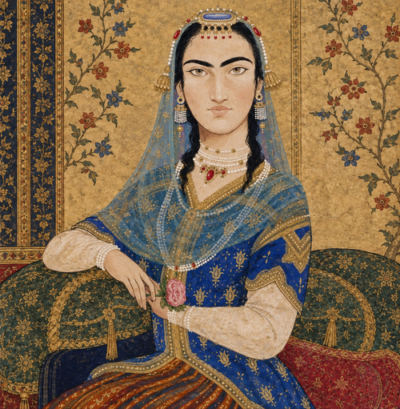
Ruqaiya Sultan Begum was an Empress consort of the Mughal Empire. Born 1542. Died January 19, 1626, in Agra.
Facts
8 facts · 2 confirmed by two sources · 0 cited · 6 from one source
Where this comes from
Papalocal keeps its own record. It started from these sources; what each one said is kept here as it was copied, so a change on their side never changes this page by itself. Tap one to read its version.
What Wikidata says · copied November 18, 2026 · revision 2567954223
- Described as
- Empress consort of the Mughal Empire
- Born
- 1542
- Died
- January 19, 1626
- Died in
- Agra
- Buried in
- Gardens of Babur
- Citizen of
- Mughal Empire
- Spouse
- Akbar
- Father
- Mirza Hindal
- Religion
- Islam
- Wikipedias with a page
- 21
Wikidata item Q7380456 (wikidata.org/wiki/Q7380456), public domain (CC0). Copied November 18, 2026.
What Wikipedia says · copied November 18, 2026 · revision 1375897139
Ruqaiya Sultan Begum (alternatively spelled Ruqayya or Ruqayyah; c. 1542 – January 1626) was the first and chief wife of the third Mughal emperor, Akbar. She was one of the longest-serving Mughal empress consorts for nearly fifty years. However, she never held the title of Padshah Begum. During Akbar's reign, the title was instead held by his mother, Hamida Banu Begum (titled Mariam Makani), until her death in 1604.
Ruqaiya was a first cousin of her husband and was a Mughal princess by birth. Her father, Hindal Mirza, was the youngest brother of Akbar's father, Humayun. She was betrothed to Akbar at the age of nine and married him at 14, but remained childless throughout her marriage. In later years, she raised Akbar and Mariam-uz-Zamani’s grandson, Khurram (the future emperor Shah Jahan).
- Born, in its opening lines
- c. 1542
- Died, in its opening lines
- January 1626
From the Wikipedia article “Ruqaiya Sultan Begum” (en.wikipedia.org/wiki/Ruqaiya_Sultan_Begum), by its contributors, under CC BY-SA 4.0 (creativecommons.org/licenses/by-sa/4.0/). Copied November 18, 2026; not changed.
Confirmed Two sources agree. Cited One source, and it names where it got it. One source One source, without a reference of its own. Sources disagree The sources disagree. We show the best-supported value and keep theirs below.
