
Ruth Asawa
Ruth Asawa was a Japanese American sculptor. Born January 24, 1926, in Norwalk. Died August 6, 2013, in San Francisco. Educated at Black Mountain College and University of Wisconsin–Milwaukee. Awards include Women's Caucus for Art Lifetime Achievement Award.
Facts
17 facts · 1 confirmed by two sources · 9 cited · 6 from one source · 1 where the sources disagree
What’s different
- Died: we show August 6, 2013 (Sources disagree). Wikipedia says August 5, 2013
Where this comes from
Papalocal keeps its own record. It started from these sources; what each one said is kept here as it was copied, so a change on their side never changes this page by itself. Tap one to read its version.
What Wikidata says · copied November 15, 2026 · revision 2563821923
- Described as
- Japanese American sculptor (1926–2013)
- Other names
- Ruth Aiko Asawa, Ruth Asawa Lanier, Ruth Aiko {Lanier} Asawa, Asawa, Ruth, 1926-2013
- Born
- January 24, 1926 · 5 references
- Died
- August 6, 2013 · 2 references
- Born in
- Norwalk · 3 references
- Died in
- San Francisco · 3 references
- Citizen of
- United States · 1 reference
- Occupation
- sculptor · 2 references; lithographer · 2 references; textile artist; object artist · 1 reference
- Education
- Black Mountain College (1946–1949) · 2 references; University of Wisconsin–Milwaukee; Wisconsin State College of Milwaukee
- Genre
- public art · 2 references; abstract art · 1 reference
- Awards
- Women's Caucus for Art Lifetime Achievement Award (1993)
- Field
- art of sculpture · 1 reference
- Website
- https://ruthasawa.com/
- Wikipedias with a page
- 24
Wikidata item Q7382874 (wikidata.org/wiki/Q7382874), public domain (CC0). Copied November 15, 2026.
What Wikipedia says · copied November 15, 2026 · revision 1384413943
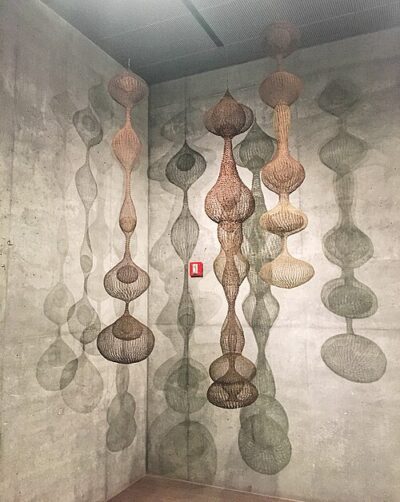
Ruth Aiko Asawa (Japanese: 浅和 愛子, Hepburn: Asawa Aiko; January 24, 1926 – August 5, 2013) was an American modernist artist primarily known for her abstract looped-wire sculptures inspired by natural and organic forms. In addition to her three-dimensional work, Asawa created figurative and abstract drawings and prints influenced by nature, particularly flowers and plants.
Born in Norwalk, California in 1926 to Japanese immigrant parents, Asawa was the fourth of seven children and grew up on a truck farm. In 1942, her family was sent to different Japanese internment camps as a result of U.S. isolation policies during World War II. At the Rohwer War Relocation Center, Asawa learned to draw from animators who previously worked at Walt Disney Studios interned there. In 1943, she was able to leave the camp to attend Milwaukee State Teachers College on scholarship. Hoping to become a teacher, Asawa was ultimately unable to, as her Japanese ancestry prevented her from obtaining a teaching position in Wisconsin.
In 1945, Ruth and her older sister traveled outside of the U.S. to study in Mexico. She was taken by the colors and arts there. It was during her second trip to Mexico in 1947 that she learned the knitted-wire loop technique from a Mexican teacher, which she used to make the sculptures for which she is most famous
Eventually in 1946, Asawa joined the avant-garde artistic community at Black Mountain College, where she studied under German-American Bauhaus painter and color theorist Josef Albers, as well as the American architect and designer Buckminster Fuller. At Black Mountain College, Asawa began making looped-wire sculptures inspired by the basket crocheting technique she learned on a 1947 trip to Mexico. In 1955, she held her first exhibition in New York. By the early 1960s, Asawa had achieved commercial and critical success and became an advocate for public art, saying, "art for everyone." Asawa was the driving force behind the creation of the San Francisco School of the Arts, which was renamed the Ruth Asawa San Francisco School of the Arts in 2010.
Her work is featured in collections at the Solomon R. Guggenheim Museum and the Whitney Museum of American Art in New York City. Fifteen of Asawa's wire sculptures are on permanent display in the tower of San Francisco's de Young Museum in Golden Gate Park, and several of her fountains are located in public places in San Francisco. In 2019, Asawa and her work was the subject of the Google Doodle celebrating Asian American Pacific Islander Month in the U.S. In 2020, the U.S. Postal Service honored her work by producing a series of ten stamps that commemorate her well-known wire sculptures.
- Born, in its opening lines
- January 24, 1926
- Died, in its opening lines
- August 5, 2013
From the Wikipedia article “Ruth Asawa” (en.wikipedia.org/wiki/Ruth_Asawa), by its contributors, under CC BY-SA 4.0 (creativecommons.org/licenses/by-sa/4.0/). Copied November 15, 2026; not changed.
Confirmed Two sources agree. Cited One source, and it names where it got it. One source One source, without a reference of its own. Sources disagree The sources disagree. We show the best-supported value and keep theirs below.
