
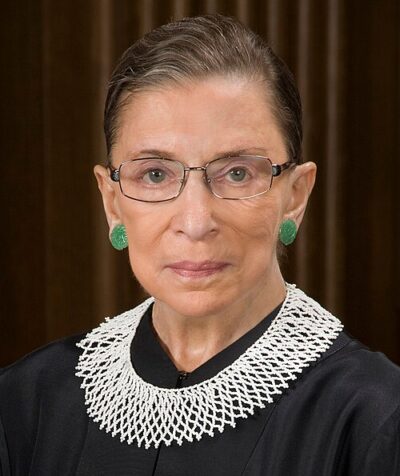
Ruth Bader Ginsburg
Ruth Bader Ginsburg was an American lawyer and jurist. Born March 15, 1933, in Brooklyn. Died September 18, 2020, in Washington, D.C.. Positions held include Associate Justice of the Supreme Court of the United States (1993–2020) and Judge of the United States Court of Appeals for the D.C. Circuit (1980–1993). Educated at Cornell University and Harvard Law School. Awards include Brandeis Medal, National Women's Hall of Fame and honorary doctor of the Ohio State University.
Facts
47 facts · 2 confirmed by two sources · 23 cited · 22 from one source
Where this comes from
Papalocal keeps its own record. It started from these sources; what each one said is kept here as it was copied, so a change on their side never changes this page by itself. Tap one to read its version.
What Wikipedia says · copied November 13, 2026 · revision 1383880792
Joan Ruth Bader Ginsburg ( BAY-dər GHINZ-burg; née Bader; March 15, 1933 – September 18, 2020) was an American lawyer and jurist who served as an associate justice of the Supreme Court of the United States from 1993 until her death in 2020. She was nominated by President Bill Clinton to replace retiring justice Byron White, and at the time was viewed as a moderate consensus-builder. Ginsburg was the first Jewish woman and the second woman to serve on the Court, after Sandra Day O'Connor. During her tenure, Ginsburg authored the majority opinions in cases such as United States v. Virginia (1996), Olmstead v. L.C. (1999), Friends of the Earth, Inc. v. Laidlaw Environmental Services, Inc. (2000), and City of Sherrill v. Oneida Indian Nation of New York (2005). Later in her tenure, Ginsburg received attention for passionate dissents that reflected liberal views of the law.
Ginsburg was born and grew up in Brooklyn, New York. Just over a year later her older sister and only sibling, Marilyn, died of meningitis at the age of six. Her mother died shortly before she graduated from high school. She earned her bachelor's degree at Cornell University and married Martin D. Ginsburg, becoming a mother before starting law school at Harvard, where she was one of the few women in her class. Ginsburg transferred to Columbia Law School, where she graduated joint first in her class. During the early 1960s she worked with the Columbia Law School Project on International Procedure, learned Swedish, and co-authored a book with Swedish jurist Anders Bruzelius; her work in Sweden profoundly influenced her thinking on gender equality. She then became a professor at Rutgers Law School and Columbia Law School, teaching civil procedure as one of the few women in her field and the first female member of the law faculty at Columbia to attain tenure.
Ginsburg spent much of her legal career as an advocate for gender equality and women's rights, winning many arguments before the Supreme Court. She advocated as a volunteer attorney for the American Civil Liberties Union and was a member of its board of directors and one of its general counsel in the 1970s. In 1980, President Jimmy Carter appointed her to the U.S. Court of Appeals for the District of Columbia Circuit, where she served until her appointment to the Supreme Court in 1993. Between O'Connor's retirement in 2006 and the appointment of Sonia Sotomayor in 2009, she was the only female justice on the Supreme Court. During that time, Ginsburg became more forceful with her dissents, such as with Ledbetter v. Goodyear Tire & Rubber Co. (2007).
Despite two bouts with cancer and public pleas from liberal law scholars, she decided not to retire in 2013 or 2014 when President Barack Obama and a Democratic-controlled Senate could appoint and confirm her successor. Ginsburg died at her home in Washington, D.C., on September 18, 2020, at the age of 87, from complications of metastatic pancreatic cancer. The vacancy created by her death was filled 39 days later by Amy Coney Barrett. The result was one of three major rightward shifts in the Court since 1953, following the appointment of Clarence Thomas to replace Thurgood Marshall in 1991 and the appointment of Warren Burger to replace Earl Warren in 1969.
- Born, in its opening lines
- March 15, 1933
- Died, in its opening lines
- September 18, 2020
From the Wikipedia article “Ruth Bader Ginsburg” (en.wikipedia.org/wiki/Ruth_Bader_Ginsburg), by its contributors, under CC BY-SA 4.0 (creativecommons.org/licenses/by-sa/4.0/). Copied November 13, 2026; not changed.
What Wikidata says · copied November 14, 2026 · revision 2569081318
- Described as
- American lawyer and jurist (1933–2020)
- Other names
- Joan Ruth Biggie, Ruth Joan Biggie Ginsburg, Joan Ruth Biggie Ginsburg, Joan Ruth Bader Ginsburg, Notorious RBG, RBG, Joan Ruth Bader, Ruth Bader, notorious rbg
- Born
- March 15, 1933 · 4 references
- Died
- September 18, 2020 · 3 references
- Born in
- Brooklyn · 2 references
- Died in
- Washington, D.C. · 2 references
- Buried in
- Arlington National Cemetery
- Cause of death
- pancreatic cancer · 1 reference
- Name at birth
- Joan Ruth Bader
- Citizen of
- United States
- Occupation
- judge; lawyer; jurist · 1 reference; Member of the Constitutional Court of Austria · 1 reference
- Positions held
- Associate Justice of the Supreme Court of the United States (1993–2020) · 1 reference; Judge of the United States Court of Appeals for the D.C. Circuit (1980–1993)
- Worked for
- Rutgers University; Columbia University; Federal Government of the United States
- Education
- Cornell University; Harvard Law School; Columbia Law School; James Madison High School · 1 reference
- Member of
- American Academy of Arts and Sciences · 1 reference
- Awards
- Brandeis Medal (2003) · 2 references; National Women's Hall of Fame (2002) · 1 reference; honorary doctor of the Ohio State University (2009) · 1 reference; Fellow of the American Academy of Arts and Sciences; honorary doctor of Harvard University (2011) · 1 reference; Forbes list of The World's 100 Most Powerful Women (2004); Time 100 (2015) · 1 reference; honorary doctorate from Princeton University (2010) · 1 reference; Four Freedoms Award – Freedom Medal (2015); Jefferson Awards for Public Service (2011); Golden Plate Award (1995); Genesis Prize (2018); Margaret Brent Award (1993) · 1 reference; Berggruen Prize (2019); honorary doctorate of Lund University (1969) · 2 references
- Field
- law · 1 reference; women's rights · 1 reference; gender equality · 1 reference; gender · 1 reference; court · 1 reference; supreme court · 1 reference
- Spouse
- Martin D. Ginsburg (1954–2010) · 1 reference
- Children
- Jane C. Ginsburg · 1 reference; James Steven Ginsburg
- Religion
- Judaism
- Wikipedias with a page
- 89
Wikidata item Q11116 (wikidata.org/wiki/Q11116), public domain (CC0). Copied November 14, 2026.
Confirmed Two sources agree. Cited One source, and it names where it got it. One source One source, without a reference of its own. Sources disagree The sources disagree. We show the best-supported value and keep theirs below.
