
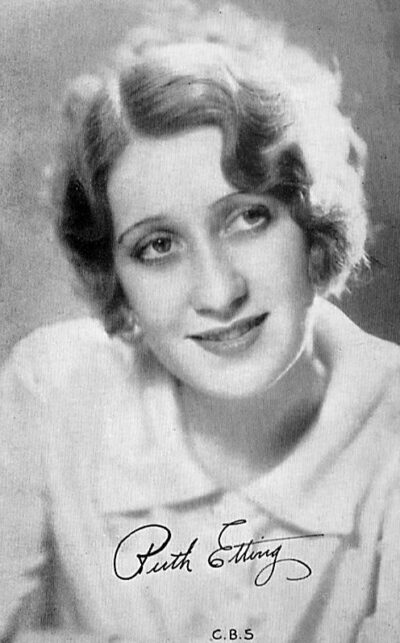
Ruth Etting
Ruth Etting was an American singer, vaudevillian, musical theatre performer and film actress. Born November 23, 1896, in David City. Died September 24, 1978, in Colorado Springs. Awards include star on Hollywood Walk of Fame.
Facts
16 facts · 2 confirmed by two sources · 4 cited · 10 from one source
What’s different
- Born: we show November 23, 1896 (Confirmed). Wikidata also lists November 23, 1897
Where this comes from
Papalocal keeps its own record. It started from these sources; what each one said is kept here as it was copied, so a change on their side never changes this page by itself. Tap one to read its version.
What Wikidata says · copied November 16, 2026 · revision 2567015659
- Described as
- American singer, vaudevillian, musical theatre performer and film actress (1897–1978)
- Born
- November 23, 1897 · 1 reference; November 23, 1896 · 1 reference
- Died
- September 24, 1978
- Born in
- David City
- Died in
- Colorado Springs · 1 reference
- Buried in
- Shrine of Remembrance Mausoleum · 1 reference
- Cause of death
- disease
- Citizen of
- United States
- Occupation
- singer; stage actor; film actor; Ziegfeld girl; actor · 1 reference; musician · 1 reference
- Instrument
- voice
- Awards
- star on Hollywood Walk of Fame · 1 reference
- Website
- http://www.ruthetting.com
- Wikipedias with a page
- 20
Wikidata item Q456051 (wikidata.org/wiki/Q456051), public domain (CC0). Copied November 16, 2026.
What Wikipedia says · copied November 16, 2026 · revision 1372995307
Ruth Etting (November 23, 1896 – September 24, 1978) was an American singer and actress during the 1920s and 1930s, who had over 60 hit recordings and worked in stage, radio, and film. Known as "America's sweetheart of song", her signature tunes were "Shine On, Harvest Moon", "Ten Cents a Dance" and "Love Me or Leave Me".
As a young girl in Nebraska, Etting had wanted to become an artist; she drew and sketched all the time. At sixteen, her grandparents decided to send her to art school in Chicago. While Etting attended class, she found a job at the Marigold Gardens nightclub. After a short time there, Etting gave up art classes in favor of a career in show business. Etting, who enjoyed singing in school and church, never took any formal singing lessons. She quickly became a featured vocalist at the club. Etting was then managed by Moe Snyder, whom she married in 1922. Snyder was known for being very protective of Ruth, keeping her out of trouble in the dangerous city and referring to her as "the little lady", along with other affectionate names. He made arrangements for Etting's recording and film contracts as well as her personal and radio appearances. She became nationally known when she appeared in Flo Ziegfeld's Follies of 1927.
Etting intended to retire from performing in 1935, but that did not happen until after a messy divorce from Snyder in 1937. Harry Myrl Alderman, Etting's pianist, was separated from his wife when he and Etting began a relationship. Snyder began making telephone threats to Etting in January 1938. In October, Snyder traveled to Los Angeles and detained Alderman as he was leaving a local radio station. At gunpoint, he forced the pianist to take him to Etting's home, saying he intended to kill Etting, Alderman, and his own daughter, Edith Snyder, who worked for Etting. Snyder shot Alderman, who survived. Three days later, Alderman's wife filed suit against Etting for alienation of affection.
While Alderman and Etting claimed to have been married in Mexico in July 1938, Alderman's divorce would not be finalized until December of that year. The couple married during Moe Snyder's trial for attempted murder in December 1938. Etting and Alderman relocated to a farm outside of Colorado Springs, Colorado, where they kept out of the spotlight except for occasional public appearances and interviews. Her fictionalized story was told in the musical film Love Me Or Leave Me (1955) with Doris Day as Ruth Etting and James Cagney as Moe Snyder.
- Born, in its opening lines
- November 23, 1896
- Died, in its opening lines
- September 24, 1978
From the Wikipedia article “Ruth Etting” (en.wikipedia.org/wiki/Ruth_Etting), by its contributors, under CC BY-SA 4.0 (creativecommons.org/licenses/by-sa/4.0/). Copied November 16, 2026; not changed.
Confirmed Two sources agree. Cited One source, and it names where it got it. One source One source, without a reference of its own. Sources disagree The sources disagree. We show the best-supported value and keep theirs below.
