
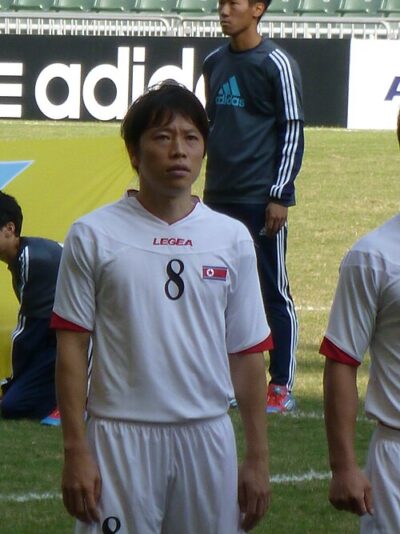
Ryang Yong-gi
Ryang Yong-gi is a North Korean association football player. Born January 7, 1982, in Osaka. Teams include Vegalta Sendai (2004–) and North Korea men's national football team (2008–). Educated at Hannan University.
Facts
9 facts · 1 confirmed by two sources · 0 cited · 8 from one source
Where this comes from
Papalocal keeps its own record. It started from these sources; what each one said is kept here as it was copied, so a change on their side never changes this page by itself. Tap one to read its version.
What Wikidata says · copied November 17, 2026 · revision 2546278036
- Described as
- North Korean association football player
- Born
- January 7, 1982 · 1 reference
- Born in
- Osaka
- Citizen of
- North Korea
- Occupation
- association football player
- Education
- Hannan University
- Teams
- Vegalta Sendai (2004–); North Korea men's national football team (2008–)
- Sport
- association football
- Height
- 1.73 m (5 ft 8 in)
- Wikipedias with a page
- 27
Wikidata item Q437568 (wikidata.org/wiki/Q437568), public domain (CC0). Copied November 17, 2026.
What Wikipedia says · copied November 17, 2026 · revision 1384821517
Ryang Yong-gi (Korean: 량용기; Hancha: 梁勇基; born 7 January 1982) is a former professional footballer who played as a midfielder. Born in Japan, he represented North Korea internationally.
Ryang served as the captain of his club where he played as a creative midfielder.
Ryang has made one appearance for the Korea DPR national football team in the 2010 FIFA World Cup qualifying rounds and was named as one of the North Korean squad for the 2010 AFC Challenge Cup. Ryang won the Golden Boot and Most Valuable Player awards at the competition that guided Korea DPR to win the title and qualify for 2011 AFC Asian Cup.
- Born, in its opening lines
- January 7, 1982
From the Wikipedia article “Ryang Yong-gi” (en.wikipedia.org/wiki/Ryang_Yong-gi), by its contributors, under CC BY-SA 4.0 (creativecommons.org/licenses/by-sa/4.0/). Copied November 17, 2026; not changed.
Confirmed Two sources agree. Cited One source, and it names where it got it. One source One source, without a reference of its own. Sources disagree The sources disagree. We show the best-supported value and keep theirs below.
