
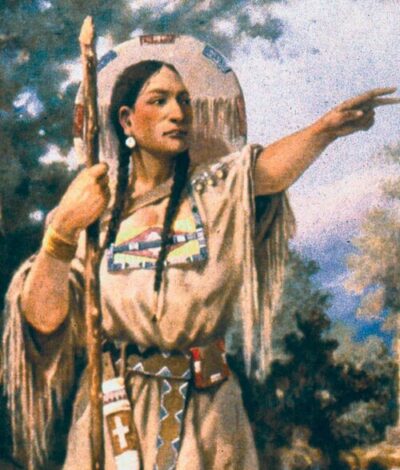
Sacagawea
Sacagawea was a Native American woman & companion to Lewis and Clark at age 16. Born May 16, 1788, in Salmon. Died December 12, 1812, in Fort Lisa. Awards include National Women's Hall of Fame and National Cowgirl Museum and Hall of Fame.
Facts
12 facts · 1 confirmed by two sources · 1 cited · 9 from one source · 1 where the sources disagree
What’s different
- Born: we show May 16, 1788 (Confirmed). Wikidata also lists 1786
- Died: we show December 12, 1812 (Sources disagree). Wikidata also lists April 9, 1884
Where this comes from
Papalocal keeps its own record. It started from these sources; what each one said is kept here as it was copied, so a change on their side never changes this page by itself. Tap one to read its version.
What Wikidata says · copied November 13, 2026 · revision 2568850813
- Described as
- Native American woman & companion to Lewis and Clark at age 16
- Other names
- Sahcahgar Wea, Sahcahgahwea, Sarcargahwea, Sahcahgagwea, Sakakawea, Sacajewea, Sahcahgarweah, Sa-ka-ka-wea, Sahkahgarwea, Sahcahgahweah, Sacajawea, Sahcargarweah
- Born
- May 16, 1788; 1786 · 1 reference
- Died
- December 12, 1812 · 1 reference; April 9, 1884 · 1 reference
- Born in
- Salmon
- Died in
- Fort Lisa
- Cause of death
- epidemic typhus
- Citizen of
- United States
- Occupation
- explorer; interpreter
- Awards
- National Women's Hall of Fame (2004) · 1 reference; National Cowgirl Museum and Hall of Fame
- Spouse
- Toussaint Charbonneau · 1 reference
- Children
- Jean Baptiste Charbonneau
- Wikipedias with a page
- 52
Wikidata item Q238960 (wikidata.org/wiki/Q238960), public domain (CC0). Copied November 13, 2026.
What Wikipedia says · copied November 13, 2026 · revision 1379665278
Sacagawea ( SAK-ə-jə-WEE-ə or sə-KAH-gə-WAY-ə; also spelled Sakakawea or Sacajawea; c. May 1788 – December 20, 1812) was a Lemhi Shoshone or Hidatsa woman who, in her teens, helped the Lewis and Clark Expedition in achieving their chartered mission objectives by exploring the Louisiana Territory. Sacagawea traveled with the expedition thousands of miles from North Dakota to the Pacific Ocean, helping to establish cultural contacts with Native American people and contributing to the expedition's knowledge of natural history in different regions.
The National American Woman Suffrage Association of the early 20th century adopted Sacagawea as a symbol of women's worth and independence, erecting several statues and plaques in her memory, and doing much to recount her accomplishments.
- Born, in its opening lines
- May 1788
- Died, in its opening lines
- December 20, 1812
From the Wikipedia article “Sacagawea” (en.wikipedia.org/wiki/Sacagawea), by its contributors, under CC BY-SA 4.0 (creativecommons.org/licenses/by-sa/4.0/). Copied November 13, 2026; not changed.
Confirmed Two sources agree. Cited One source, and it names where it got it. One source One source, without a reference of its own. Sources disagree The sources disagree. We show the best-supported value and keep theirs below.
