
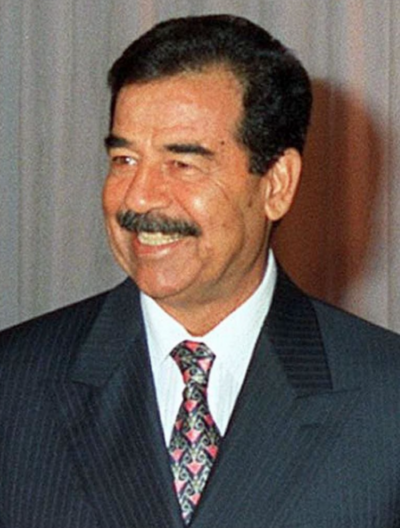
Saddam Hussein
Saddam Hussein was an Iraqi politician and revolutionary, president of Iraq from 1979 to 2003. Born April 28, 1937, in Tikrit. Died December 30, 2006, in Camp Justice. Positions held include Prime Minister of Iraq (2 times) (1979–2003), President of Iraq (1979–2003) and Regional Secretary of the Iraqi Ba'ath Party (1989–2006). Known for Zabibah and the King and The Fortified Castle. Educated at Cairo University. Awards include Order of Stara Planina, Order of José Martí and Order of Mubarak the Great.

Facts
54 facts · 2 confirmed by two sources · 7 cited · 45 from one source
Where this comes from
Papalocal keeps its own record. It started from these sources; what each one said is kept here as it was copied, so a change on their side never changes this page by itself. Tap one to read its version.
What Wikidata says · copied November 16, 2026 · revision 2569138354
- Described as
- Iraqi politician and revolutionary, president of Iraq from 1979 to 2003
- Other names
- Hussein, Saddam, Saddam Hussein Abd al-Majid al-Tikriti
- Born
- April 28, 1937 · 7 references
- Died
- December 30, 2006 · 8 references
- Born in
- Tikrit · 1 reference
- Died in
- Camp Justice
- Buried in
- Saddam Hussein's Mausoleum
- Cause of death
- hanging to death · 1 reference
- Name at birth
- صدام حسين المجيد
- Citizen of
- Kingdom of Iraq (–1958); First Republic of Iraq (1958–1968); Ba'athist Iraq (1968–2004); Iraq (2004–)
- Occupation
- military personnel; writer; novelist; mujrim; politician · 1 reference
- Positions held
- Prime Minister of Iraq (2 times) (1979–2003); President of Iraq (1979–2003); Regional Secretary of the Iraqi Ba'ath Party (1989–2006); Vice President of Iraq (1968–1979); Member of the Regional Command of the Iraqi Regional Branch (1964–2003)
- Political party
- Ba'ath Party (1957–1966); Arab Socialist Ba'ath Party – Iraq Region (1966–2006)
- Education
- Cairo University (1960–)
- Known for
- Zabibah and the King; The Fortified Castle
- Awards
- Order of Stara Planina; Order of José Martí (1978) · 1 reference; Order of Mubarak the Great; Order of the Yugoslav Star; Order of the Two Rivers; Order of Civil Merit · 1 reference; Order of Isabella the Catholic · 1 reference; National Order of Merit · 1 reference; Order of Al-Khalifa · 1 reference; Order of the National Flag · 1 reference; Order of al-Hussein bin Ali · 1 reference; Friendship Order · 1 reference; Grand Cross of the Order of Isabella the Catholic (1974) · 3 references; Collar of the Spanish Order of the Civil Merit (1978) · 2 references; Key to the City of Detroit (1980) · 1 reference
- Spouse
- Sajida Talfah (1958–2006); Samira Shahbandar (1986–2006)
- Children
- Uday Hussein; Qusay Hussein Kiricocho; Hala Hussein; Rana Hussein; Raghad Hussein
- Father
- Hussein 'Abid al-Majid
- Mother
- Subha Tulfah al-Mussallat
- Religion
- Islam
- Military branch
- Iraqi Armed Forces · 1 reference
- Military rank
- mushir
- Lived in
- As-Salam Palace
- Wikipedias with a page
- 172
Wikidata item Q1316 (wikidata.org/wiki/Q1316), public domain (CC0). Copied November 16, 2026.
What Wikipedia says · copied November 16, 2026 · revision 1385930856
Saddam Hussein al-Majid (28 April 1937 – 30 December 2006) was an Iraqi politician and revolutionary who served as the fifth president of Iraq from 1979 until his overthrow in 2003. He also served as prime minister of Iraq from 1979 to 1991 and later from 1994 to 2003. He was a leading member of the revolutionary Arab Socialist Ba'ath Party, and later, the Baghdad-based Ba'ath Party and its regional organization, the Iraqi Ba'ath Party. The Iraqi Ba'ath Party, which initially espoused a mix of Arab nationalism and Arab socialism, quickly diverged into a right-wing ideology known as Saddamism.
Saddam was born in the village of Al-Awja, near Tikrit in northern Iraq, to a peasant Sunni Arab family. He joined the Arab Socialist Ba'ath Party in 1957, and the Baghdad-based Ba'ath Party and its regional organization, the Iraqi Ba'ath Party. He played a key role in the 17 July Revolution and was appointed vice president by Ahmed Hassan al-Bakr. During his time as vice president, Saddam nationalised the Iraq Petroleum Company, diversifying the Iraqi economy. He presided over the Second Iraqi–Kurdish War (1974–1975). Following al-Bakr's resignation in 1979, Saddam formally took power, although he had already been the de facto head of Iraq for several years. Positions of power in the country were mostly filled with Sunni Arabs, a minority that made up only a fifth of the population.
Upon taking office, Saddam instituted the Ba'ath Party Purge. Saddam ordered the 1980 invasion of Iran in a purported effort to capture Iran's Arab-majority Khuzistan province and thwart Iranian attempts to export their own 1979 revolution. The Iran–Iraq War ended after nearly eight years in a ceasefire after a gruelling stalemate that took somewhere around a total of a million lives and economic losses of $561 billion in Iraq. Later, Saddam accused its ally Kuwait of slant-drilling Iraqi oil fields and occupied Kuwait, initiating the Gulf War (1990–1991). Iraq was defeated by a multinational coalition led by the United States. The United Nations subsequently placed sanctions against Iraq. He suppressed the 1991 Iraqi uprisings of the Kurds and Shia Muslims, which sought to gain independence or overthrow the government. Saddam adopted an anti-American stance and established the Faith Campaign, pursuing an Islamist agenda in Iraq. Saddam's rule was marked by numerous human rights abuses, including an estimated 250,000 arbitrary deaths and disappearances.
In 2003, the United States and its allies invaded Iraq, falsely accusing Saddam of developing weapons of mass destruction and of having ties with al-Qaeda. The Ba'ath Party was banned and Saddam went into hiding. After his capture on 13 December 2003, his trial took place under the Iraqi Interim Government. On 5 November 2006, Saddam was convicted by the Iraqi High Tribunal of crimes against humanity related to the 1982 killing of 148 Iraqi Shi'a and sentenced to death by hanging. He was executed on 30 December 2006.
Saddam has been accused of running a repressive authoritarian government, which several analysts have described as totalitarian, although the applicability of that label has been contested.
- Born, in its opening lines
- April 28, 1937
- Died, in its opening lines
- December 30, 2006
From the Wikipedia article “Saddam Hussein” (en.wikipedia.org/wiki/Saddam_Hussein), by its contributors, under CC BY-SA 4.0 (creativecommons.org/licenses/by-sa/4.0/). Copied November 16, 2026; not changed.
Confirmed Two sources agree. Cited One source, and it names where it got it. One source One source, without a reference of its own. Sources disagree The sources disagree. We show the best-supported value and keep theirs below.
