
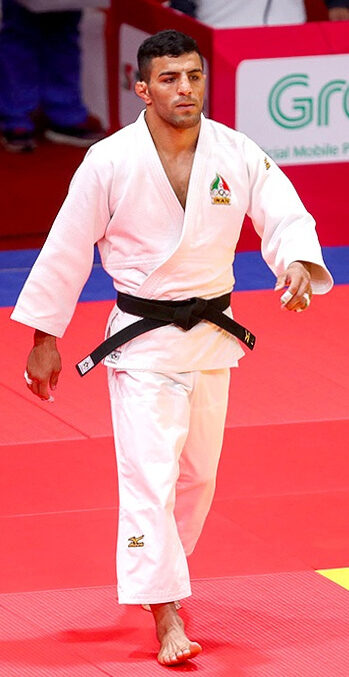
Saeid Mollaei is an Iranian judoka. Born January 5, 1992, in Tehran.
Facts
9 facts · 1 confirmed by two sources · 1 cited · 7 from one source
Where this comes from
Papalocal keeps its own record. It started from these sources; what each one said is kept here as it was copied, so a change on their side never changes this page by itself. Tap one to read its version.
What Wikidata says · copied November 16, 2026 · revision 2516730288
- Described as
- Iranian judoka
- Born
- January 5, 1992
- Born in
- Tehran
- Citizen of
- Iran (–2019); Mongolia (2019–)
- Occupation
- judoka · 1 reference
- Sport
- judo · 1 reference
- Lived in
- Tehran (–2018); Ulaanbaatar (2019–)
- Height
- 1.75 m (5 ft 9 in)
- Wikipedias with a page
- 28
Wikidata item Q26300210 (wikidata.org/wiki/Q26300210), public domain (CC0). Copied November 16, 2026.
What Wikipedia says · copied November 16, 2026 · revision 1383822886
Saeid Mollaei (Persian: سعید ملایی; Mongolian: Саид Моллай; Azerbaijani: Səid Mollayi; born January 5, 1992) is an Iranian-born Mongolian half-middleweight judoka. He was born in Tehran to ethnic Azerbaijani parents originally from Khoy. Iranian authorities ordered Mollaei to lose intentionally in the semi-final at the Tokyo 2019 World Championships, so as to avoid a potential match in the finals against Israeli 2019 world champion Sagi Muki. In August 2019, he moved to Europe with a two-year visa from Germany, saying he was afraid to return to Iran after exposing and criticizing its pressure on him to deliberately lose in the World Championships. In December 2019, he became a citizen of Mongolia. He dedicated his 2020 Olympic medal to Mongolia, to the Mongol people, and to Israel. From May 2022 on, Mollaei represents Azerbaijan.
- Born, in its opening lines
- January 5, 1992
From the Wikipedia article “Saeid Mollaei” (en.wikipedia.org/wiki/Saeid_Mollaei), by its contributors, under CC BY-SA 4.0 (creativecommons.org/licenses/by-sa/4.0/). Copied November 16, 2026; not changed.
Confirmed Two sources agree. Cited One source, and it names where it got it. One source One source, without a reference of its own. Sources disagree The sources disagree. We show the best-supported value and keep theirs below.
