
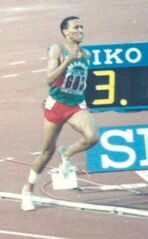
Saïd Aouita
Saïd Aouita is a Moroccan runner Olympic and world 5000 m champion. Born November 2, 1959, in Kenitra. Awards include Bislett medal.
Facts
10 facts · 1 confirmed by two sources · 2 cited · 7 from one source
Where this comes from
Papalocal keeps its own record. It started from these sources; what each one said is kept here as it was copied, so a change on their side never changes this page by itself. Tap one to read its version.
What Wikidata says · copied November 16, 2026 · revision 2558234261
- Described as
- Moroccan runner Olympic and world 5000 m champion
- Born
- November 2, 1959 · 2 references
- Born in
- Kenitra · 1 reference
- Citizen of
- Morocco
- Occupation
- long-distance runner; middle-distance runner; athletics competitor · 1 reference
- Sport
- athletics
- Awards
- Bislett medal (1985)
- Lived in
- Miami · 1 reference
- Height
- 1.75 m (5 ft 9 in)
- Wikipedias with a page
- 36
Wikidata item Q311364 (wikidata.org/wiki/Q311364), public domain (CC0). Copied November 16, 2026.
What Wikipedia says · copied November 16, 2026 · revision 1375245250
Saïd Aouita (Arabic: سعيد عويطة; born November 2, 1959) is a former Moroccan track and field athlete. He is the only athlete in history to have won a medal in each of the 800 meters and 5000 meters at the Olympic Games. He won the 5000 meters at the 1984 Summer Olympics and the 1987 World Championships in Athletics, as well as the 3000 meters at the 1989 IAAF World Indoor Championships. He is a former world record holder over 1500 metres (3:29.46), 2000 m (4:50.81), 3000 m (7:29.45), and twice at 5000 m (13:00.40 and 12:58.39).
- Born, in its opening lines
- November 2, 1959
From the Wikipedia article “Saïd Aouita” (en.wikipedia.org/wiki/Saïd_Aouita), by its contributors, under CC BY-SA 4.0 (creativecommons.org/licenses/by-sa/4.0/). Copied November 16, 2026; not changed.
Confirmed Two sources agree. Cited One source, and it names where it got it. One source One source, without a reference of its own. Sources disagree The sources disagree. We show the best-supported value and keep theirs below.
