
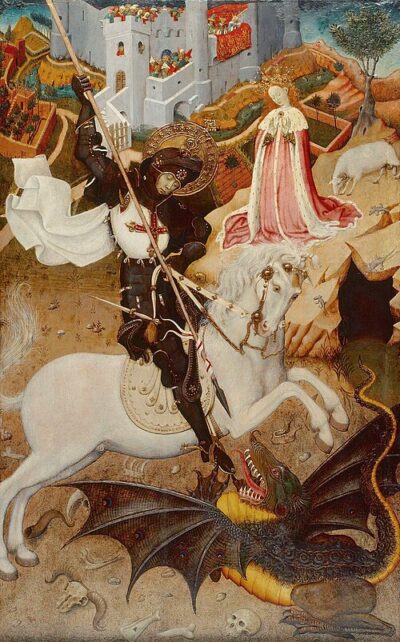
Saint George
Saint George was a Christian saint and martyr (died 303). Born 275, in Kayseri. Died April 23, 303, in Nicomedia. Positions held include Praetorian Guard.
Facts
14 facts · 1 confirmed by two sources · 0 cited · 12 from one source · 1 where the sources disagree
What’s different
- Died in: we show Nicomedia (Sources disagree). Wikidata also lists Lod
Where this comes from
Papalocal keeps its own record. It started from these sources; what each one said is kept here as it was copied, so a change on their side never changes this page by itself. Tap one to read its version.
What Wikidata says · copied November 16, 2026 · revision 2568917833
- Described as
- Christian saint and martyr (died 303)
- Other names
- Georgios, St. George, St George, Georgius, Saint Georgios, George, Red Cross Knight, George of Lydda
- Born
- 275
- Died
- April 23, 303 · 1 reference
- Born in
- Kayseri
- Died in
- Nicomedia; Lod
- Buried in
- Lod
- Cause of death
- decapitation
- Citizen of
- Ancient Rome
- Occupation
- warrior; dragonslayer; thaumaturge
- Positions held
- Praetorian Guard
- Father
- Gerontius
- Mother
- Polychronia
- Religion
- Christianity
- Wikipedias with a page
- 96
Wikidata item Q48438 (wikidata.org/wiki/Q48438), public domain (CC0). Copied November 16, 2026.
What Wikipedia says · copied November 16, 2026 · revision 1382353909
Saint George (Greek: Γεώργιος, romanized: Geṓrgios; died 23 April 303), also George of Lydda, was an early Christian martyr who is venerated as a saint in Christianity. According to holy tradition, he was a soldier in the Roman army. Of Cappadocian Greek origin, he became a member of the Praetorian Guard for Roman emperor Diocletian. During the Diocletianic Persecution, he was sentenced to death for refusing to recant his Christian faith. He became one of the most venerated saints, heroes, and megalomartyrs in Christianity. Since the Crusades, he has been venerated especially as a military saint. He is respected by Christians, Druze, as well as some Muslims as a martyr of monotheistic faith.
In hagiography, he is immortalised in the legend of Saint George and the Dragon and as one of the most prominent military saints. In Roman Catholicism, he is also venerated as one of the Fourteen Holy Helpers. His feast day, Saint George's Day, is traditionally celebrated on 23 April. Historically, the countries of Portugal, England, Bosnia and Herzegovina, Bulgaria, Georgia, Ukraine, Malta, Ethiopia, Catalonia and Aragon, and the cities of Genoa, Moscow and Beirut have claimed George as their patron saint, as have several other regions, cities, universities, professions, and organizations. The Church of Saint George in Lydda, now Lod in Israel, has a sarcophagus traditionally believed to contain St. George's relics.
- Died, in its opening lines
- April 23, 303
From the Wikipedia article “Saint George” (en.wikipedia.org/wiki/Saint_George), by its contributors, under CC BY-SA 4.0 (creativecommons.org/licenses/by-sa/4.0/). Copied November 16, 2026; not changed.
Confirmed Two sources agree. Cited One source, and it names where it got it. One source One source, without a reference of its own. Sources disagree The sources disagree. We show the best-supported value and keep theirs below.
