
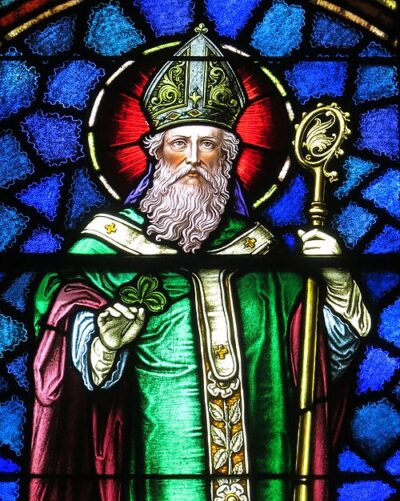
Saint Patrick
Saint Patrick was the 5th-century Romano-British Christian missionary and bishop in Ireland. Born 385, in Roman Britain. Died March 17, 461, in Saul. Positions held include Roman Catholic Bishop of Armagh (445–455) and emeritus bishop (455–493).
Facts
16 facts · 0 confirmed by two sources · 3 cited · 13 from one source
Where this comes from
Papalocal keeps its own record. It started from these sources; what each one said is kept here as it was copied, so a change on their side never changes this page by itself. Tap one to read its version.
What Wikidata says · copied November 16, 2026 · revision 2569931304
- Described as
- 5th-century Romano-British Christian missionary and bishop in Ireland
- Other names
- Magonus, Patrick, Cothirthiacus, Patricius, Enlightener of Ireland, St Patrick, Apostle of Ireland, Saint Patrick of Ireland, Maewyn Succat, St. Patrick of Ireland, Succetus, St. Patrick
- Born
- 385 · 1 reference
- Died
- March 17, 461
- Born in
- Roman Britain
- Died in
- Saul
- Occupation
- farmer; missionary · 1 reference; writer · 1 reference; Catholic priest; bishop · 1 reference
- Positions held
- Roman Catholic Bishop of Armagh (445–455) · 2 references; emeritus bishop (455–493)
- Father
- Calpornius
- Mother
- Conchesa
- Siblings
- Tigris of Ireland
- Religion
- Christianity
- Nickname
- Apostle of Ireland
- Wikipedias with a page
- 76
Wikidata item Q165479 (wikidata.org/wiki/Q165479), public domain (CC0). Copied November 16, 2026.
What Wikipedia says · copied November 16, 2026 · revision 1385557360
Saint Patrick was a fifth-century Romano-British Christian missionary and bishop in Ireland. Known as the "Apostle of Ireland", he is the primary patron saint of Ireland, the other patron saints being Brigid of Kildare and Columba. He is also the patron saint of Nigeria. Patrick is venerated as a saint in the Catholic Church, the Church of Ireland (part of the Anglican Communion), Lutheranism, and in the Eastern Orthodox Church, where he is regarded as equal-to-the-apostles and Enlightener of Ireland.
The dates of Patrick's life cannot be fixed with certainty, but there is general agreement that he was active as a missionary in Ireland during the fifth century. Two Latin writings by Patrick survive: the Confessio and the Letter to the soldiers of Coroticus. Patrick writes that when he was sixteen, he was captured by Irish pirates from his home in Britain and taken as a slave to Ireland. He writes that he lived there for six years as a herder before escaping and returning to his family. After studying for many years, probably in Gaul, he returned to spread Christianity in Ireland. As a bishop, Patrick converted "thousands" and ordained many priests. Years later, he was summoned to Britain by church leaders to answer various accusations. Patrick issued a lengthy and personal statement denying the accusations and defending himself, which became the Confessio.
The earliest hagiographies of Patrick were written in the seventh century by Muirchú and Tírechán. By this time, he had come to be revered as a patron saint of Ireland. According to tradition, Patrick was the first bishop of Armagh and Primate of Ireland, and is credited with bringing Christianity to Ireland (despite evidence of some earlier Christian presence), converting the people from paganism. There are many legends about Patrick, such as him using a shamrock to symbolize the Trinity, banishing snakes and demons from Ireland, and fasting on a mountaintop.
Saint Patrick's Day, considered his feast day, is observed on 17 March, the supposed date of his death. It is celebrated in Ireland and among the Irish diaspora as a religious and cultural holiday. In the Catholic Church in Ireland, it is both a solemnity and a holy day of obligation.
From the Wikipedia article “Saint Patrick” (en.wikipedia.org/wiki/Saint_Patrick), by its contributors, under CC BY-SA 4.0 (creativecommons.org/licenses/by-sa/4.0/). Copied November 16, 2026; not changed.
Confirmed Two sources agree. Cited One source, and it names where it got it. One source One source, without a reference of its own. Sources disagree The sources disagree. We show the best-supported value and keep theirs below.
