
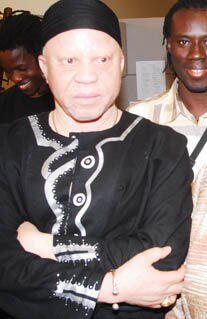
Salif Keita
Salif Keita is a Malian singer-songwriter, referred to as the "Golden Voice of Africa".. Born August 25, 1949, in Djoliba. Awards include Victory of the album of traditional musics or musics of the world, Kora Awards and All African Music Legend Award.
Facts
18 facts · 1 confirmed by two sources · 8 cited · 9 from one source
Where this comes from
Papalocal keeps its own record. It started from these sources; what each one said is kept here as it was copied, so a change on their side never changes this page by itself. Tap one to read its version.
What Wikidata says · copied November 16, 2026 · revision 2563747701
- Described as
- Malian singer-songwriter, referred to as the "Golden Voice of Africa".
- Born
- August 25, 1949 · 7 references
- Born in
- Djoliba · 1 reference
- Citizen of
- Mali · 2 references
- Occupation
- singer · 1 reference; songwriter · 1 reference
- Member of
- Super Rail Band (–1972); Les Ambassadeurs du Motel (1972–1977); Les Ambassadeurs Internationaux (1977–)
- Genre
- music of Africa · 1 reference; African popular music · 1 reference
- Instrument
- voice · 1 reference; guitar · 1 reference
- Record label
- Universal Music Group
- Awards
- Victory of the album of traditional musics or musics of the world (2010); Kora Awards (2004); All African Music Legend Award (2017)
- Spouse
- Coumba Makalou Keita
- Children
- Nantenin Keïta · 1 reference
- Wikipedias with a page
- 50
Wikidata item Q313318 (wikidata.org/wiki/Q313318), public domain (CC0). Copied November 16, 2026.
What Wikipedia says · copied November 16, 2026 · revision 1371757390
Salif Keïta (IPA: [salif keita]) (born 25 August 1949) is a Malian singer-songwriter, referred to as the "Golden Voice of Africa". He is a member of the Keita royal family of Mali.
- Born, in its opening lines
- August 25, 1949
From the Wikipedia article “Salif Keita” (en.wikipedia.org/wiki/Salif_Keita), by its contributors, under CC BY-SA 4.0 (creativecommons.org/licenses/by-sa/4.0/). Copied November 16, 2026; not changed.
Confirmed Two sources agree. Cited One source, and it names where it got it. One source One source, without a reference of its own. Sources disagree The sources disagree. We show the best-supported value and keep theirs below.
