
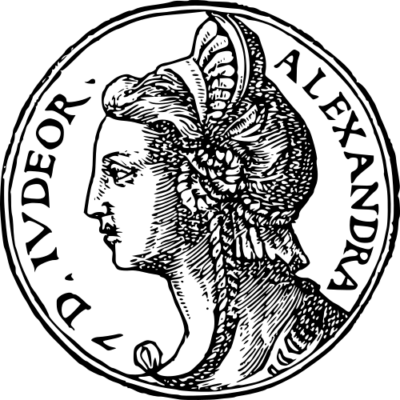
Salome Alexandra
Salome Alexandra was a Queen regnant of Hasmonean Judaea from c.76 to 67 BCE. Born 140 BC. Died 67 BC. Positions held include King of Judea (-76–-67).
Facts
10 facts · 0 confirmed by two sources · 1 cited · 9 from one source
Where this comes from
Papalocal keeps its own record. It started from these sources; what each one said is kept here as it was copied, so a change on their side never changes this page by itself. Tap one to read its version.
What Wikidata says · copied November 16, 2026 · revision 2568927265
- Described as
- Queen regnant of Hasmonean Judaea from c.76 to 67 BCE
- Other names
- Alexandra of Jerusalem, Alexandra, Shlomtzion, Šəlōmṣīyyōn
- Born
- 140 BC
- Died
- 67 BC · 2 references
- Citizen of
- Hasmonean Judea
- Occupation
- monarch
- Positions held
- King of Judea (-76–-67)
- Spouse
- Alexander Jannaeus; Aristobulus I
- Children
- Hyrcanus II; Aristobulus II · 1 reference
- Religion
- Judaism
- Wikipedias with a page
- 36
Wikidata item Q266591 (wikidata.org/wiki/Q266591), public domain (CC0). Copied November 16, 2026.
What Wikipedia says · copied November 16, 2026 · revision 1379819382
Salome Alexandra, also Shlomtzion, Shelamzion (Ancient Greek: Σαλώμη Ἀλεξάνδρα; Hebrew: שְׁלוֹמְצִיּוֹן, Šəlōmṣīyyōn, "peace of Zion"; 141–67 BC), was a regnant queen of Hasmonean Judea, one of only three women in Jewish historical tradition to rule over the country, the other two being Deborah and Athaliah. The wife of Alexander Jannaeus, she was also the last ruler of Judea to die as the sovereign of an independent kingdom. Her nine-year reign has been described as a "golden age" of Hasmonean history. Many suspect that she had previously been married to Alexander Janneaus's older brother, Aristobolus I, but this is most likely a misidentification.
From the Wikipedia article “Salome Alexandra” (en.wikipedia.org/wiki/Salome_Alexandra), by its contributors, under CC BY-SA 4.0 (creativecommons.org/licenses/by-sa/4.0/). Copied November 16, 2026; not changed.
Confirmed Two sources agree. Cited One source, and it names where it got it. One source One source, without a reference of its own. Sources disagree The sources disagree. We show the best-supported value and keep theirs below.
