
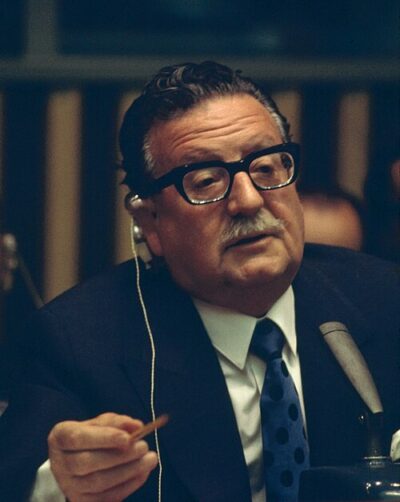
Salvador Allende
Salvador Allende was the 28th president of Chile. Born June 26, 1908, in Santiago. Died September 11, 1973, in Santiago. Positions held include President of Chile (1970–1973), president of the Senate of Chile (1966–1969) and deputy of Chile (1937–1939). Educated at University of Chile and Instituto Nacional General José Miguel Carrera. Awards include Order of José Martí, Order of Augusto César Sandino and Lenin Peace Prize.
Facts
35 facts · 2 confirmed by two sources · 11 cited · 21 from one source · 1 where the sources disagree
What’s different
- Buried in: we show Viña del Mar (Sources disagree). Wikidata also lists Santiago General Cemetery
Where this comes from
Papalocal keeps its own record. It started from these sources; what each one said is kept here as it was copied, so a change on their side never changes this page by itself. Tap one to read its version.
What Wikidata says · copied November 16, 2026 · revision 2568845529
- Described as
- 28th president of Chile (1908–1973)
- Other names
- Allende, Salvador Guillermo Allende Gossens
- Born
- June 26, 1908 · 4 references
- Died
- September 11, 1973 · 10 references
- Born in
- Santiago · 2 references
- Died in
- Santiago · 2 references
- Buried in
- Santiago General Cemetery; Viña del Mar · 1 reference
- Cause of death
- gunshot wound · 1 reference
- Name at birth
- Salvador Isabelino del Sagrado Corazón de Jesús Allende Gossens · 1 reference
- Citizen of
- Chile · 1 reference
- Occupation
- politician · 3 references; physician · 3 references; surgeon · 1 reference; President of Chile
- Positions held
- President of Chile (1970–1973); president of the Senate of Chile (1966–1969); deputy of Chile (1937–1939); senator of Chile (1945–1970); Chilean minister of Health (1939–1942); general secretary (1943–1944)
- Political party
- Socialist Party of Chile
- Education
- University of Chile; Instituto Nacional General José Miguel Carrera
- Member of
- Grand Lodge of Chile · 1 reference
- Awards
- Order of José Martí; Order of Augusto César Sandino; Lenin Peace Prize; Grand Cross of the Order Bernardo O'Higgins; Grand Cross of the Order of Merit; Order of the Companions of O. R. Tambo
- Spouse
- Hortensia Bussi (1940–1973) · 1 reference
- Children
- María Isabel Allende · 1 reference; Beatriz Allende
- Father
- Salvador Allende Castro
- Mother
- Laura Gossens Uribe
- Siblings
- Laura Allende
- Website
- http://www.fundacionsalvadorallende.cl/
- Wikipedias with a page
- 123
Wikidata item Q440 (wikidata.org/wiki/Q440), public domain (CC0). Copied November 16, 2026.
What Wikipedia says · copied November 16, 2026 · revision 1385497556
Salvador Guillermo Allende Gossens (26 June 1908 – 11 September 1973) was a Chilean politician who served as the 29th president of Chile from 1970 until his suicide during the 1973 Chilean coup d'état. He has been described as the first Marxist to be elected president in a liberal democracy in Latin America. Due to his commitment to democracy in the pursuit of socialism, and the manner of his death and deposition, he is revered as a hero and martyr by many socialists worldwide, across many different strains of beliefs, to a degree unusual in socialist politics.
Allende's involvement in Chilean politics spanned a period of nearly forty years, during which he held various positions including senator, deputy, and cabinet minister. As a life-long committed member of the Socialist Party of Chile, whose foundation he had actively contributed to, he unsuccessfully ran for the national presidency in the 1952, 1958, and 1964 elections. In 1970, he won the presidency as the candidate of the Popular Unity coalition in a close three-way race. He was elected in a run-off by Congress, as no candidate had gained a majority. In office, Allende pursued a policy he called "The Chilean Path to Socialism". The coalition government was far from unanimous. Allende said that he was committed to democracy and represented the more moderate faction of the Socialist Party, while the radical wing sought a more radical course. Instead, the Communist Party of Chile favored a gradual and cautious approach that sought cooperation with Christian democrats, which proved influential for the Italian Communist Party and the Historic Compromise.
As president, Allende sought to nationalize major industries, expand education, and improve the living standards of the working class. He clashed with the right-wing parties that controlled Congress and with the judiciary. On 11 September 1973, the military moved to oust Allende's democratically elected government in a coup d'état supported by the CIA. Declassified documents showed that US president Richard Nixon and his national security advisor Henry Kissinger were aware of the military's plans to overthrow Allende in the days before the coup d'état. As troops surrounded La Moneda Palace, Allende gave his last speech vowing not to resign. Later that day, Allende died by suicide in his office; the exact circumstances of his death are still disputed.
Following Allende's death, General Augusto Pinochet refused to return authority to a civilian government, and Chile was later ruled by the Government Junta, ending more than four decades of uninterrupted democratic governance, a period known as the Presidential Republic. The military junta that took over dissolved Congress, suspended the Constitution of 1925, and initiated a program of persecuting alleged dissidents, in which at least 3,095 civilians disappeared or were killed. Pinochet's military dictatorship only ended after the successful internationally backed 1989 constitutional referendum led to the peaceful Chilean transition to democracy.
- Born, in its opening lines
- June 26, 1908
- Died, in its opening lines
- September 11, 1973
From the Wikipedia article “Salvador Allende” (en.wikipedia.org/wiki/Salvador_Allende), by its contributors, under CC BY-SA 4.0 (creativecommons.org/licenses/by-sa/4.0/). Copied November 16, 2026; not changed.
Confirmed Two sources agree. Cited One source, and it names where it got it. One source One source, without a reference of its own. Sources disagree The sources disagree. We show the best-supported value and keep theirs below.
