
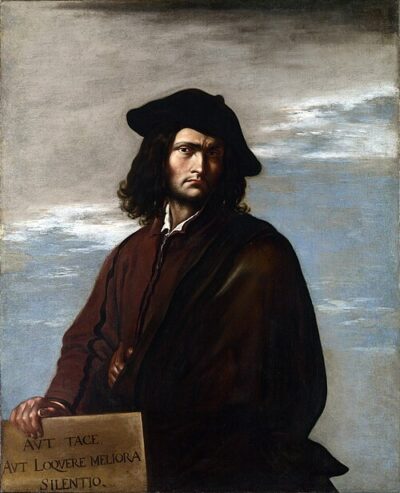
Salvator Rosa
Salvator Rosa was an Italian painter, poet and printmaker. Born June 20, 1615, in Naples. Died March 15, 1673, in Rome. Known for Jason Charming the Dragon, Heroic Battle and Saul and the Witch of Endor.
Facts
22 facts · 2 confirmed by two sources · 12 cited · 7 from one source · 1 where the sources disagree
What’s different
- Buried in: we show Salvator Rosa's grave (Sources disagree). Wikidata also lists Santa Maria degli Angeli e dei Martiri
Where this comes from
Papalocal keeps its own record. It started from these sources; what each one said is kept here as it was copied, so a change on their side never changes this page by itself. Tap one to read its version.
What Wikidata says · copied November 16, 2026 · revision 2564340755
- Described as
- Italian painter, poet and printmaker (1615 –1673)
- Other names
- Salvatore Rosa
- Born
- June 20, 1615 · 5 references
- Died
- March 15, 1673 · 12 references
- Born in
- Naples · 3 references
- Died in
- Rome · 3 references
- Buried in
- Salvator Rosa's grave · 1 reference; Santa Maria degli Angeli e dei Martiri · 1 reference
- Occupation
- painter · 4 references; poet · 1 reference; stage actor; printmaker · 3 references; musician · 1 reference; draftsperson · 1 reference; writer · 2 references; visual artist · 2 references
- Genre
- history painting · 1 reference; religious painting · 1 reference; landscape painting · 1 reference
- Known for
- Jason Charming the Dragon; Heroic Battle; Saul and the Witch of Endor; The Dream of Aeneas · 1 reference
- Field
- painting · 1 reference
- Spouse
- Lucrezia Paolini (1673–)
- Wikipedias with a page
- 45
Wikidata item Q359421 (wikidata.org/wiki/Q359421), public domain (CC0). Copied November 16, 2026.
What Wikipedia says · copied November 16, 2026 · revision 1385687255
Salvator Rosa (1615 – 15 March 1673) is best known today as an Italian Baroque painter, whose romanticised landscapes and history paintings, often set in dark and untamed nature, exerted considerable influence from the 17th century into the early 19th century. In his lifetime, he was among the most famous painters, known for his flamboyant personality, and regarded as an accomplished poet, satirist, actor, musician and printmaker. He was active in Naples, Rome, and Florence, where on occasion he was compelled to move between cities, as his caustic satire earned him enemies in the artistic and intellectual circles of the day.
As a history painter, he often selected obscure and esoteric subjects from the Bible, mythology, and the lives of philosophers, which were seldom addressed by other artists. He rarely painted the common religious subjects, unless they allowed a treatment dominated by the landscape element. He also produced battle scenes, allegories, scenes of witchcraft, and many self-portraits. However, he is most highly regarded for his very original landscapes, depicting "sublime" nature: often wild and hostile, at times rendering the people that populated them as marginal in the greater realm of nature. They were prototypes of the romantic landscape and the very antithesis of the "picturesque" classical views of Claude Lorrain. Some critics have noted that his technical skills and craftsmanship as a painter were not always equal to his truly innovative and original visions. This is in part due to a large number of canvases he hastily produced in his youth (1630s) in pursuit of financial gain, paintings that Rosa himself came to loathe and distance himself from in his later years, as well as posthumously misattributed paintings. Many of his peopled landscapes ended up abroad by the 18th century, and he was better known in England and France than most Italian Baroque painters.
Rosa has been described as "unorthodox and extravagant", a "perpetual rebel", "The Anti-Claude", and a proto-Romantic. He had a great influence on Romanticism, becoming a cult-like figure in the late 18th and early 19th centuries, and myths and legends grew around his life to the point that his real life was scarcely distinguished from the bandits and outsiders that roamed the wild and thundery landscapes he painted. By the mid-19th century, however, with the rise of realism and Impressionism, his work fell from favour and received very little attention. A renewed interest in his paintings emerged in the late 20th century, and although he is not ranked among the very greatest of the Baroque painters by art historians today, he is considered an innovative and significant landscape painter and a progenitor of the Romantic movement.
- Born, in its opening lines
- 1615
- Died, in its opening lines
- March 15, 1673
From the Wikipedia article “Salvator Rosa” (en.wikipedia.org/wiki/Salvator_Rosa), by its contributors, under CC BY-SA 4.0 (creativecommons.org/licenses/by-sa/4.0/). Copied November 16, 2026; not changed.
Confirmed Two sources agree. Cited One source, and it names where it got it. One source One source, without a reference of its own. Sources disagree The sources disagree. We show the best-supported value and keep theirs below.
