
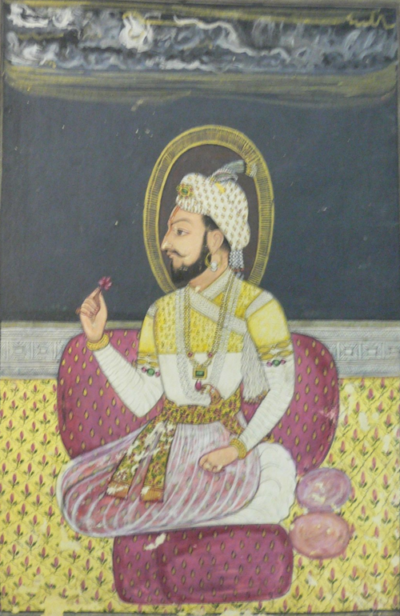
Sambhaji
Sambhaji was a Second Maratha king of the Maratha Empire, also a writer, philosopher and successor of Shivaji. Born May 14, 1657, in Purandar Fort. Died March 11, 1689, in Tulapur. Positions held include Chatrapati (1680–1689). Educated at N/A.
Facts
15 facts · 2 confirmed by two sources · 3 cited · 10 from one source
Where this comes from
Papalocal keeps its own record. It started from these sources; what each one said is kept here as it was copied, so a change on their side never changes this page by itself. Tap one to read its version.
What Wikidata says · copied November 16, 2026 · revision 2568430286
- Described as
- Second Maratha king of the Maratha Empire, also a writer, philosopher and successor of Shivaji (1657-1689)
- Other names
- Sambhaji Bhosale, Sambhaji I, Shambhu, Sambhaji Maharaj, Chhatrapati Sambhaji Maharaj, Second Maratha king of the Maratha Empire, also a writer, philosopher and successor of Shivaji (1657-1689)
- Born
- May 14, 1657
- Died
- March 11, 1689
- Born in
- Purandar Fort
- Died in
- Tulapur
- Cause of death
- decapitation
- Occupation
- king · 1 reference; writer · 1 reference
- Positions held
- Chatrapati (1680–1689)
- Education
- N/A
- Spouse
- Maharani Yesubai
- Children
- Shahu I
- Father
- Shivaji · 1 reference
- Mother
- Saibai
- Siblings
- Rajaram I
- Religion
- Hinduism
- Wikipedias with a page
- 30
Wikidata item Q2737041 (wikidata.org/wiki/Q2737041), public domain (CC0). Copied November 16, 2026.
What Wikipedia says · copied November 16, 2026 · revision 1381115056
Sambhaji (Sambhajiraje Shivajiraje Bhonsle, Marathi pronunciation: [saːmˈbʱaːdʑiː ˈbʱos(ə)le]; 14 May 1657 – 11 March 1689), also known as Shambhuraje, ruled from 1681 to 1689 as the second king (Chhatrapati) of the Maratha Empire, a prominent state in early modern India. He was the eldest son of Shivaji, the founder of the Maratha Empire.
At the age of nine, Sambhaji was taken as a political hostage of the Mughal Empire, to guarantee his father's compliance with the treaty of Purandar. He later accompanied his father to Agra where both were placed under house arrest by the Mughal Emperor Aurangzeb; they subsequently escaped. He was later confined by his father at Panhala Fort, with some theories suggesting that it was due to his addiction to "sensual pleasures" or for violating a Brahmin woman. He subsequently defected to the Mughal Empire and served under Diler Khan in the Battle of Bhupalgarh against his father. He ascended the throne following his father's death, with his rule being largely shaped by the ongoing wars between the Marathas and the Mughal Empire, as well as other neighbouring powers such as the Siddi of Janjira, the Wadiyars of Mysore and the Portuguese Empire in Goa.
Early in his rule, Marathas under Sambhaji attacked and disrupted supply lines and raided into the Mughal territory, although they were unsuccessful in taking over main forts. In 1683, Sambhaji executed 24 members of influential families including top government ministers after discovering a plot to poison him. By 1685, Mughals had gradually pushed back Sambhaji's forces by taking over their strongholds. Desertions became common by the end of his reign, and he had alienated Maratha deshmukhs (land owners) by burning villages to deny supplies to the Portuguese. In 1689, he was captured by Mughal forces and executed. His brother Rajaram I succeeded him as king and continued the Mughal–Maratha Wars.
Sambhaji is viewed poorly by historians, who note that his personal problems—and war crimes committed by his soldiers—overshadowed his moderate military and administrative successes. Maratha soldiers under Sambhaji's command during his campaigns committed atrocities against civilians including massacres and mass rape. As a ruler, Sambhaji implemented drought relief measures and encouraged agricultural development while continuing his father's administrative systems. He was also a scholar who authored several works in Sanskrit and Hindustani, including the political treatise Budhbhushanam. His torture and death at the hands of the Mughal Empire elevated him to the status of a martyr. He remains popular in modern India among many Hindu nationalists.
- Born, in its opening lines
- May 14, 1657
- Died, in its opening lines
- March 11, 1689
From the Wikipedia article “Sambhaji” (en.wikipedia.org/wiki/Sambhaji), by its contributors, under CC BY-SA 4.0 (creativecommons.org/licenses/by-sa/4.0/). Copied November 16, 2026; not changed.
Confirmed Two sources agree. Cited One source, and it names where it got it. One source One source, without a reference of its own. Sources disagree The sources disagree. We show the best-supported value and keep theirs below.
