
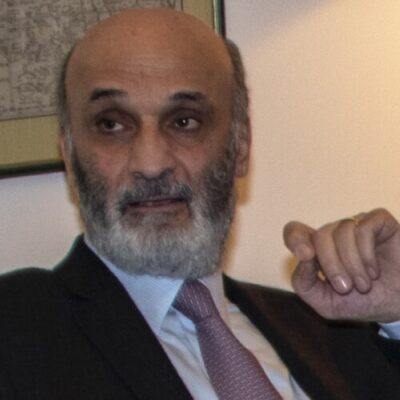
Samir Geagea
Samir Geagea is a Lebanese politician. Born October 25, 1952, in Ain El Remmaneh.
Facts
10 facts · 1 confirmed by two sources · 1 cited · 8 from one source
Where this comes from
Papalocal keeps its own record. It started from these sources; what each one said is kept here as it was copied, so a change on their side never changes this page by itself. Tap one to read its version.
What Wikidata says · copied November 17, 2026 · revision 2547494291
- Described as
- Lebanese politician
- Other names
- Samir Farid Geagea
- Born
- October 25, 1952 · 1 reference
- Born in
- Ain El Remmaneh · 1 reference
- Citizen of
- Lebanon
- Occupation
- politician; military personnel · 1 reference
- Political party
- Lebanese Forces; Kataeb Party
- Spouse
- Sethrida Geagea (1991–)
- Religion
- Maronite Church
- Website
- http://www.samirgeagea.info/
- Wikipedias with a page
- 24
Wikidata item Q733686 (wikidata.org/wiki/Q733686), public domain (CC0). Copied November 17, 2026.
What Wikipedia says · copied November 17, 2026 · revision 1384414695
Samir Farid Geagea (Arabic: سمير فريد جعجع, Lebanese Arabic: [saˈmiːɾ faˈɾiːd ˈʒaʕʒaʕ] , also spelled Samir Ja'ja'; born 25 October 1952) is a Lebanese politician and former militia commander who has been the leader of the Lebanese Forces political party and former militia since 1986.
Born in Ain al-Remaneh, Geagea joined the nationalist Kataeb Party in his early years. He led the Northern Front in the Lebanese Forces from 1979 to 1984. In March 1985, after the deterioration of the Christian political situation in the eastern regions after the assassination of the Lebanese Forces leader Bachir Gemayel, he led, jointly with Elie Hobeika and Karim Pakradouni, an uprising that led to control of the political situation without any bloodshed. On 15 January 1986, Geagea led a coup against the tripartite agreement sponsored by Syria to become the commander of the Lebanese Forces after the overthrow of Elie Hobeika, head of the executive body at the time and one of the signatories of the tripartite agreement.
Geagea initially supported the "War of Liberation" declared by disputed Prime Minister General Michel Aoun against the Syrian Army. On 31 January 1990, the Lebanese Armed Forces led by Michel Aoun declared war on the Lebanese Forces, officially naming it "the War of the Unification of the Rifle," but later being referred to as the War of Elimination.
Under Geagea, the Lebanese Forces agreed to the Taif Accord peace agreement that ended the civil war and ceded control of its territory to the Lebanese Army, and sold their arms to Serbian factions fighting in the Yugoslav Wars in 1991. In accordance with the agreement, he immediately dissolved the military and security arm of the Lebanese Forces and surrendered all its military assets to the Lebanese Army. But as Beirut was under the control of the Syrian Army, the party members were subject to pressure and Syrian forces refused to withdraw as set out in the agreement.
On 24 January 1990, Geagea was appointed a Minister of State in the first post-war cabinet, led by Prime Minister Omar Karami. Geagea rejected the position due to the flagrant control of the cabinet by the Syrian regime. On 16 May 1992, Geagea was again appointed as a minister in the Rashid El Solh cabinet, only to refuse it again for the same reasons. In 1994, Geagea was arrested and put on trial for bombing a church and political killings in the war. He denied the accusations and claimed he was the target of a political prosecution fabricated by the Syrian-Lebanese security apparatus.
Geagea spent 11 years in solitary confinement. Following the Cedar Revolution, and the subsequent withdrawal of Syrian forces from Lebanon, a newly elected Lebanese Parliament voted to grant him amnesty on 18 July 2005.
- Born, in its opening lines
- October 25, 1952
From the Wikipedia article “Samir Geagea” (en.wikipedia.org/wiki/Samir_Geagea), by its contributors, under CC BY-SA 4.0 (creativecommons.org/licenses/by-sa/4.0/). Copied November 17, 2026; not changed.
Confirmed Two sources agree. Cited One source, and it names where it got it. One source One source, without a reference of its own. Sources disagree The sources disagree. We show the best-supported value and keep theirs below.
