
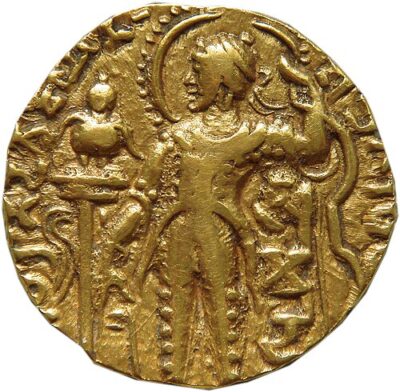
Samudragupta
Samudragupta was the 4th-century ruler of the Gupta Empire. Born 335, in Indraprastha. Died 380, in Pataliputra. Positions held include Gupta emperor (335–380).
Facts
12 facts · 0 confirmed by two sources · 0 cited · 10 from one source · 2 where the sources disagree
What’s different
- Born: we show 335 (Sources disagree). Wikipedia says 318
- Died: we show 380 (Sources disagree). Wikipedia says 375
Where this comes from
Papalocal keeps its own record. It started from these sources; what each one said is kept here as it was copied, so a change on their side never changes this page by itself. Tap one to read its version.
What Wikidata says · copied November 16, 2026 · revision 2554143701
- Described as
- 4th-century ruler of the Gupta Empire
- Born
- 335
- Died
- 380
- Born in
- Indraprastha
- Died in
- Pataliputra
- Citizen of
- Gupta Empire
- Positions held
- Gupta emperor (335–380)
- Spouse
- Dattadevi
- Children
- Ramagupta; Chandragupta II
- Father
- Chandragupta I
- Mother
- Kumaradevi
- Siblings
- Prabhavati Gupta
- Wikipedias with a page
- 52
Wikidata item Q1133363 (wikidata.org/wiki/Q1133363), public domain (CC0). Copied November 16, 2026.
What Wikipedia says · copied November 16, 2026 · revision 1375861037
Samudragupta (Gupta script: Sa-mu-dra-gu-pta; 318–375) was the second emperor of the Gupta Empire of ancient India. As a son of the Gupta emperor Chandragupta I and the Licchavi princess Kumaradevi, he inherited the kingdom and transformed it into a vast empire through his military campaigns.
The Allahabad Pillar inscription, a prashasti (eulogy) composed by his courtier Harisena, credits him with extensive military conquests. It suggests that he defeated several kings of northern India, and annexed their territories into his empire. He also marched along the southeastern coast of India, advancing as far south as Kanchipuram in the Pallava kingdom. In addition, he subjugated several frontier kingdoms and tribal oligarchies. At the height of his power, his empire under his direct control extended from Ravi River in the west (present-day Punjab) to the Brahmaputra River in the east (present-day Assam), and from the Himalayan foothills in the north to central India in the southwest; several rulers along the southeastern coast were also his tributaries. The inscription also states that many neighbouring rulers tried to please him, which probably refers to his friendly relations with them.
He performed the Ashvamedha sacrifice to prove his imperial sovereignty and remained undefeated in battle. His gold coins and inscriptions suggest that he was an accomplished poet, and also played musical instruments such as the veena. His expansionist policy was continued by his son and successor Chandragupta II.
- Born, in its opening lines
- 318
- Died, in its opening lines
- 375
From the Wikipedia article “Samudragupta” (en.wikipedia.org/wiki/Samudragupta), by its contributors, under CC BY-SA 4.0 (creativecommons.org/licenses/by-sa/4.0/). Copied November 16, 2026; not changed.
Confirmed Two sources agree. Cited One source, and it names where it got it. One source One source, without a reference of its own. Sources disagree The sources disagree. We show the best-supported value and keep theirs below.
