
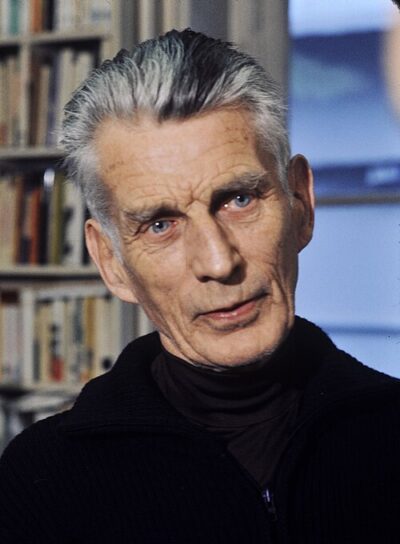
Samuel Beckett
Samuel Beckett was an Irish writer. Born April 13, 1906, in Foxrock. Died December 22, 1989, in 14th arrondissement of Paris. Known for Murphy, Molloy and Malone Dies. Educated at Trinity College, Dublin and Portora Royal School. Awards include Scholar of Trinity College, Dublin, honorary doctorate of Trinity College, Dublin and Obie Award (5 times).
Facts
42 facts · 2 confirmed by two sources · 21 cited · 19 from one source
Where this comes from
Papalocal keeps its own record. It started from these sources; what each one said is kept here as it was copied, so a change on their side never changes this page by itself. Tap one to read its version.
What Wikidata says · copied November 16, 2026 · revision 2568330718
- Described as
- Irish writer (1906–1989)
- Other names
- Sam Beckett, Samuel Beḳeṭ, Andrew Belis, Sa-miao-erh Pei-kʻo-tʻe, Samuel Barclay Beckett
- Born
- April 13, 1906 · 7 references
- Died
- December 22, 1989 · 5 references
- Born in
- Foxrock · 2 references
- Died in
- 14th arrondissement of Paris · 1 reference
- Buried in
- Montparnasse Cemetery
- Name at birth
- Samuel Barclay Beckett · 1 reference
- Citizen of
- Ireland; France
- Occupation
- writer · 4 references; linguist · 1 reference; film director · 1 reference; screenwriter · 1 reference; cricketer · 2 references; poet · 3 references; novelist; playwright · 3 references
- Education
- Trinity College, Dublin (1923–1927) · 1 reference; Portora Royal School · 2 references
- Member of
- American Academy of Arts and Sciences (1968–) · 1 reference; Aosdána · 1 reference
- Sport
- cricket · 1 reference
- Genre
- drama film
- Known for
- Murphy; Molloy; Malone Dies; The Unnamable; Waiting for Godot; Watt; Endgame; Krapp's Last Tape; How It Is
- Awards
- Scholar of Trinity College, Dublin (1926) · 1 reference; honorary doctorate of Trinity College, Dublin (1959) · 1 reference; Obie Award (5 times) (1958, 1960, 1962, 1964, 1984) · 1 reference; Prix Formentor (1961) · 2 references; Fellow of the American Academy of Arts and Sciences (1968) · 1 reference; Nobel Prize in Literature (1969) · 2 references; Saoi (1985); star on Playwrights' Sidewalk · 1 reference
- Field
- drama · 1 reference
- Spouse
- Suzanne Dechevaux-Dumesnil · 1 reference
- Lived in
- County Dublin
- Wikipedias with a page
- 140
Wikidata item Q37327 (wikidata.org/wiki/Q37327), public domain (CC0). Copied November 16, 2026.
What Wikipedia says · copied November 16, 2026 · revision 1384044626
Samuel Barclay Beckett ( ; 13 April 1906 – 22 December 1989) was an Irish playwright, novelist, and poet. Written in both English and French, his literary and theatrical works feature bleak, impersonal, and tragicomic episodes of life, coupled with black comedy and literary nonsense. As a key proponent of Irish literature, he is best known for his tragicomedy play Waiting for Godot (1953), and is widely regarded as one of the most influential and important writers of the 20th century, credited with transforming modern theatre. For his foundational contribution to both literature and theatre, Beckett received the 1969 Nobel Prize in Literature, "for his writing, which—in new forms for the novel and drama—in the destitution of modern man acquires its elevation."
During his early career, Beckett worked as a literary critic and commentator, and in 1930 he took up a role as a lecturer in Dublin. He wrote his first novel Dream of Fair to Middling Women in 1932, but it was not published until after his death. Around this time, Beckett also began studying artistic expressions and art history, particularly of paintings displayed at the National Gallery of Ireland. He was a close friend of the Irish writer James Joyce, and cited him as a major inspiration for his works. As a resident of Paris for most of his adult life, Beckett wrote in both French and English, sometimes under the pseudonym Andrew Belis. His later literary works, especially his plays, became increasingly austere and minimalistic as his career progressed, involving more aesthetic and linguistic experimentation, with techniques of stream of consciousness, repetition and self-reference. During the Second World War, Beckett became a member of the French Resistance group Gloria SMH (Réseau Gloria) and was awarded the Croix de Guerre in 1945.
His works were well received by critics and theatre audiences during his own lifetime, and his career spanned both Ireland and France, with short stints in Germany and Italy. During these terms, Beckett collaborated with many leading actors, actresses and theatre directors for his plays. Beckett's works are known for their existential themes, and these made them an important part of 20th-century plays and dramas. In 1961, he shared the inaugural Prix International with Jorge Luis Borges. He was also the first Saoi of the Aosdána, having been elected to the position in 1984.
Beckett is considered to be one of the last modernist writers and a key figure in what Martin Esslin called the "Theatre of the Absurd." He died in 1989 and was buried at the Cimetière du Montparnasse. He posthumously became one of the most prized and widely discussed Irish authors, and several landmarks have been named in his honour, with the most notable being the Samuel Beckett Bridge in Dublin. His best-known play, Waiting for Godot, has since become a centrepiece of modernist literature, and in a public poll by London's Royal National Theatre in 1998, it was voted as "the most significant English-language play of the 20th century."
- Born, in its opening lines
- April 13, 1906
- Died, in its opening lines
- December 22, 1989
From the Wikipedia article “Samuel Beckett” (en.wikipedia.org/wiki/Samuel_Beckett), by its contributors, under CC BY-SA 4.0 (creativecommons.org/licenses/by-sa/4.0/). Copied November 16, 2026; not changed.
Confirmed Two sources agree. Cited One source, and it names where it got it. One source One source, without a reference of its own. Sources disagree The sources disagree. We show the best-supported value and keep theirs below.
