
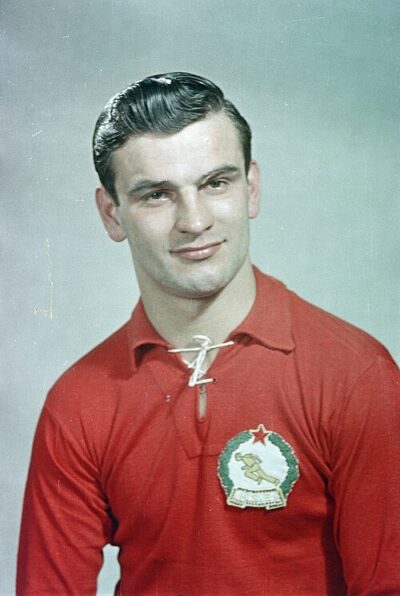
Sándor Kocsis
Sándor Kocsis was a Hungarian footballer. Born September 21, 1929, in Budapest. Died July 22, 1979, in Barcelona. Teams include SC Young Fellows Juventus (1957–1958), Ferencvárosi TC (1946–1950) and FC Barcelona (1958–1965). Awards include honorary citizen of Budapest.
Facts
17 facts · 2 confirmed by two sources · 2 cited · 12 from one source · 1 where the sources disagree
What’s different
- Buried in: we show St. Stephen's Basilica (Sources disagree). Wikidata also lists Montjuïc Cemetery
Where this comes from
Papalocal keeps its own record. It started from these sources; what each one said is kept here as it was copied, so a change on their side never changes this page by itself. Tap one to read its version.
What Wikidata says · copied November 16, 2026 · revision 2558898613
- Described as
- Hungarian footballer
- Other names
- Sandor Kocsis
- Born
- September 21, 1929 · 5 references
- Died
- July 22, 1979 · 2 references
- Born in
- Budapest
- Died in
- Barcelona
- Buried in
- Montjuïc Cemetery; St. Stephen's Basilica · 1 reference
- Name at birth
- Kocsis Sándor
- Citizen of
- Hungary
- Occupation
- association football player · 1 reference; association football coach; athlete · 1 reference
- Teams
- SC Young Fellows Juventus (1957–1958); Ferencvárosi TC (1946–1950); FC Barcelona (1958–1965); Kispest-Honvéd FC (1950–1957); Hungary men's national football team (1948–1956)
- Sport
- association football
- Awards
- honorary citizen of Budapest (2012)
- Wikipedias with a page
- 53
Wikidata item Q295265 (wikidata.org/wiki/Q295265), public domain (CC0). Copied November 16, 2026.
What Wikipedia says · copied November 16, 2026 · revision 1382002373
Sándor Péter Kocsis (SHAWN-dor KOTCH-ish; Hungarian: [ˈʃaːndor ˈpeːtɛr ˈkot͡ʃiʃ]; 21 September 1929 – 22 July 1979) was a Hungarian footballer who played for Ferencvárosi TC, Budapest Honvéd, Young Fellows Zürich, FC Barcelona and Hungary as a striker. During the 1950s, along with Ferenc Puskás, Zoltán Czibor, József Bozsik and Nándor Hidegkuti, he was a member of the Mighty Magyars. After the 1956 Hungarian Revolution, he moved to Spain where he became a member of the FC Barcelona team of the late 1950s.
Kocsis was a prolific goalscorer for both Budapest Honvéd and Hungary. While playing for Honvéd, he was the top goalscorer in any European league in both 1952 and 1954. He also scored 75 goals in 68 appearances for Hungary – a 1.10 goal/game average at the game's highest level. Kocsis was the top goalscorer in the 1954 World Cup with 11 goals, a record at the time for goals in a single World Cup. That year he scored 23 goals with his national team, the most by any player during a calendar year. He was also the first player to score two hat-tricks in a World Cup. His 2.2 goal/game average in the World Cup finals is second only to that of Ernst Wilimowski (Poland) who scored four goals in his only World Cup match, and only Just Fontaine has scored more goals than Kocsis in a single World Cup. According to the Rec.Sport.Soccer Statistics Foundation (RSSSF) he totalled 556 goals in 537 official games among which 123 goals in national team matches at all levels ranked third in recorded history. Kocsis was particularly known for scoring headers.
His 1.103 goals/game average is ranked No.1 for players past 43 caps in FIFA class-A competition, closely followed by Gerd Müller with 1.097 goals/game (68 goals in 62 games). They are the only two players in history above a +1.0 goals/game average encompassing over 43 internationals. Ferenc Puskás with .99 goals/game (84 goals in 85 matches) is currently ranked 3rd.
Sándor Kocsis registered a national record of seven hat-tricks for Hungary, including a four-goal haul against West Germany at the 1954 World Cup.
- Born, in its opening lines
- September 21, 1929
- Died, in its opening lines
- July 22, 1979
From the Wikipedia article “Sándor Kocsis” (en.wikipedia.org/wiki/Sándor_Kocsis), by its contributors, under CC BY-SA 4.0 (creativecommons.org/licenses/by-sa/4.0/). Copied November 16, 2026; not changed.
Confirmed Two sources agree. Cited One source, and it names where it got it. One source One source, without a reference of its own. Sources disagree The sources disagree. We show the best-supported value and keep theirs below.
