
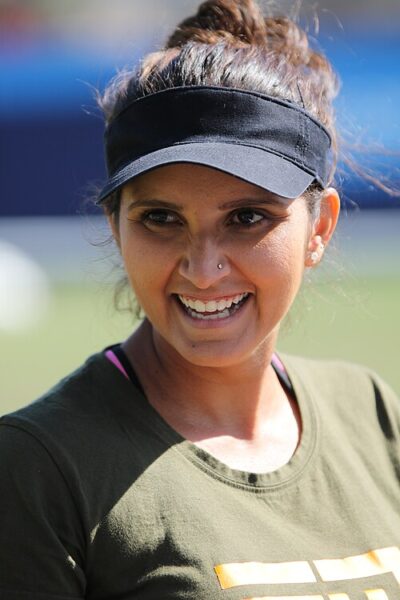
Sania Mirza
Sania Mirza is an Indian tennis player. Born November 15, 1986, in Mumbai. Teams include India Billie Jean King Cup team (2003–). Educated at Osmania University and Nasr School. Awards include Arjuna Award, BBC 100 Women and Padma Shri in Sports.
Facts
16 facts · 1 confirmed by two sources · 7 cited · 8 from one source
Where this comes from
Papalocal keeps its own record. It started from these sources; what each one said is kept here as it was copied, so a change on their side never changes this page by itself. Tap one to read its version.
What Wikidata says · copied November 16, 2026 · revision 2548942627
- Described as
- Indian tennis player
- Born
- November 15, 1986 · 2 references
- Born in
- Mumbai · 1 reference
- Citizen of
- India · 1 reference
- Occupation
- tennis player (2003–) · 1 reference
- Education
- Osmania University; Nasr School
- Teams
- India Billie Jean King Cup team (2003–)
- Sport
- tennis · 1 reference
- Awards
- Arjuna Award (2004); BBC 100 Women (2015) · 1 reference; Padma Shri in Sports (2006); CNN-News18 Indian of the Year (2015)
- Spouse
- Shoaib Malik (2010–) · 1 reference
- Religion
- Islam
- Lived in
- Hyderabad · 1 reference
- Height
- 1.73 m (5 ft 8 in)
- Wikipedias with a page
- 67
Wikidata item Q132147 (wikidata.org/wiki/Q132147), public domain (CC0). Copied November 16, 2026.
What Wikipedia says · copied November 16, 2026 · revision 1385808791
Sania Mirza ([ˈsaːnijaː ˈmirzaː]; born 15 November 1986) is an Indian former professional tennis player. A former doubles world No. 1, she won six major titles – three in women's doubles and three in mixed doubles. From 2003 until her retirement from singles in 2013, she was ranked by the Women's Tennis Association as the No. 1 Indian in singles. Throughout her career, Mirza has established herself as one of the most known, highest-paid, and influential athletes in India.
In singles, Mirza had wins over Svetlana Kuznetsova, Vera Zvonareva, and Marion Bartoli, as well as former world-number-ones Martina Hingis, Dinara Safina, and Victoria Azarenka. She is the highest-ranked Indian female player ever, peaking at world No. 27 in mid-2007. However, a major wrist injury caused her to shift to doubles. Mirza has achieved a number of firsts for women's tennis in India, including reaching the one million-US$ mark in career earnings (currently over US$7.2 million), winning a singles WTA Tour title, and winning a major title, as well as qualifying for (and eventually winning) the WTA Finals in 2014 in doubles partnering Cara Black, and defending her title the following year partnering Martina Hingis. Mirza retired from professional tennis in February 2023.
She is one of only two Indian women to win a WTA Tour title, and the only one to be ranked within the top 100 in singles. Mirza is the third Indian woman in the Open Era (after Nirupama Mankad and Nirupama Sanjeev, and the second in singles after Sanjeev) to contest and win a match at a major, and the first to advance past the second round. In doubles, Mirza won 43 titles and spent 91 weeks as world No. 1. In 2005, Mirza was crowned the Newcomer of the Year by the WTA, and in 2015 she and Martina Hingis were the Doubles Team of the Year, going on to earn a 44-match winning streak, one of the longest in history. Mirza has also won a total of 14 medals (including six golds) at three major multi-sport events, namely the Asian Games, the Commonwealth Games and the Afro-Asian Games.
Mirza was named one of the "50 Heroes of Asia" by Time in October 2005. In March 2010, The Economic Times named Mirza in its list of the "33 women who made India proud". She was appointed as the UN Women's Goodwill Ambassador for South Asia during the International Day for the Elimination of Violence against Women on 25 November 2013. She was named in Time magazine's 2016 list of the 100 most influential people in the world.
- Born, in its opening lines
- November 15, 1986
From the Wikipedia article “Sania Mirza” (en.wikipedia.org/wiki/Sania_Mirza), by its contributors, under CC BY-SA 4.0 (creativecommons.org/licenses/by-sa/4.0/). Copied November 16, 2026; not changed.
Confirmed Two sources agree. Cited One source, and it names where it got it. One source One source, without a reference of its own. Sources disagree The sources disagree. We show the best-supported value and keep theirs below.
