
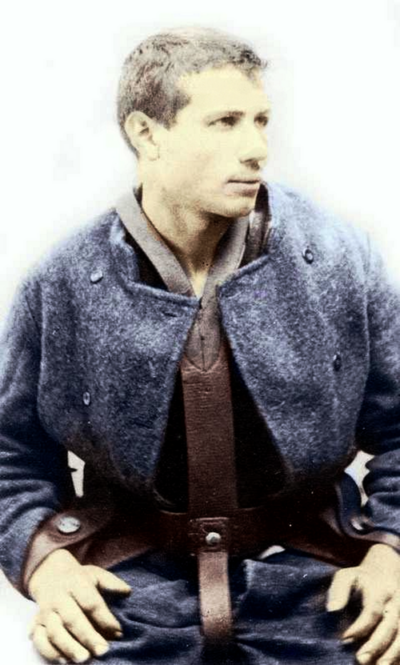
Sante Geronimo Caserio
Sante Geronimo Caserio was a sentenced to death in France. Born September 8, 1873, in Motta Visconti. Died August 16, 1894, in Lyon.
Facts
10 facts · 2 confirmed by two sources · 1 cited · 6 from one source · 1 where the sources disagree
What’s different
- Cause of death: we show decapitation (Sources disagree). Wikidata also lists decapitation by guillotine
Where this comes from
Papalocal keeps its own record. It started from these sources; what each one said is kept here as it was copied, so a change on their side never changes this page by itself. Tap one to read its version.
What Wikidata says · copied November 18, 2026 · revision 2545358096
- Described as
- sentenced to death in France
- Other names
- Sante Caserio, Santo Ironimo Caserio
- Born
- September 8, 1873 · 1 reference
- Died
- August 16, 1894 · 2 references
- Born in
- Motta Visconti
- Died in
- Lyon · 2 references
- Buried in
- Cimetière de Loyasse
- Cause of death
- decapitation · 1 reference; decapitation by guillotine · 1 reference
- Citizen of
- Kingdom of Italy
- Occupation
- militant; baker
- Religion
- atheism
- Wikipedias with a page
- 21
Wikidata item Q928209 (wikidata.org/wiki/Q928209), public domain (CC0). Copied November 18, 2026.
What Wikipedia says · copied November 18, 2026 · revision 1380802194
Sante Geronimo Caserio (Italian: [ˈsante kaˈzɛrjo]; 8 September 1873 – 16 August 1894) was an Italian baker, anarchist, and propagandist by the deed. He is primarily known for assassinating Sadi Carnot, the sitting president of the French Republic, on 24 June 1894. This act marked the final attack of the Ère des attentats (1892–1894) and became a pivotal event in the history of anarchism in France. It was also an anticolonial attack, as Caserio targeted the president during the first French colonial exhibition.
Born into a working-class family, Caserio began working as a baker in Milan at age thirteen. During his adolescence there, he met anarchist militants such as Pietro Gori, who drew him into the Italian anarchist movement. Over time, he became a prominent figure in Milanese anarchist circles and was arrested and imprisoned for distributing anti-militarist leaflets to soldiers. He later escaped his sentence, fled to Switzerland, and then settled in France, where he connected with fellow anarchists. In October 1893, Caserio moved to Sète, mingled with local anarchists, and resumed work as a baker before contracting a venereal disease. During his hospitalization, he engaged in anarchist propaganda and received visits from militants as far away as Lyon.
In June 1894, Caserio seemingly abruptly decided to assassinate Sadi Carnot. He traveled to Lyon and positioned himself precisely along the president's route on the Rue de la République, where he fatally stabbed him. His arrest and the revelation of his identity triggered significant anti-Italian riots in Lyon, leading to the looting of properties owned by Italians, like bars or the Italian consulate of the city.
Caserio fully claimed responsibility for the attack, insisting he acted alone—a claim disputed by modern historians, who argue his act was likely part of a plot orchestrated by a small group of militants. He defended his actions as revenge against Carnot for repressing the anarchist movement in France. Convicted of murder by the Rhône Assize Court on 3 August 1894 after an expeditious trial, he refused to appeal and was guillotined thirteen days later.
- Born, in its opening lines
- September 8, 1873
- Died, in its opening lines
- August 16, 1894
From the Wikipedia article “Sante Geronimo Caserio” (en.wikipedia.org/wiki/Sante_Geronimo_Caserio), by its contributors, under CC BY-SA 4.0 (creativecommons.org/licenses/by-sa/4.0/). Copied November 18, 2026; not changed.
Confirmed Two sources agree. Cited One source, and it names where it got it. One source One source, without a reference of its own. Sources disagree The sources disagree. We show the best-supported value and keep theirs below.
