
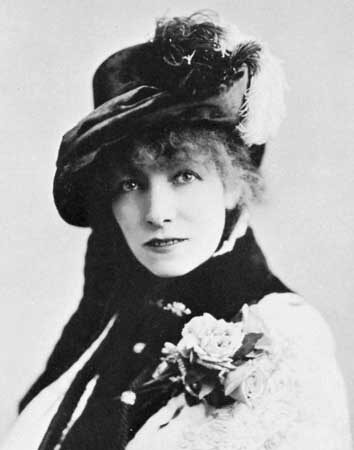
Sarah Bernhardt
Sarah Bernhardt was a French stage actress, painter and sculptor. Born October 23, 1844, in Paris. Died March 26, 1923, in 17th arrondissement of Paris. Positions held include Sociétaire of the Comédie-Française (1875–1880). Educated at Conservatoire national supérieur d'art dramatique. Awards include Officer of the Legion of Honour and star on Hollywood Walk of Fame.
Facts
26 facts · 1 confirmed by two sources · 10 cited · 11 from one source · 4 where the sources disagree
What’s different
- Born: we show October 23, 1844 (Sources disagree). Wikipedia says October 22, 1844
- Buried in: we show Père Lachaise Cemetery (Sources disagree). Wikidata also lists Grave of Bernhardt
- Cause of death: we show uremia (Sources disagree). Wikidata also lists kidney failure
- Name at birth: we show Sara Marie Henriette Bernhardt (Sources disagree). Wikidata also lists Sarah Marie Henriette Bernard
Where this comes from
Papalocal keeps its own record. It started from these sources; what each one said is kept here as it was copied, so a change on their side never changes this page by itself. Tap one to read its version.
What Wikidata says · copied November 16, 2026 · revision 2567720483
- Described as
- French stage actress, painter and sculptor (1844–1923)
- Other names
- Rosine Bernard Bernhardt
- Born
- October 23, 1844 · 5 references
- Died
- March 26, 1923 · 4 references
- Born in
- Paris · 5 references
- Died in
- 17th arrondissement of Paris · 1 reference
- Buried in
- Père Lachaise Cemetery; Grave of Bernhardt
- Cause of death
- uremia; kidney failure
- Name at birth
- Sara Marie Henriette Bernhardt · 1 reference; Sarah Marie Henriette Bernard
- Citizen of
- France · 1 reference
- Occupation
- stage actor; film actor; dancer; writer · 1 reference; actor · 2 references; painter · 2 references; sculptor · 2 references; theatre manager · 1 reference
- Positions held
- Sociétaire of the Comédie-Française (1875–1880)
- Education
- Conservatoire national supérieur d'art dramatique
- Awards
- Officer of the Legion of Honour (1921–); star on Hollywood Walk of Fame (1960) · 1 reference
- Spouse
- Jacques Damala (1882–1889)
- Children
- Maurice Bernhardt
- Father
- Edouard Bernhardt · 1 reference
- Mother
- Judith-Julie Bernardt
- Siblings
- Jeanne Bernhardt
- Religion
- Catholicism · 1 reference
- Wikipedias with a page
- 195
Wikidata item Q4605 (wikidata.org/wiki/Q4605), public domain (CC0). Copied November 16, 2026.
What Wikipedia says · copied November 16, 2026 · revision 1385176271
Sarah Bernhardt (French: [saʁa bɛʁnɑʁt]; born Henriette-Rosine Bernard; 22 October 1844 – 26 March 1923) was a French stage actress who starred in some of the most popular French plays of the late 19th and early 20th centuries, including La Dame aux Camélias by Alexandre Dumas fils, Ruy Blas by Victor Hugo, Fédora and La Tosca by Victorien Sardou, and L'Aiglon by Edmond Rostand. She played female and male roles, including Shakespeare's Hamlet.
Rostand called her "the queen of the pose and the princess of the gesture", and Hugo praised her "golden voice". She made several theatrical tours worldwide and was one of the early prominent actresses to make sound recordings and act in motion pictures. She was also an accomplished visual artist, as a painter and particularly as a sculptor.
At the height of her world fame, Bernhardt commissioned the first lithographic theater poster created by the then-unknown artist Alphonse Mucha for the play she was starring in and directing: Gismonda. Bernhardt was delighted with the result, gave him a contract for six more posters, and Mucha became one of the more sought-after artists of this period for his Art Nouveau style.
- Born, in its opening lines
- October 22, 1844
- Died, in its opening lines
- March 26, 1923
From the Wikipedia article “Sarah Bernhardt” (en.wikipedia.org/wiki/Sarah_Bernhardt), by its contributors, under CC BY-SA 4.0 (creativecommons.org/licenses/by-sa/4.0/). Copied November 16, 2026; not changed.
Confirmed Two sources agree. Cited One source, and it names where it got it. One source One source, without a reference of its own. Sources disagree The sources disagree. We show the best-supported value and keep theirs below.
